Bitcoin Tax Software

Bitcoin Tax Software and Records: What Holders Need Before Choosing a Tool

A Bitcoin-only guide to tax software and records: what tools can and cannot do, why self-custody can break record continuity, and when to get help.

  • Records first
  • No tool ranking
  • Tax-scope boundary
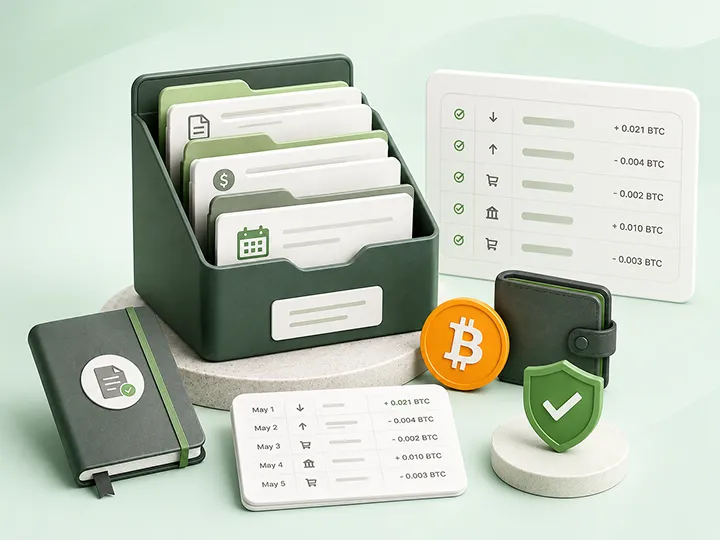
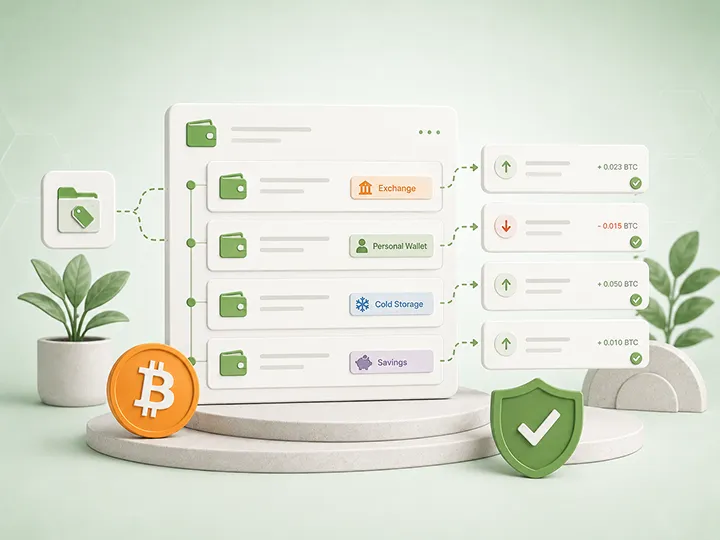
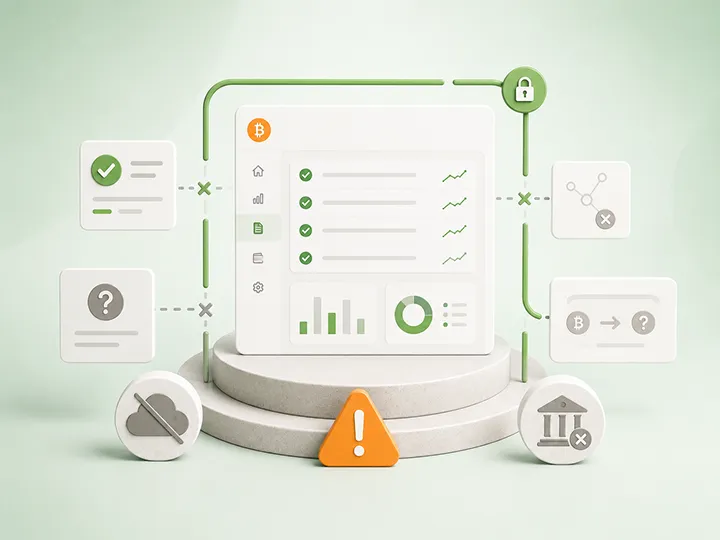
Bitcoin tax software and records thumbnail showing recordkeeping, software evaluation, and self-custody tax context.
Frederick Staunch avatar

Author and review posture

Educational Bitcoin recordkeeping guidance

This Route A commercial-support hub explains records, software limits, and evaluation criteria without affiliate links, tool endorsements, filing instructions, or tax advice.

Published June 2026Last updated June 2026Route A commercial-support hub

The page is a records-first lane hub, not a product recommendation, comparison, ranking, verdict, or money page.

Tax rules vary by jurisdiction and change over time, so this implementation keeps examples at the recordkeeping level rather than making tax-law conclusions.

The commercial role is support: building the trust and evaluation standard for later tax software pages without monetizing this route directly.

Quick answer

Bitcoin tax software starts after the record problem is understood.

The better first question is not which software to use. It is whether you have the records a tool would need to produce anything useful.

Bitcoin tax software is downstream of your records. If the records are incomplete, the report can look polished while resting on weak data.

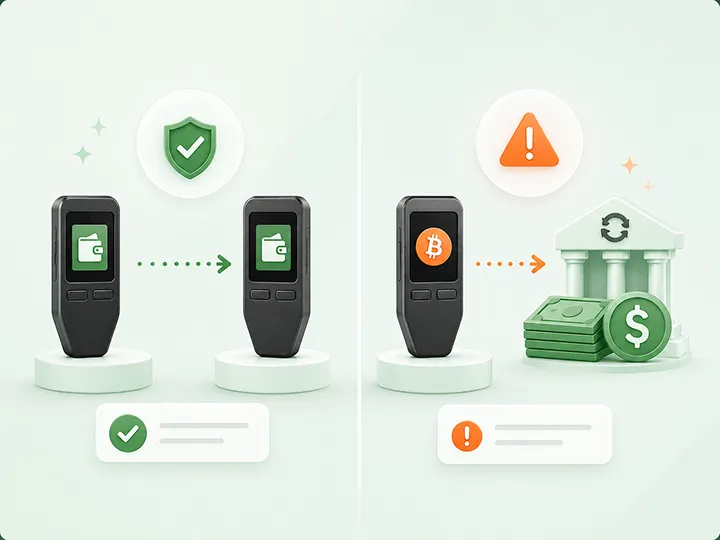
Self-custody can break record continuity when the wallet shows movement but does not automatically preserve purchase-price context from the exchange.

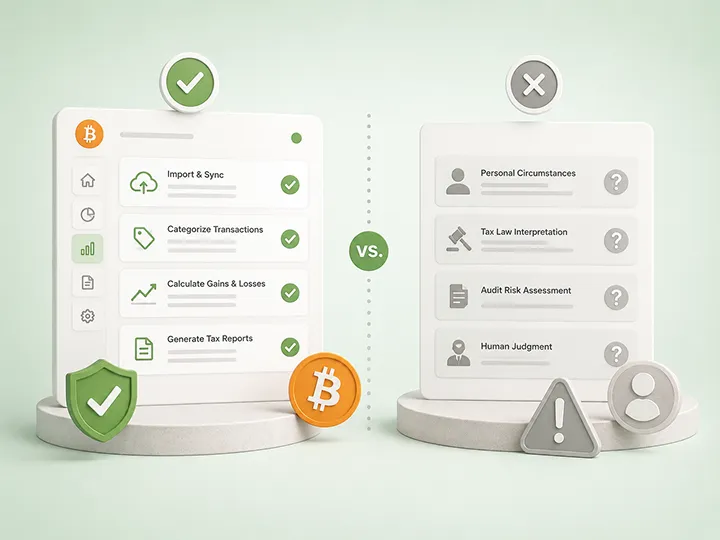
Software can organize and calculate from records, but it cannot decide ambiguous treatment, repair missing history, or replace qualified professional judgment.

1

Preserve records

Start with acquisition, movement, fee, export, and transaction records before choosing a tool.

2

Understand the records

Know the practical difference between a disposal and a transfer so movements are not left ambiguous.

3

Use the right help layer

Use software for organization and calculation when appropriate, and involve a qualified professional when judgment or local rules matter.

Starting point

Holding Bitcoin eventually becomes a records problem.

At some point, holding Bitcoin stops being only about buying it and storing it. It starts involving records.

You bought at different times. You may have paid different fees. You moved some coins off an exchange. Maybe you later sold, spent, gifted, or transferred coins again. Now a tax year is closing, and the question is not only “which software should I use?”

Bitcoin tax software can help, but it is downstream of your records. If the records are incomplete, mislabeled, or scattered across exchanges and wallets, software can produce a clean-looking report that still rests on weak data.

This page is the hub for Bitcoin tax software and records. It does not rank tools. It does not recommend a product. It does not tell you what you owe. It explains what records matter, what software can and cannot do, and when a situation belongs with a qualified professional instead of an app alone.

Scope boundary

What this page is for, and what it is not.

This hub is commercially useful because it prepares the reader for later evaluation pages. It does not become a recommendation, tax guide, or filing guide.

This page is for

Understanding the tax-record problem before choosing software.

  • Records before tools.
  • Self-custody record continuity.
  • Software limits and evaluation criteria.

This page is not

A legal, tax, filing, audit-defense, or tool recommendation page.

  • No country-specific tax rules, forms, rates, thresholds, or filing instructions.
  • No tool rankings, endorsements, product cards, pricing tables, affiliate links, or shop CTAs.
  • No claim that software replaces a qualified professional.

Core rule

Records first, tools second.

A tool can organize transactions, apply settings, calculate totals, and produce reports from the data it receives. But it cannot turn incomplete history into complete history just because the final report looks polished.

  1. Preserve records

    Keep the transaction history, exports, fees, movement records, and acquisition context while access still works.

  2. Understand what the records mean

    Disposals and transfers need to be distinguishable in your records before software can classify them usefully.

  3. Use software when data volume justifies it

    Software can aggregate, calculate, and organize, but the output depends on the quality of the input data.

  4. Bring in professional judgment when needed

    Ambiguity, scale, local rules, incomplete records, and meaningful filing impact can belong with a qualified professional.

Core distinction

Disposal versus transfer.

A Bitcoin holder should understand the difference between a disposal and a transfer at the recordkeeping level.

A disposal usually means you no longer own the same Bitcoin position in the same way. Depending on local rules and facts, this may include selling Bitcoin, spending it, swapping it for another asset, or otherwise changing ownership or economic exposure.

A transfer is different in concept. It means Bitcoin moved from one place to another, but the owner may not have changed. A common example is moving coins from an exchange account to a wallet you control.

This page does not decide how your jurisdiction treats any specific movement. The point is recordkeeping: disposals and transfers need to be distinguishable in your records. If your records cannot tell them apart, software may classify them incorrectly or leave you with gaps you have to resolve later.

A self-custody fundamentals guide, notebook, pen, hardware wallet, and coffee on a calm desk.

Self-custody record gap

Moving to self-custody can break record continuity.

The central self-custody action Bitcoin Plaster teaches, moving coins off an exchange and into your own wallet, is also one of the moments where tax records often become weaker.

You buy Bitcoin on an exchange. The exchange may have records showing date, amount, price, fees, and ordinary-currency value at the time of acquisition. Later, you withdraw that Bitcoin to a hardware wallet or another wallet you control.

The wallet records that Bitcoin arrived. The blockchain records that Bitcoin moved. But neither one automatically carries the full purchase-price context from the exchange.

That is the self-custody cost-basis break. The calm fix is not to avoid self-custody. The fix is to record transfers deliberately and preserve the original acquisition records that explain what you paid.

  • For custody context, start with self-custody and the live exchange-withdrawal safety guide.
  • This page covers the recordkeeping consequence, not the custody steps.
Read self-custody basics

Plain English

What cost basis means in Bitcoin records.

Cost basis is the record of what you paid to acquire Bitcoin, usually including acquisition-related fees where local rules allow or require that treatment.

The exact tax treatment depends on jurisdiction and facts. But the practical recordkeeping idea is simple: if you later dispose of Bitcoin, your records need a way to connect what you received with what you originally paid.

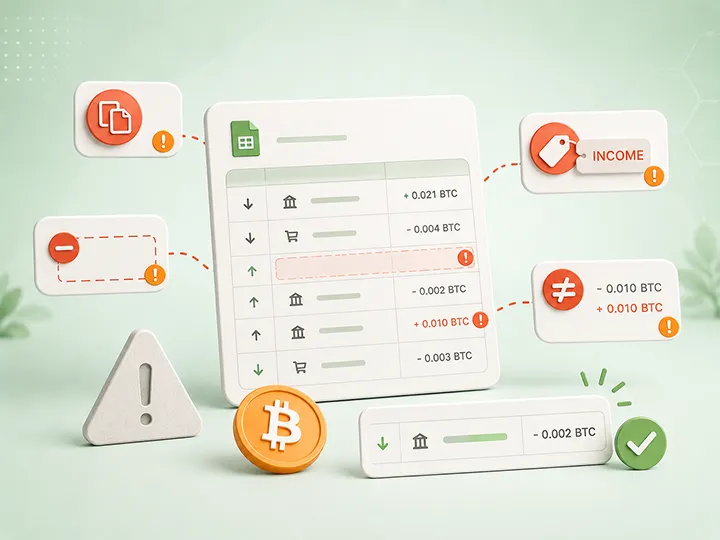
Missing basis can create serious confusion. If a tool sees a later sale but cannot connect it to an earlier purchase, it may flag the basis as missing or produce a result that needs manual review.

Bitcoin makes this awkward because normal holder behavior creates fragmented history: buys happen on one exchange, withdrawals move coins to self-custody, wallet history records movement but not purchase price, exchanges may not retain accessible records forever, accounts may close, files may be exported in different formats, fees may be recorded separately, and older transactions may be hard to reconstruct years later.

Record locations

Your Bitcoin history is usually scattered.

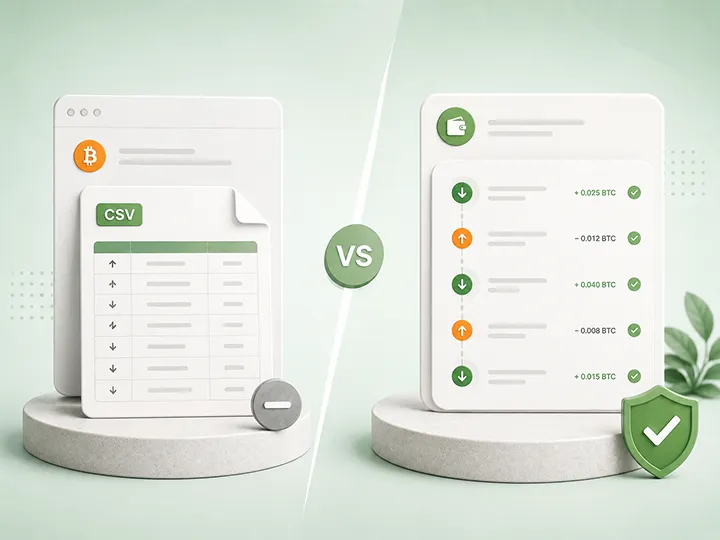
Exchange records and wallet history are complementary. One may show purchase context. The other may show movement. Neither should be treated as the whole picture by itself.

Exchange records

The purchase context usually starts where the buy happened.

  • Exchanges may hold records of purchases, sales, trading activity, fees, deposits, withdrawals, and ordinary-currency values shown at the time.
  • An exchange may only know what happened inside that platform, and may not know what happens after Bitcoin leaves.

Wallet and blockchain history

Movement is visible, but purchase context is not automatic.

  • Wallet and blockchain history can help confirm when Bitcoin moved, how much moved, which addresses were involved, and whether coins arrived.
  • They do not automatically explain what you originally paid, whether a movement was to yourself, or which acquisition lot belongs to a later disposal.

Import problems

Why imports and exports go wrong.

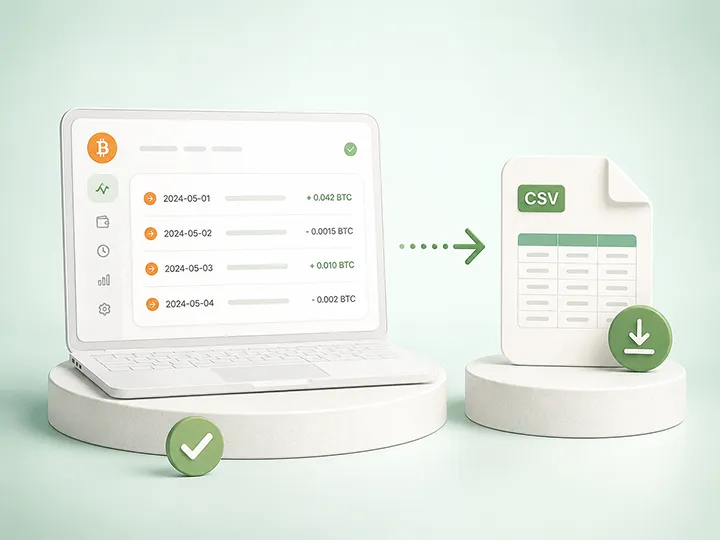
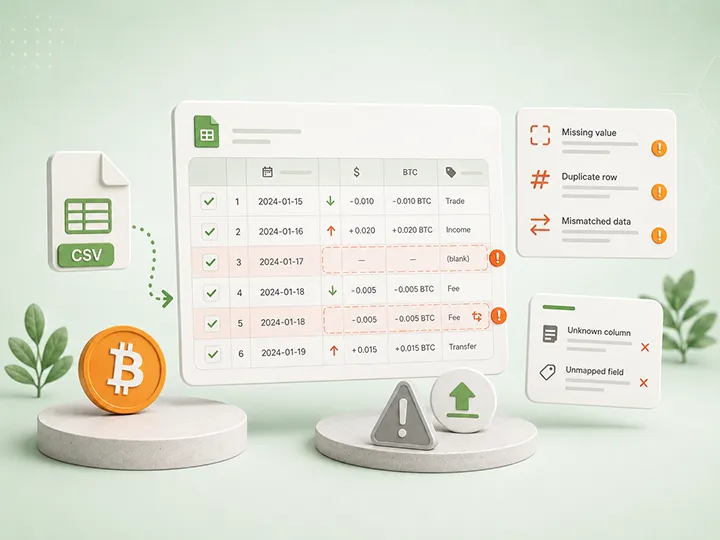
Many tax tools rely on exchange connections, wallet addresses, CSV files, or manual imports. Real history can break that clean model.

Data source problems

  • An exchange connection returns only part of the account history.
  • An old account is inaccessible.
  • Exported files omit details that matter.
  • A file format changes.

Classification problems

  • Fees are recorded separately.
  • Deposits and withdrawals are not labeled clearly.
  • Internal transfers are confused with external movements.
  • A wallet address shows movement without explaining intent.

Import workflow problems

  • The same data is imported twice.
  • A file upload overlaps with an exchange connection.
  • The holder waits years and tries to reconstruct history from memory.

Software limits

What Bitcoin tax software can and cannot do.

Software can be useful when your history is too large or scattered to manage comfortably by hand. It is still your record set.

Software can help with

Organizing records when the history is too large or scattered to manage comfortably by hand.

  • Importing data from multiple sources.
  • Organizing transactions in one place.
  • Finding missing or inconsistent entries.
  • Producing summaries for review and reducing arithmetic work at scale.

Software cannot do

Repair missing history, decide ambiguous treatment, or replace qualified judgment.

  • It cannot know what you paid if no record was imported.
  • It cannot always know whether a wallet movement was a transfer to yourself or something else.
  • It cannot tell you which local rule applies to a specific fact pattern.
  • It cannot guarantee a correct result just because the report looks complete.

Privacy note

Treat tax records as sensitive financial information.

Tax software cannot move your Bitcoin just because it sees records, wallet addresses, or exchange data. But connecting accounts, uploading files, or adding wallet addresses can reveal sensitive financial history to a third party.

Before connecting anything, ask

  • What data will this tool see?
  • Is the connection read-only?
  • Can the tool view balances or only transactions?
  • Do I understand what I am uploading?
  • Do I need this connection, or would an export be enough?
  • What does the tool say about data handling and retention?

Common mistakes

Most Bitcoin tax record problems are ordinary.

They happen because the holder was focused on buying, holding, and securing coins, not building a clean record trail.

Transfer and history mistakes

  • Not recording transfers.
  • Starting from this year only.
  • Losing old exchange records.

Import and review mistakes

  • Trusting automatic labels without review.
  • Double-counting transactions.
  • Treating software output as final without review.

Reconstruction mistakes

  • Guessing instead of documenting.
  • Waiting until years later to collect available evidence.
  • Relying only on memory when old records are missing.

Decision framework

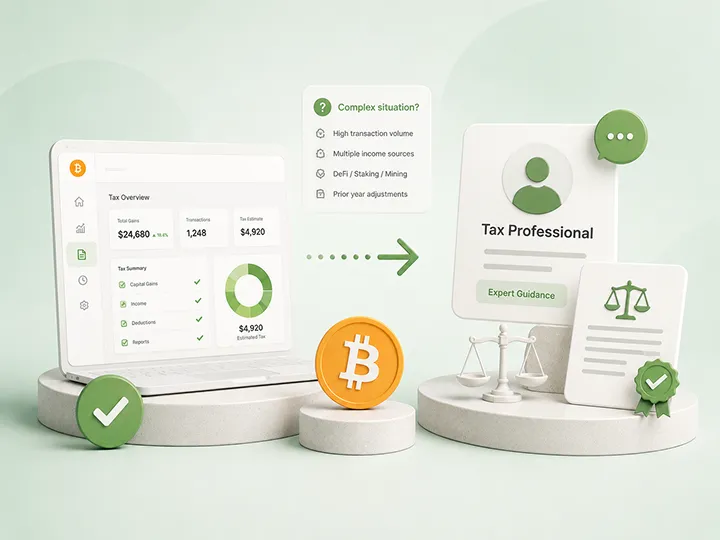
Do you need a spreadsheet, software, or a professional?

This is a complexity decision, not a default. These categories are not mutually exclusive.

  1. A few transactions on one exchange

    Careful records and a spreadsheet may be enough.

  2. Several exchanges or wallets

    Software may help organize and calculate.

  3. Many transactions across years

    Software plus careful review is usually more realistic.

  4. Missing old records

    Software may help, but reconstruction needs documentation.

  5. Large amounts or unclear treatment

    Qualified professional support becomes more important.

  6. Cross-border or jurisdiction uncertainty

    Qualified professional support is strongly worth considering.

  7. Business-like activity or unusual facts

    Do not rely on software alone.

Evaluation criteria

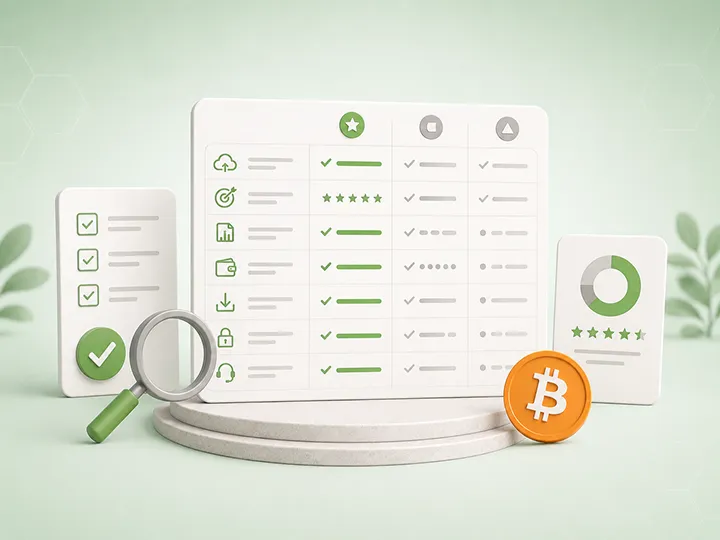
How to evaluate Bitcoin tax software when you are ready.

This page does not rank tools. It gives the criteria you should use before reading tool evaluations.

  1. Transfer and basis handling

    Can the tool help identify transfers between places you control, preserve acquisition history, and clearly show missing basis or unmatched transfers?

  2. Source coverage

    Does it support the exchanges, wallets, and file types you actually used? Evaluate it against your own history.

  3. Manual review workflow

    Does the software make uncertain items easy to find and review, show warnings clearly, and let you inspect classification?

  4. Jurisdiction fit

    Does it support the reports and settings relevant to your jurisdiction? This is something to verify before relying on any tool.

  5. Data handling and privacy

    What data does the tool receive, how are exchange connections handled, and what does the tool say about retention, deletion, and privacy?

  6. Pricing model

    How does pricing scale with transaction volume, years, reports, or features? Pricing is not the main trust question, but it matters for long histories.

  7. Honesty about limits

    A tool that clearly explains what it cannot do is easier to trust than a tool that implies it can turn messy records into a perfect answer automatically.

Professional boundary

Some situations are not software problems.

Software may still be useful in these cases. It can organize records and reduce manual work. But it does not replace professional judgment.

Consider qualified professional help when

  • your history is incomplete
  • the amounts are significant
  • you are reconstructing older records
  • transactions are hard to classify
  • multiple jurisdictions may be involved
  • your activity is not simple holding
  • you are unsure what local rules require
  • the result could materially affect a filing decision

Where to go next

Software can help you calculate, but records make the calculation possible.

Get the records right before you ask any tool to finish the job.

If you are still learning the custody side, start with self-custody and moving Bitcoin off an exchange. Those pages explain the ownership and custody side. This page explains the recordkeeping consequence.

If your immediate problem is that your transaction history is scattered, start by collecting records before choosing software.

If you already have records and want to evaluate tools later, use the criteria above before reading any product page.

As this lane develops, Bitcoin Plaster can add deeper support pages on cost basis, transfers versus disposals, transaction exports, common record mistakes, software limitations, and when professional support matters. Those pages should strengthen this hub without turning it into a ranking page.

FAQ

Bitcoin tax software FAQ

Concise answers that keep the page records-first, non-jurisdiction-specific, and non-recommendation.

No. Bitcoin tax software can organize records and calculate from the data it receives, but it cannot fix missing history, decide ambiguous treatment, or replace a qualified professional. The quality of the output depends on the quality of the records.