Buying a hardware wallet second-hand

A second-hand hardware wallet can be a bad bargain even when the device is real.
The problem is not that every used wallet is compromised. Most are probably ordinary. The problem is that the buyer is asked to trust a custody history they did not control.
For a device that may later protect meaningful Bitcoin, that is the wrong place to save a small amount of money.
Bitcoin Plaster verdict
For beginners, the winner is a new hardware wallet from the manufacturer or a manufacturer-confirmed authorized seller.
A second-hand hardware wallet is not the right default for meaningful Bitcoin storage. The discount is visible immediately. The downside stays hidden until the wallet is funded, recovery is needed, or a compromised setup has already done damage.
A used device may be acceptable only as an empty learning device, a lab device, or an advanced-user experiment where no meaningful Bitcoin is at risk and the user knows how to verify, wipe, initialize, and distrust the entire seller-provided setup path.
For real storage, buy clean-origin first. Then verify before funding.
| Reader situation | Better choice | Why |
|---|---|---|
| First hardware wallet for meaningful Bitcoin | New device from a trusted source | Removes unnecessary history risk before setup |
| Tight budget but serious long-term custody intent | Cheaper new model, not used | A lower-cost clean-origin device is usually a better tradeoff than an unknown-history device |
| Already bought a used wallet | Do not fund it yet | Verify source, device state, firmware path, and setup path before deciding whether to use it at all |
| Learning only with no real funds | Used device can be a practice object | Practice risk is different from custody risk |
| Advanced user testing hardware behavior | Maybe acceptable | Only if the user accepts residual risk and keeps meaningful Bitcoin away from it |
What this page is responsible for
This page answers one narrow question: should you trust a second-hand hardware wallet with Bitcoin?
It does not replace the broader <a href="/hardware-wallets/hardware-wallet-supply-chain-risk/">hardware wallet supply-chain risk</a> guide, which covers purchase paths before delivery. It also does not replace <a href="/hardware-wallets/how-to-check-if-a-hardware-wallet-is-genuine/">how to check if a hardware wallet is genuine</a>, which covers verification after the box is in your hands.
The job here is the beginner-safe verdict: a used hardware wallet adds avoidable uncertainty at exactly the moment when the user has the least ability to judge it.
What counts as second-hand
Second-hand does not only mean visibly old or scratched.
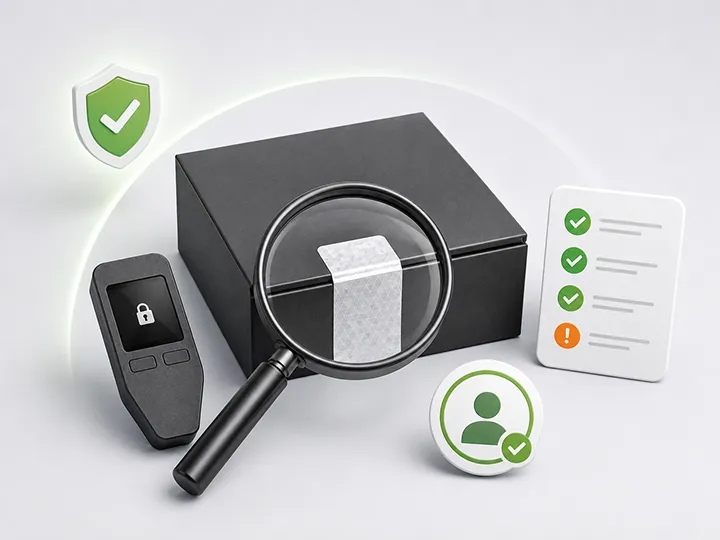
In custody terms, second-hand includes any hardware wallet that left the clean source path before it reached you:
- used by another person;
- bought from a marketplace listing;
- sold as open box, returned, refurbished, or unsealed;
- received as a gift after someone else handled setup;
- bought from a seller who cannot be verified as authorized;
- delivered with seller instructions, extra inserts, QR codes, or support links;
- already initialized when you turn it on;
- accompanied by recovery words, a seed card, or a pre-filled backup sheet.
Some of those situations may be harmless. The point is that they force you to investigate history before you even begin self-custody.
Why a used hardware wallet is not like a used phone
Buying a used phone is mostly a device-quality question.
Buying a used hardware wallet is a custody-history question.
A hardware wallet is not valuable because of its plastic shell, screen, buttons, or cable. It is valuable because it helps generate, protect, and use private keys. If the setup path is compromised, the device can look normal while the wallet it creates is unsafe.
That is why a used hardware wallet asks harder questions than normal used electronics:
| Question | Why it matters |
|---|---|
| Who handled it before you? | Prior access can affect trust in setup history. |
| Was it initialized before? | A wallet should generate a fresh seed during your own setup. |
| Did anyone see or create recovery words? | Anyone with the seed phrase can restore the wallet. |
| Did the seller include setup links? | Fake software or fake support can capture recovery material. |
| Was it returned or resealed? | You may not know what happened between first sale and resale. |
| Are you confident enough to verify it? | Beginner uncertainty is part of the risk. |
The problem is not visible wear. The problem is invisible custody history.
The highest-risk scenario: supplied recovery words
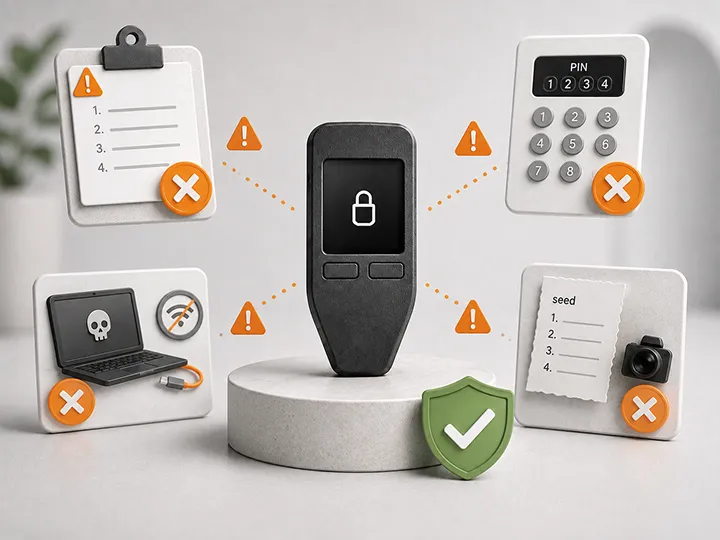
The cleanest rule is simple: never use recovery words supplied by anyone else.
A hardware wallet should create a fresh seed phrase during your setup. The words should appear as part of the device-controlled setup flow, and you should write them down offline.
Do not use words that arrive:
- printed on a card;
- written on paper;
- hidden behind a scratch panel;
- sent in a message;
- shown in a seller guide;
- attached to a support ticket;
- displayed by a website;
- already present on a restored wallet.
If someone else created or saw the words, they may be able to restore the wallet later.
This is the easiest second-hand scam for a beginner to miss because the device can still appear to work. The address can receive Bitcoin. The balance can show in the app. Everything can look normal until the funds move.
Resetting the device does not recreate clean origin
A common answer is: just reset the hardware wallet.
A reset can be useful. It may clear the device state and let you initialize a new wallet.
But reset is not the same as clean origin.
| Reset can help with | Reset does not prove |
|---|---|
| Removing a previous wallet state | Who controlled the device before you |
| Starting a new setup flow | Whether the device path was trustworthy |
| Generating a fresh seed if the device is genuine and setup is clean | Whether the seller-provided instructions were safe |
| Reducing risk from an old user configuration | Whether firmware, bootloader, packaging, or source path deserve trust |
For an advanced user, reset plus official verification may reduce risk enough for low-value testing. For a beginner protecting meaningful Bitcoin, it is still an unnecessary complication.
The beginner problem: too many judgments too early
A second-hand wallet pushes advanced decisions to the start of the journey.
Before the user has even practiced receiving Bitcoin, they now need to judge:
- seller trust;
- package integrity;
- setup state;
- firmware behavior;
- authenticity checks;
- fake software risk;
- seed phrase boundaries;
- residual risk after reset;
- whether a warning sign is serious or normal.
That is a lot to ask from someone buying their first hardware wallet.
A clean-source device does not remove all self-custody responsibility. It simply removes a layer of unnecessary history risk before the real work begins.
Second-hand risk table
| Risk | What it looks like | Beginner-safe response |
|---|---|---|
| Pre-initialized wallet | Device already shows accounts or asks for an existing PIN | Do not fund it |
| Supplied recovery words | Words included in the box, message, guide, or scratch card | Hard stop |
| Fake setup path | Seller gives links, QR codes, or support contacts | Ignore and use official sources only |
| Marketplace ambiguity | Seller cannot prove authorized status | Treat as unnecessary risk |
| Open-box or returned device | Device path includes unknown handling | Prefer new clean-origin device |
| Suspicious firmware prompt | Setup does not match current official instructions | Stop and verify through the manufacturer |
| Seller pressure | Seller urges quick setup, special instructions, or private support | Do not continue through that path |
| Privacy exposure | Seller knows you are buying custody hardware | Reduce public exposure and use a cleaner purchase path next time |
What to do if you already bought one
Do not panic and do not fund it yet.
Use a calm sequence:
- Keep the device empty.
- Reject any supplied seed phrase or prepared wallet.
- Ignore seller-provided links, QR codes, phone numbers, downloads, and support contacts.
- Find the official manufacturer setup path independently.
- Check whether the manufacturer supports a genuine or authenticity check for your exact device.
- Check firmware only through the official process.
- Wipe or initialize only through official instructions.
- Generate a fresh seed phrase during your own setup if you decide to continue.
- Use a tiny test only if you fully understand the remaining risk.
- Prefer buying a clean-origin device if you are not confident.
If you are a beginner and the wallet is meant for meaningful Bitcoin, the better answer is usually not to salvage the used device. Use it for practice if you want. Do not make it your primary vault.
When a used hardware wallet might be acceptable
There are limited cases where a second-hand device can make sense.
It may be acceptable when:
- the device will hold no meaningful Bitcoin;
- the purpose is learning the menus or practicing setup;
- the user is testing hardware behavior in a lab setting;
- the user understands official verification, wipe, firmware, seed generation, and residual risk;
- the user is willing to throw the device away if anything feels wrong.
That is not the same as recommending it for real custody.
For most readers, the question is not whether a used device can ever be made safer. The question is whether the savings justify the extra trust burden. For a first hardware wallet, usually they do not.
Better alternatives to buying used
If price is the reason you are considering second-hand, there are safer options:
| Constraint | Better path |
|---|---|
| Hardware wallet feels expensive | Choose a lower-cost new model from a trusted source |
| You are not holding meaningful Bitcoin yet | Start with a small learning balance and buy hardware before the balance becomes meaningful |
| You do not know which model to choose | Use <a href="/hardware-wallets/best-bitcoin-hardware-wallets/">Bitcoin Plaster hardware wallet winners</a> to narrow the choice |
| You are worried about setup | Read <a href="/hardware-wallets/how-to-set-up-a-bitcoin-hardware-wallet/">how to set up a Bitcoin hardware wallet</a> before buying |
| You are unsure what risks matter | Read <a href="/hardware-wallets/hardware-wallet-threat-models/">hardware wallet threat models</a> first |
The winner-first path for buyers belongs on the money page. This support page has a narrower verdict: do not let a small discount add avoidable custody uncertainty.
Clean-origin buying checklist
Before you trust a hardware wallet with meaningful Bitcoin, you should be able to say:
- I bought it from the manufacturer or a manufacturer-confirmed authorized seller.
- I reached the purchase and setup path independently.
- I did not follow seller-provided setup links.
- The device did not arrive already initialized.
- No recovery words were supplied by anyone else.
- The device generated a fresh seed phrase during my setup.
- I used the manufacturer's current official verification process where available.
- I checked firmware through official software or documentation.
- I understand that the seed phrase is the recovery authority.
- I will start with a small test before moving meaningful Bitcoin.
If a second-hand device prevents you from saying these things confidently, do not use it as your main Bitcoin storage device.
Final verdict
Do not buy a second-hand hardware wallet for your first serious Bitcoin self-custody setup.
The discount is too small compared with the uncertainty it adds. A hardware wallet is supposed to reduce risk, not make you solve seller history, fake setup paths, supplied seed phrases, reset confidence, and authenticity questions before you even start.
Use a new clean-origin device for meaningful Bitcoin. Use official setup paths. Generate your own seed phrase. Verify before funding.
If you already bought a used wallet, keep it empty until you can prove to yourself that the remaining risk is acceptable. If you cannot explain the risk clearly, do not put Bitcoin on it.
FAQ
Is it safe to buy a used Bitcoin hardware wallet?
For beginners, no. A used hardware wallet may be fine, but its prior handling and setup history are hard to verify. For meaningful Bitcoin, use a new device from a trusted source.
Can I reset a second-hand hardware wallet and make it safe?
A reset can reduce some device-state risk, but it does not fully recreate clean origin. It does not prove the seller path, instructions, firmware path, or prior handling were trustworthy.
What if the used wallet comes with recovery words?
Do not use it. Recovery words supplied by another person should be treated as already known to someone else.
Can I use a second-hand hardware wallet for practice?
Yes, if it stays empty or holds only a tiny amount you are willing to lose. Practice use is different from using it as a long-term Bitcoin storage device.
Is an open-box hardware wallet the same as second-hand?
It can carry similar uncertainty because the clean source path was interrupted. Treat open-box, returned, refurbished, or resealed devices cautiously.
Should I buy from a marketplace if the price is much lower?
Not for meaningful Bitcoin. A lower price is not useful if it adds uncertainty around seller trust, setup path, recovery words, or device history.
What is the biggest warning sign?
A supplied seed phrase is the clearest warning sign. An already initialized device, fake setup link, failed genuine check, or seller pressure should also stop the process.
What should I do if I already funded a used hardware wallet?
Do not improvise in panic. Confirm whether you control the seed phrase and whether it was generated during your own clean setup. If there is any doubt that someone else could know the recovery words, move funds to a new clean-origin wallet after setting it up correctly.
Is buying used ever acceptable for advanced users?
Only in narrow situations where the user understands the residual risk and keeps meaningful Bitcoin away from the device unless they are fully comfortable with the verification path.
What should I buy instead?
Use the current <a href="/hardware-wallets/best-bitcoin-hardware-wallets/">Bitcoin Plaster hardware wallet winners</a> page to choose a clean-origin device that fits your workflow.