Seed Phrase Storage

Bitcoin Recovery Drill: How To Practice Without Putting Your Seed Phrase at Risk

Learn how to rehearse Bitcoin recovery safely, what to practice without seed words, what not to test online, and how to find backup gaps before an emergency.

  • Recovery practice
  • No seed entry
  • Offline readiness
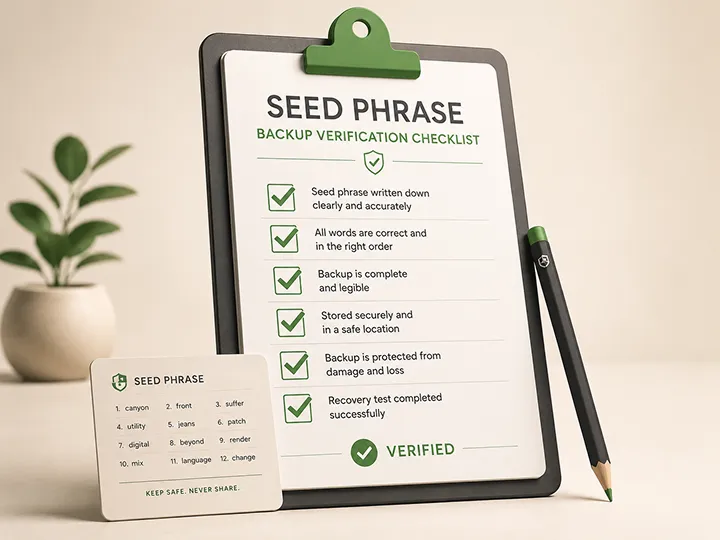
Seed phrase storage thumbnail showing a seed phrase card, metal backup plate, hardware wallet, and security icons.
Frederick Staunch avatar

Author and experience

Written by Frederick Staunch

Frederick Staunch is the pseudonymous editor of Bitcoin Plaster. He teaches the Bitcoin Holder Standard: money literacy, the Bitcoin thesis, holder psychology, and self-custody for people who want to hold Bitcoin without expensive mistakes.

Bitcoin self-custody and key control

Hardware wallet setup and testing

Recovery and backup planning

Bitcoin-only product evaluation

Bitcoin tax-record workflows and tax-software evaluation

Money literacy and sound money

Holder psychology and volatility

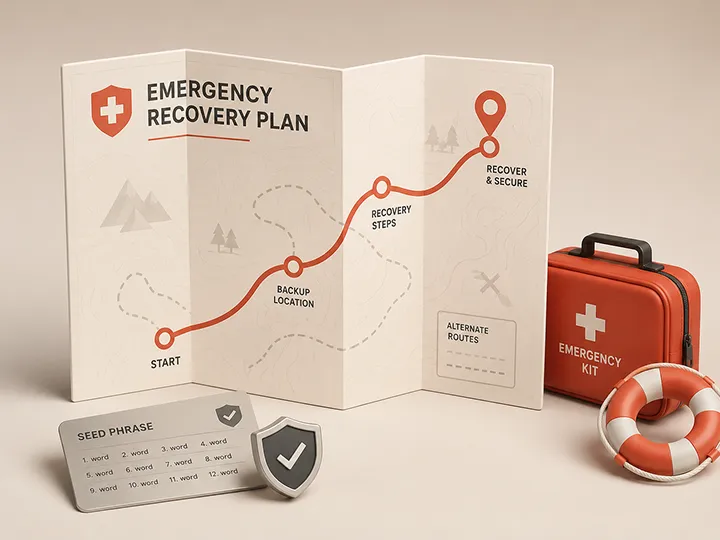
Seed phrase storage thumbnail showing a secure lockbox, backup card, metal plate, and checklist.

Recovery practice

A seed phrase backup can look safe and still fail when you need it.

Maybe the words are hard to read. Maybe the order is unclear. Maybe the backup is in a place you cannot reach. Maybe a passphrase exists but is not accounted for. Maybe your family would panic and type the words into the first website they find.

A Bitcoin recovery drill is how you find those problems while things are calm.

It is not a wallet restore walkthrough. It is not a transaction guide. It is not an excuse to type your seed phrase into an app, website, seed checker, or recovery tool.

A good drill rehearses the recovery process around the secret material without exposing the secret material itself.

Quick answer

A Bitcoin recovery drill is a planned rehearsal of your recovery readiness.

Most useful drill steps do not require touching seed words at all.

A Bitcoin recovery drill is a planned rehearsal of recovery readiness, not a wallet restore walkthrough or transaction guide.

Most useful drill steps do not require touching seed words at all. Secret material is not the drill.

The drill should help you find gaps in materials, instructions, passphrase awareness, official documentation, and human readiness before an emergency.

1

Locate recovery materials

Check whether you can locate the backup and related non-secret instructions without opening or exposing the seed phrase.

2

Review the plan

Confirm official wallet documentation, wallet context, passphrase awareness, and human instructions are findable and understandable.

3

Avoid unsafe testing

Do not type the real seed phrase into websites, seed checkers, random apps, support interactions, or connected software.

Safety boundary

Secret material is not the drill.

Do not type, photograph, scan, upload, email, cloud-store, password-manager-store, AI-tool-enter, digitize, or paste a real seed phrase while doing a recovery drill.

Do not digitize secret material

  • a website
  • a phone camera
  • a computer file
  • an online document
  • a password manager
  • cloud storage

Do not send secrets to tools or people

  • email
  • chat apps
  • AI tools
  • connected software
  • random recovery tools
  • seed checkers
  • recovery phrase validators
  • recovery services
  • unknown support agents
  • public forums

Do not document exact recovery paths

  • a legal document
  • a will document
  • a trust document
  • an online legal tool
  • an online note
  • a shared note
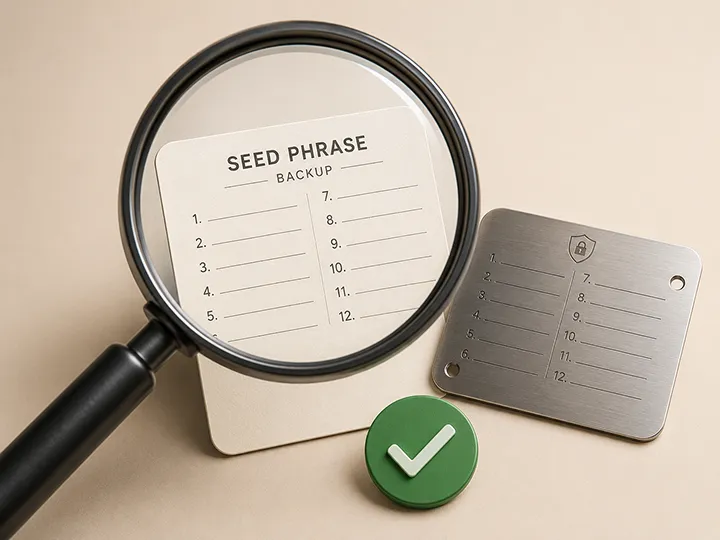
Seed phrase storage thumbnail showing paper and metal backup materials side by side.

Fire-drill analogy

A fire drill does not set the building on fire.

It checks whether people can find exits, follow instructions, notice blocked paths, and act without panic.

A recovery drill works the same way. The goal is not to create a live emergency. The goal is to find weak points before a real emergency happens.

A good Bitcoin recovery drill checks the exits: where the backup is, whether it is readable, what wallet or setup it belongs to, whether the instructions are understandable, whether passphrases or advanced structures are accounted for, who can help without seeing seed words, and what the reader must never do under stress.

The drill is not the recovery. It is the rehearsal around recovery.

Definitions

What a recovery drill is, and what it is not

People often use test recovery to mean several different things. Keep them separate. This page focuses on non-secret recovery drills and safe backup verification.

Safest starting point

Non-secret recovery drill

  • Checks logistics, instructions, locations, readiness, and human recovery.
  • Rehearses the process around recovery without exposing secret material.

Offline review

Backup verification

  • Checks completeness, order, legibility, physical condition, and exposure risk.
  • Safe when done offline without typing, photographing, scanning, or uploading the phrase.

Official documentation only

Wallet-supported check

  • May be useful when documented by the wallet maker.
  • Must not use third-party websites, seed checkers, or support interactions that ask for seed words.

Not taught here

Real restore or fund movement

  • Live operational recovery or movement of funds is not required for this page and is not taught here.

Non-secret drill checklist

What a non-secret recovery drill can check

A useful drill can reveal many gaps without seed words. If you cannot locate materials calmly, a real emergency will not make that easier.

Can you locate the recovery materials?

  • Do you know where the backup is?
  • Can you reach it when needed?
  • Is the location still valid?
  • Has anything moved since the plan was written?
  • Is there more than one recovery item?
  • Are the wallet device and backup separated enough that one event does not take both?

Can you identify the wallet or setup?

  • What wallet or setup the backup belongs to.
  • Where official wallet documentation begins.
  • Whether any passphrase is involved.
  • Whether any split backup, multisig, or advanced structure exists.
  • What should not be done with seed words.
  • Do not write the seed phrase itself into those instructions.

Is the backup readable and still offline?

  • The words are legible.
  • The order is clear.
  • Numbering is unambiguous.
  • No word requires guessing.
  • The backup is physically intact.
  • The backup is still protected from fire, water, damage, disposal, and casual discovery.

Would a trusted person know what not to do?

  • That a plan exists.
  • Where non-secret instructions begin.
  • Who can help.
  • What official documentation to use.
  • What must never be done with seed words.
  • They should not need casual access to the seed phrase today.

Offline rule

The drill should confirm that the seed phrase has not become digital.

If any of these happened, treat it as an exposure question, not a normal drill.

  • No photos or scans

    Confirm the phrase has not been photographed, scanned, saved in a file, or stored in a phone note.

  • No cloud or password manager copies

    Confirm it has not been uploaded to cloud storage, stored in a password manager, emailed, or sent through chat.

  • No ai, websites, or checkers

    Confirm it has not been pasted into an AI tool, entered into a website, entered into a seed checker, or shared with support.

Verification boundary

What backup verification can and cannot prove

Backup verification and a recovery drill are related, but they are not identical.

Backup verification can help confirm that the backup appears complete, in order, readable, physically intact, offline, and not obviously exposed.

It does not prove that every future recovery will work. A valid-looking backup could still be tied to a passphrase, a setup detail, or a wallet-specific issue that the checklist alone does not resolve.

For the full safety model, read how to verify your seed phrase backup. For the scannable backup review, use the seed phrase backup verification checklist.

Official documentation boundary

Wallet-supported checks belong in official documentation.

Some wallets may offer official ways to check a backup or confirm recovery readiness. This page does not describe those features, name devices, or provide steps.

Question

Is this documented by the wallet maker?

  • The safe answer is yes, in official documentation.

Question

Does it require a third-party website?

  • The safe answer is no.

Question

Does it require a seed checker?

  • The safe answer is no.

Question

Does it require sending words to support?

  • The safe answer is no.

Question

Do you understand what it proves?

  • The safe answer is yes.

Question

Do you understand what it does not prove?

  • The safe answer is yes.
Bitcoin Plaster circular mark

Recovery readiness

A recovery drill reduces risk. It does not eliminate risk.

The value of a drill is not perfection. The value is finding gaps while they are still fixable.

  • No restore tutorial
  • No transaction guide
  • Use official documentation

Passphrase, split backup, and family readiness

Advanced setup choices make drills more important.

The drill should confirm that the recovery plan accounts for complexity without exposing seed words, passphrases, or exact recovery paths.

Passphrase readiness

A passphrase is a separate recovery-critical secret.

  • The drill should confirm that the plan accounts for it without exposing it.
  • Future-you or a trusted person may need to know that the seed phrase alone may not be enough.

Split backup readiness

Complex backup structures can create new failure paths.

  • The plan should explain the structure without exposing secrets.
  • This page does not teach seed splitting, Shamir setup, multisig setup, thresholds, descriptors, device setup, or recovery flows.

Family readiness

The human side must be rehearsable without secrets.

  • A trusted person may need to know that a plan exists, where non-secret instructions begin, and what not to do.
  • They should not receive casual access to seed words or passphrases.

Advanced setup routing

Keep passphrase and split-backup questions on their own support routes.

A recovery drill can reveal that advanced setup complexity exists, but it should not become a setup guide.

For passphrase basics, read passphrase vs seed phrase. For split-backup tradeoffs, read should you split a seed phrase.

This page does not teach passphrase setup, seed splitting, Shamir setup, multisig setup, threshold setup, device configuration, or recovery flows.

Human readiness

A recovery drill should include the human side.

If you are unavailable, injured, incapacitated, or dead, the right person needs non-secret readiness, not casual access to secrets.

A safe family-readiness drill can check whether a trusted person knows a plan exists, whether non-secret instructions are findable, whether the instructions warn against seed checkers and recovery services, whether official wallet documentation is identified, whether passphrase or advanced-setup awareness is included, and whether legal or tax questions are routed to qualified professionals.

Do not put a seed phrase, passphrase, wallet backup, private key, PIN, exact storage location, or exact recovery path into a will, trust document, legal document, online legal tool, cloud file, email, password manager, online note, shared note, AI tool, or connected software.

For the planning layer, use the emergency recovery plan. For inheritance awareness, use Bitcoin inheritance basics.

Gap finding

A good drill is not just a pass or fail exercise.

Finding a gap is the purpose of the drill. Fixing it calmly is the next step.

Gap revealed

Backup is hard to locate

  • A real emergency will add stress and delay.

Gap revealed

Backup is hard to read

  • Recovery depends on exact words and order.

Gap revealed

Wallet context is unclear

  • Future-you may not know what setup the backup belongs to.

Gap revealed

Official documentation is missing

  • A stressed person may search randomly and find unsafe help.

Gap revealed

Passphrase is unaccounted for

  • The seed phrase alone may not be enough.

Gap revealed

Family instructions are missing

  • Recovery may depend on you being present.

Gap revealed

Digital copies exist

  • The phrase may already be exposed.

Gap revealed

The plan depends on memory

  • Memory is not a recovery plan.

Safer next steps

Do not rush when the drill reveals a gap.

A rushed fix can create the exposure you were trying to avoid.

Problem found

Backup is unreadable or incomplete

  • Stop. Use official wallet documentation before relying on it. Do not guess or use seed checkers.

Problem found

Backup has been digitized

  • Treat it as potential exposure and review compromise guidance.

Problem found

Passphrase is unclear

  • Treat the setup as incomplete until the recovery plan accounts for it safely.

Problem found

Split or advanced setup is confusing

  • Revisit whether the structure is recoverable before relying on it.

Problem found

Family instructions are weak

  • Build non-secret instructions and route legal questions to qualified professionals.

Problem found

You do not understand an official check

  • Stop before entering seed words and read official documentation carefully.

Prevention and loss routing

Use dedicated pages when the drill reveals a broader problem.

This recovery drill should surface gaps without turning into an incident-response or recovery-service page.

For common prevention issues, read seed phrase backup mistakes.

If the problem is that the seed phrase may already be lost, read what if you lose your seed phrase.

When not to run a drill

Do not run a drill when the situation is unsafe or unclear.

This page is not an active-theft response guide. It is a preparation page. If there is a live theft, coercion, legal, forensic, or personal-safety situation, a general recovery drill article is not the right tool.

Do not run a drill when you are

  • panicked
  • rushed
  • distracted
  • using untrusted devices
  • screen sharing
  • surrounded by cameras or people who should not see recovery materials
  • following random online advice
  • trying to respond to active theft

Where to go next

A recovery drill connects the rest of the seed phrase storage system.

Use the supporting pages to keep recovery practice safe, non-secret, and connected to official documentation.

  1. Use the backup verification checklist

    If you need a scannable review, use the seed phrase backup verification checklist.

    Open checklist
  2. Review the verification safety model

    If you need the safety model for checking a backup, read how to verify your seed phrase backup.

    Read verification guide
  3. Build the emergency layer

    If someone else may need to recover later, build an emergency recovery plan.

    Build emergency plan
  4. Review passphrase complexity

    If a passphrase is involved, read passphrase vs seed phrase before relying on the plan.

    Read passphrase guide
  5. Review common backup mistakes

    If the drill reveals preventable setup habits, review seed phrase backup mistakes.

    Review backup mistakes
  6. Handle loss scenarios calmly

    If the problem is that the seed phrase may already be lost, read the loss-scenario guide.

    Read loss guidance
Seed phrase storage thumbnail warning against unsafe seed phrase storage locations.

Primary next step

Start with the scannable backup-quality review.

The seed phrase backup verification checklist helps you review completeness, order, legibility, storage, and recovery readiness without exposing the phrase.

Use it before escalating to any wallet-specific check. If the drill reveals a human or emergency-planning gap, build the emergency recovery plan next.

Open the checklist

Recovery drill principle

The calm version is simple.

Do the drill before the emergency. Keep secret words out of screens, tools, services, and casual documents. Use the drill to find gaps while you still have time to fix them.

  1. Do the drill before the emergency

    A calm rehearsal reveals gaps while they are still fixable.

  2. Keep secret words out of screens and tools

    The drill should never turn into a seed-entry event.

  3. Use the drill to find gaps

    Fix instructions, storage, documentation, passphrase awareness, and family readiness before stress appears.

FAQ

Bitcoin recovery drill questions

Concise answers about recovery drills, backup verification, seed checkers, and family readiness.

A Bitcoin recovery drill is a planned rehearsal of recovery readiness. It checks whether you can find materials, read backups, understand instructions, account for passphrases or advanced setups, and avoid unsafe actions. It is not a live restore tutorial or transaction guide.