Should you split a seed phrase?

Most Bitcoin holders should not manually divide a standard seed phrase into private word fragments.
For most people, the safer starting point is simpler:
- Create one accurate offline seed backup.
- Verify that it restores the expected wallet.
- Keep one complete copy in a controlled location.
- Add a separately verified complete copy in a different failure domain when local disaster redundancy is justified.
- Build an emergency plan that another authorized person can understand.
A split can make sense when no single location should contain enough information to recover the wallet. But a homemade 12-and-12 division, complete duplicate backups, a supported threshold-share system, a seed stored separately from a passphrase, and multisig are not the same security model.
The right question is not simply whether to split the seed. It is which recovery model solves the real threat without making legitimate recovery more fragile.
Quick decision
| Your main problem | Better starting model | Why |
|---|---|---|
| One fire, flood, or burglary could remove the only backup | Two complete, verified copies in independent locations | Either surviving copy can recover the wallet |
| One discovered location must not provide full recovery capability | A supported threshold-share system or carefully managed seed-plus-passphrase setup | The recovery rules are defined instead of depending on a private word puzzle |
| You want to divide a 24-word seed into two halves because it feels safer | Do not use a DIY split as the default | Both halves usually become mandatory, and recovery becomes more fragile |
| Several people or locations must participate in recovery | Evaluate a supported threshold model or multisig | These systems define a threshold instead of improvising one |
| You are still learning seed recovery | Keep the setup simple and seed-only | A recoverable simple system is safer than an advanced system you cannot reconstruct |
Keep the real seed offline
You do not need to expose a real seed phrase to make this decision.
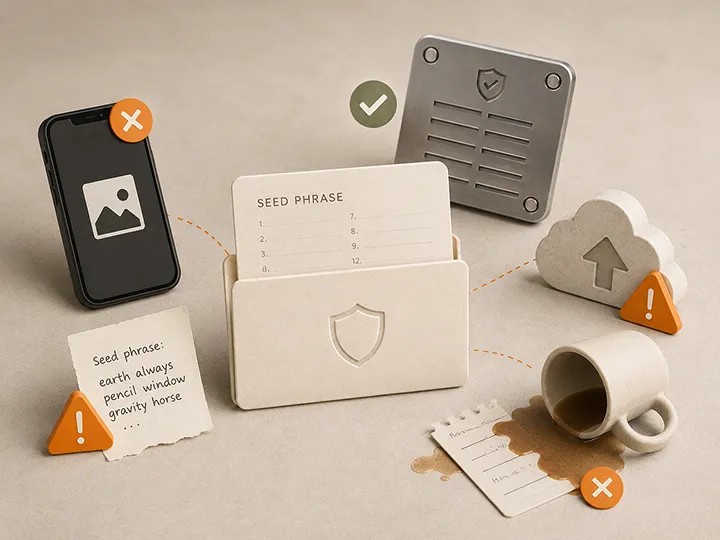
Do not photograph, scan, upload, email, cloud-store, paste into an AI tool, enter into a website, or type a real seed into ordinary connected software while comparing backup models.
This page explains decision criteria. It does not provide a recipe for distributing real words across cards, plates, people, or locations.
First define what “split” means
The phrase split a seed phrase is often used for several structures that have different recovery properties.
Complete duplicate backups
Each location contains a complete copy of the same seed phrase.
This is duplication, not splitting.
Main advantage: either valid copy can recover the wallet independently.
Main limitation: every location contains the full recovery credential. More copies reduce loss risk but increase the number of places where the seed can be read or copied.
This is often the clearest answer when the main threat is a local physical disaster.
A manual word split
Different groups of the original words are stored in different places. A common example is placing the first 12 words in one location and the remaining 12 elsewhere.
Main advantage: one location does not contain every word.
Main limitation: both unique parts are normally required. The design removes independent recovery and replaces it with multiple mandatory dependencies.
This is the model most readers should avoid.
A physical product that distributes word groups
Some products provide several numbered objects designed to hold different groups of the original seed words.
That can make organization clearer than loose paper fragments. It does not automatically create cryptographic threshold recovery or missing-share tolerance. The recovery behavior depends on how the words are distributed and which parts are required.
Supported threshold shares
A supported threshold scheme creates several shares and defines how many valid shares are required for recovery.
The important property is not the label share or shard. It is the recovery rule:
- how many total shares exist;
- how many are required;
- which combinations work;
- which wallet standard supports them;
- what happens when one or more shares are unavailable.
A threshold system can prevent one location from holding enough recovery material while preserving a defined amount of loss tolerance. It also creates more records, more locations, more verification work, and a more demanding continuity plan.
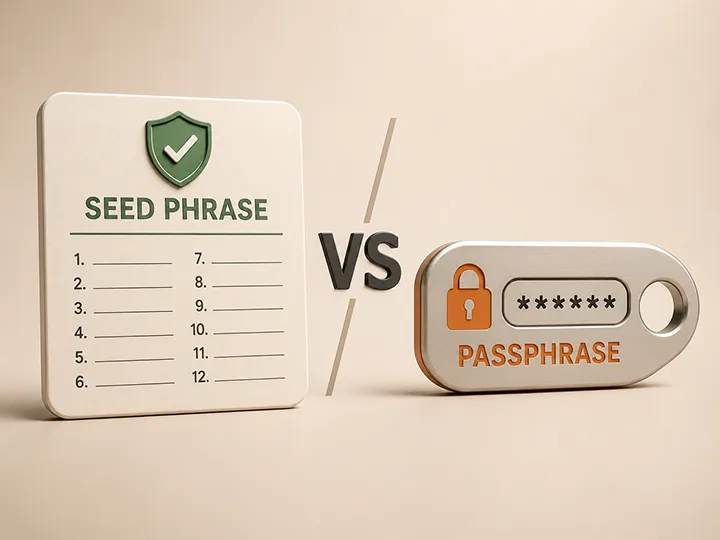
Seed plus an optional passphrase
The seed remains complete. A separate passphrase is required to derive the intended passphrase-protected wallet.
This separates two secrets rather than dividing one secret into word fragments.
It can reduce the consequence of someone finding the seed alone. It also creates permanent-loss risk if the exact passphrase is forgotten, recorded incorrectly, or unavailable to the authorized recovery person.
Read passphrase vs seed phrase before treating this as a simpler version of splitting.
Multisig
Multisig uses multiple independent keys and a signing threshold. It does not divide one seed phrase into pieces.
It may solve some of the same organizational goals as a threshold backup, but wallet policy, key backups, coordination data, signing workflows, and recovery all require a separate design process.
Duplicate backups and split backups solve different problems
This is the most important distinction.
Complete copies preserve independent recovery
Suppose two complete, verified backups are kept in genuinely independent locations.
If one copy is destroyed or becomes inaccessible, the other remains sufficient. The surviving backup does not depend on reconstructing a private layout or locating another unique fragment.
That is real recovery redundancy.
The tradeoff is exposure. Either complete copy may be enough to restore the wallet, so both locations require deliberate privacy, access control, and monitoring.
Split parts reduce information per location but create dependencies
When different words are stored in different places, no single part may be sufficient. That can reduce the immediate consequence of discovering one location.
But every required part becomes part of the recovery chain.
For a two-part disjoint split, recovery may require all of the following:
- part A survives;
- part B survives;
- both locations remain accessible;
- both records remain readable;
- the parts are correctly identified;
- the original order is known;
- the reconstruction rule is understood;
- any passphrase is also available;
- the assembled result restores the expected wallet.
A backup with more objects can therefore have less practical redundancy than one complete backup.
Duplicate copies increase exposure but preserve independent recovery. Split parts reduce what one location reveals but increase the number of dependencies that must work together.
Why a simple 12-and-12 split is usually the wrong default
A DIY split feels intuitive: someone who finds one half does not have the complete seed.
That intuition leaves out four major costs.
Both halves become mandatory single points of failure
A two-part split appears distributed, but it may have no fault tolerance.
If either half is destroyed, discarded, misplaced, inherited by the wrong person, locked behind an inaccessible process, or rendered unreadable, recovery can fail.
You removed one complete single point of failure and created two mandatory ones.
A partial seed is still sensitive
Do not treat a fragment as harmless.
A known portion of a seed changes the attacker's problem. The exact practical effect depends on the phrase format, known positions, word order, checksum constraints, and any other information available.
The safe conclusion is not that one half enables immediate recovery. It is that partial disclosure is not equivalent to revealing nothing.
The private reconstruction rule becomes part of the backup
A DIY split may depend on assumptions that exist only in the owner's memory:
- which part comes first;
- whether positions are continuous or rearranged;
- whether blank spaces mean missing words;
- whether characters were substituted;
- whether the pieces belong to the same wallet;
- whether another secret is required.
Every undocumented rule becomes another recovery dependency.
Private rearrangement, personal abbreviations, homemade encryption, or memory-only corrections make the system harder to audit and harder to inherit. Complexity can hide mistakes until the original device is gone.
Heirs inherit a puzzle
The hardest test of a split backup is not whether its creator understands it today. It is whether an authorized person can recover years later, under stress, without the owner available.
A family member may find one plate and not know whether it is:
- a complete backup;
- half of a seed;
- one threshold share;
- one of several wallet backups;
- a passphrase record;
- an obsolete copy;
- a component that requires another device or instruction.
A split that works only while the creator is alive, calm, and able to explain it is not a complete continuity plan.
Manual fragments versus threshold shares
The word shard is used too loosely. Use the recovery properties, not the product label, to identify the model.
| Question | Manual word fragments | Supported threshold shares |
|---|---|---|
| What is distributed? | Visible groups of the original seed words | Shares created under a defined recovery scheme |
| Is every part mandatory? | Often, depending on the layout | The threshold defines how many are required |
| Can one missing part be tolerated? | Only if the exact arrangement supports it | Yes, within the configured threshold limits |
| Who defines reconstruction? | Often the user or a physical layout | The supported backup standard and wallet workflow |
| Main benefit | One location may not reveal the complete phrase | One share is insufficient while a specified subset can recover |
| Main failure mode | Missing unique fragment or forgotten private rule | Insufficient valid shares, incompatible recovery support, or poor documentation |
| Suitable default for beginners? | No | Usually no; threshold systems are advanced |
A threshold system is more coherent than a private DIY split because the recovery rule exists before the emergency. That does not make it automatically appropriate. The owner must still understand wallet support, total shares, required shares, valid combinations, physical storage, and inheritance.
What happens if one component is lost?
This question must be answered before adopting any distributed backup.
Multiple complete copies
One valid remaining copy is enough.
That is why complete duplicates are the strongest starting point for disaster redundancy.
Two disjoint halves
Losing either half can permanently remove recovery.
The structure has two locations but may have zero fault tolerance.
Manual multi-part word distribution
The result depends on the exact arrangement. Never infer missing-part tolerance from the number of plates, cards, or objects.
Threshold shares
A threshold model should state how many total shares exist and how many valid shares are required.
The configured threshold determines how many shares can be unavailable before recovery fails. Do not assume every system using words such as “Shamir,” “share,” “shard,” or “multi-share” has the same rules.
Seed plus passphrase
Both components are required for the passphrase-protected wallet.
Losing the seed or the exact passphrase can be fatal to recovery. This is two-component separation, not loss-tolerant redundancy.
Treat every fragment as sensitive
One fragment may not provide immediate wallet recovery, but it can reveal:
- part of the original word set;
- word positions;
- phrase length;
- the physical format being used;
- the existence of other components;
- information that can be combined with a later leak.
A cryptographic share and a plate containing visible original seed words do not have identical disclosure properties.
Do not make security claims from labels such as:
- shard;
- share;
- split;
- multi;
- two-plate;
- secret sharing.
Confirm what the object actually contains and what one discovered component reveals.
The recovery model comes before the physical product
A kit containing several plates does not automatically provide threshold recovery. The plates may be:
- complete duplicates;
- separate wallet backups;
- unique fragments of one seed;
- physical sections required to fit one complete seed;
- unused spare media.
Before relying on any multi-part setup, answer these questions:
- Are the objects complete copies, visible word fragments, or standardized shares?
- How many total parts exist?
- How many are required for recovery?
- Can any valid subset of that size work?
- What happens when one part is lost?
- Does the wallet natively support the recovery model?
- What does one discovered part reveal?
- Is a passphrase also required?
- How is the expected wallet identified?
- Has the complete recovery workflow been tested?
Choose the recovery model first. Then choose physical media that can implement it accurately and survive the intended storage environment.
Match the model to the threat
One local disaster could destroy every recovery path
Recommended starting model: independently stored complete backups.
Use two accurate, verified copies in locations that do not share the same realistic fire, flood, burglary, structural, or access event.
This is easier to verify, easier to recover, and easier to explain than a DIY split.
Read seed phrase storage at home and seed phrase storage outside the home before choosing the locations.
One discovered location must not provide full recovery capability
Models to evaluate: a supported threshold scheme, seed-plus-passphrase separation, or properly designed multisig.
These systems solve different problems.
A threshold scheme can distribute recovery capability while retaining defined missing-share tolerance. A passphrase keeps the seed complete but requires a second exact secret. Multisig distributes signing authority across independent keys.
Do not substitute a two-half word split merely because it feels simpler.
Several people or locations must participate
Models to evaluate: a supported threshold backup or multisig.
A two-half split usually requires both custodians and provides no tolerance when one becomes unavailable. A threshold model can define a minimum subset instead.
The continuity plan must still identify the wallet, standard, threshold, authorized roles, expected wallet, and any required passphrase without placing all secrets in one ordinary document.
Heirs should not receive a complete usable seed today
Recommended approach: separate awareness, authority, instructions, and secret components.
Do not turn inheritance into an undocumented word puzzle. Start with Bitcoin inheritance basics and an emergency recovery plan.
A threshold or passphrase structure may be appropriate only when the authorized person can discover and execute the plan without relying on the owner's memory.
When threshold shares may make sense
A supported threshold backup can be justified when all of these conditions are met:
- one complete backup being discovered would create an unacceptable consequence;
- several genuinely independent storage locations are available;
- the wallet supports the chosen recovery scheme;
- the owner understands the exact total-share and required-share numbers;
- enough durable physical records can be maintained;
- unauthorized people cannot easily collect the threshold;
- recovery can be performed through current official documentation;
- the minimum required combination has been successfully tested;
- another authorized person can understand the structure;
- the owner accepts the monitoring and maintenance burden.
The reason must be stronger than “more pieces feel safer.”
When you should not split the seed
Do not add a split or threshold structure yet when any of these statements is true:
- you have never completed a safe seed verification;
- you cannot identify the exact wallet associated with the backup;
- you confuse seed phrases, passphrases, PINs, or device passwords;
- you rely on memory to explain reconstruction;
- you do not know what happens when one component is missing;
- wallet support for the recovery scheme is unclear;
- the proposed locations are temporary or unstable;
- your heirs would need you present to explain the plan;
- you want to add personal encryption, rearrangement, or substitute characters;
- you cannot perform a recovery drill;
- the idea is driven by the assumption that complexity itself creates security.
A well-protected and tested seed-only setup is safer than a multi-part system whose recovery consequences are not understood.
Safer alternatives to a DIY split
Complete backups in independent locations
Best for protection against local disaster and loss.
Why it works: either copy can recover independently.
Main limitation: each location contains the complete seed and must be protected accordingly.
This is the default recommendation for most individual holders who need physical redundancy.
Seed plus a separate passphrase
Best for a user who needs a second recovery factor and can preserve it exactly.
Why it works: the seed alone does not recover the intended passphrase-protected wallet.
Main limitation: losing or mistyping the passphrase can permanently block recovery. A weak passphrase may also provide less protection than expected after seed exposure.
Supported threshold shares
Best for an advanced user or organization that requires distributed recovery with defined missing-share tolerance.
Why it works: a specified subset can recover while one share is insufficient.
Main limitation: more physical records, locations, verification work, and inheritance complexity.
Multisig
Best when custody should depend on several independent keys rather than one master seed divided into parts.
Why it works: spending authority is distributed across separate keys.
Main limitation: wallet policy, device backups, coordinator data, descriptors, signing workflows, and recovery require separate expertise.
Evaluate the complete system before relying on it
A sound recovery model can still fail when the physical records or continuity plan are weak.
Every complete backup or required share must remain:
- accurate;
- readable;
- correctly ordered or identified;
- suited to its storage environment;
- accessible to the authorized recovery process;
- distinguishable from obsolete or unrelated backups without exposing unnecessary information.
Use this checklist before relying on a split or threshold model.
Recovery model
- [ ] I know whether the setup uses duplicates, visible fragments, threshold shares, a passphrase, or independent multisig keys.
- [ ] I know the exact wallet recovery scheme.
- [ ] I know the total number of components.
- [ ] I know the minimum number required.
- [ ] I know which combinations are valid.
- [ ] I know exactly what happens when one component is missing.
Information exposure
- [ ] I understand what one discovered component reveals.
- [ ] I am not treating partial seed information as harmless.
- [ ] No location contains more recovery capability than intended.
- [ ] An unauthorized person cannot easily collect the required threshold.
- [ ] I am not treating a lock or tamper seal as complete access control.
Physical records
- [ ] Every required record is accurate and readable.
- [ ] Positions, share identifiers, and pairings are unambiguous.
- [ ] There are no private abbreviations, substituted letters, or memory-only corrections.
- [ ] Every medium suits its storage environment.
- [ ] Required components do not share the same realistic failure event.
Verification
- [ ] The setup has passed a legitimate recovery verification.
- [ ] Verification confirmed the expected wallet, not merely plausible-looking words.
- [ ] The minimum required combination has been tested where the scheme permits it.
- [ ] Missing-component behavior is understood.
- [ ] Any required passphrase was included in the verification.
- [ ] The original working device is not the only proven recovery path.
Continuity
- [ ] The setup does not depend only on my memory.
- [ ] An authorized person can identify the recovery scheme.
- [ ] The emergency plan explains how to obtain enough components without listing all secrets together.
- [ ] The plan accounts for incapacity and death.
- [ ] Obsolete components and old wallet backups are clearly retired.
- [ ] A periodic recovery drill is scheduled.
Recovery testing is mandatory
Visual inspection is not enough.
A multi-part backup can look complete while containing:
- a wrong word or position;
- a wrong share identifier;
- mixed components from different wallets;
- a missing passphrase;
- an obsolete seed;
- a reconstruction rule that no longer makes sense.
The test must prove that the required components reproduce the expected wallet through a legitimate recovery or recovery-check workflow.
Do not enter a real seed into websites, browser tools, connected seed checkers, ordinary computers, cloud documents, or AI tools.
Read how to verify your seed phrase backup before testing, then use a controlled recovery drill to prove the complete process.
The inheritance test
Every complex backup should pass one final question:
Can the authorized person recover if the person who designed the system is unavailable?
A usable continuity plan should let that person determine:
- that a recovery plan exists;
- which wallet the components belong to;
- what recovery scheme is used;
- how many components are required;
- where access instructions begin;
- whether a passphrase also exists;
- how the expected wallet is identified;
- what must never be entered online;
- which official documentation governs recovery.
It should not place the seed, passphrase, and complete location map into one ordinary document.
If recovery still depends on the owner explaining a private trick, the system is not ready.
Final recommendation
For most individual Bitcoin holders, do not manually split the seed phrase.
Use an accurate, verified complete backup. When disaster redundancy is justified, create a separately verified complete copy and keep it in a genuinely different failure domain.
For an advanced holder who cannot allow one location to contain full recovery capability, use a supported, standardized model rather than a private DIY split. Evaluate threshold shares, seed-plus-passphrase separation, or multisig according to the actual threat. Confirm wallet support, missing-component behavior, physical storage, authorized roles, and recovery testing before relying on it.
The correct sequence is:
identify the real threat
→ choose the recovery model
→ define missing-component behavior
→ create accurate physical records
→ separate realistic failure domains
→ verify the minimum recovery path
→ document continuity without documenting the secrets
→ repeat the drill
Two locations do not automatically create redundancy. Two mandatory halves can become two single points of failure.
Build redundancy without creating a private DIY split
If the conclusion is that you need several independent complete backups, do not turn a multi-plate kit into arbitrary seed fragments. Each stored object should follow a supported recovery model, and copies intended for redundancy must leave the same failure domain.
The SecuX XSEED family, with XSEED Plus as our winner in that family, is the contextual next-stage option when several plates in one kit are useful. The store route is generic, so confirm the exact XSEED Plus package and use the plates as verified complete records unless a supported wallet scheme explicitly requires shares.
Official SecuX store affiliate link. We may earn a commission at no extra cost to you.
Read the SecuX XSEED review, then use the storage threat model to decide whether several locations are justified.
Frequently asked questions
Should I split a 24-word seed phrase into two 12-word halves?
For most holders, no. Both halves are usually required, so losing either can destroy recovery. Complete verified copies or a supported threshold scheme have clearer recovery properties.
Is a split seed safer than two complete backups?
It reduces the amount of information stored at one location, but it usually makes recovery dependent on multiple unique parts. Complete backups increase exposure at each location but let either surviving copy recover the wallet. For disaster redundancy, complete independent copies are normally simpler and more robust.
Is one half of a seed phrase useless to an attacker?
No. It may not be enough for immediate recovery, but it reveals partial recovery information and changes the attacker's problem. Treat every fragment as sensitive.
Is a multi-plate backup automatically a threshold system?
No. Several plates may be complete duplicates, unique fragments, separate wallet backups, or physical sections of one complete record. The number of plates does not define recovery behavior.
What is the advantage of threshold shares?
A threshold model can prevent one location from holding full recovery capability while allowing recovery from a specified subset of shares. The tradeoff is greater setup, storage, verification, and inheritance complexity.
Is a passphrase better than splitting the seed?
It is a different model. The seed remains complete, while the exact passphrase becomes a second recovery-critical secret. This avoids a private word-fragment rule, but losing the passphrase can permanently block recovery.
Can I keep shares with different trusted people?
Only after evaluating the threshold, access rules, collusion risk, death or incapacity, location failures, and inheritance process. Different custodians do not automatically make the system safe.
Does metal make a split backup safe?
Metal can improve physical durability. It cannot correct a wrong word, wrong share identifier, forgotten threshold, inaccessible location, missing passphrase, or misunderstood reconstruction process.
How do I know whether my split works?
A legitimate recovery verification must reproduce the expected wallet from the required components. Checking that the records look correct is not enough. Use current official wallet documentation and keep the real seed offline throughout the process.