Billfodl metal seed backup review

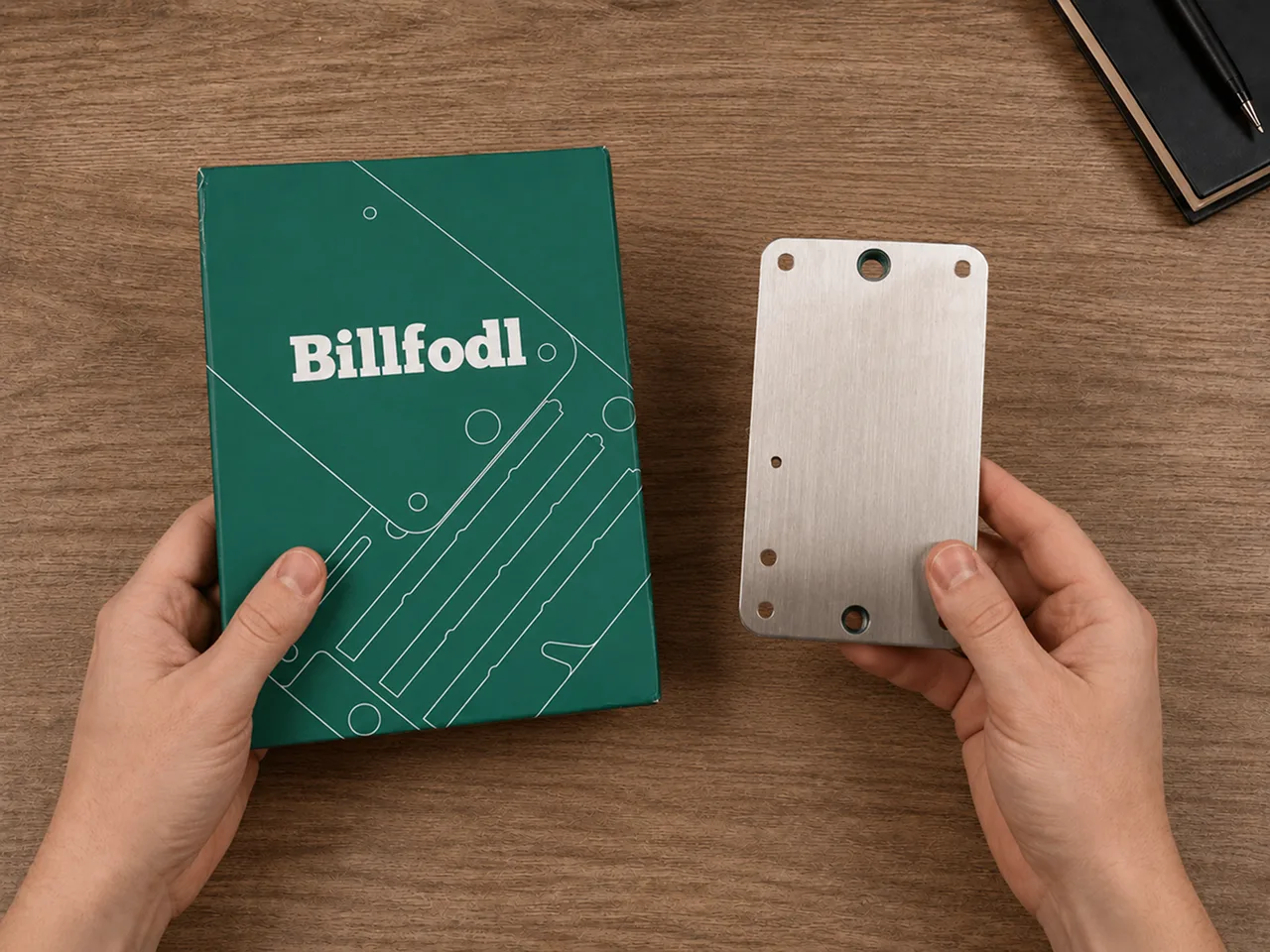
Our verdict: Buy Billfodl only for the reusable tile-cassette use case.
Billfodl is a practical metal seed backup for people who want to move a 12- or 24-word BIP39 recovery phrase off paper without permanently stamping or punching every character into a plate.
Its strongest advantage is correction before closure. You arrange engraved tiles, inspect the first four letters of each seed word, and move any character that is wrong.
Its main weakness comes from the same design choice. The recovery data depends on many removable tiles remaining inside an intact cassette and in the correct order.
In documented Bitcoin Plaster testing, Billfodl remained readable after prolonged water and fire exposure. The decisive failure appeared under major impact: the damaged cassette opened and tiles began leaving their positions.
Best for: users who want a reusable, hammer-free backup and can protect it from severe impact or crushing
Main strength: correctable setup with strong water and fire results in Bitcoin Plaster tests
Main limitation: structural failure can release tiles and destroy ordering
Better for durability-first buyers: Trezor Keep Metal
Better heavy-duty plate: Coinplate Alpha
Official Billfodl store affiliate link. We may earn a commission at no extra cost to you.
Billfodl review summary
| Category | Our assessment |
|---|---|
| Overall recommendation | Buy only for the reusable, hammer-free cassette use case |
| Best for | Users who value correction before closure and can provide crush-protected storage |
| Not best for | Users prioritizing structural simplicity, catastrophic-impact resistance, or permanently attached data |
| Main strength | Removable tiles make spelling and order errors correctable before closure |
| Main weakness | Tiles can escape or lose order if the cassette opens |
| Setup profile | Understandable but repetitive, private, and more time-consuming than product photos suggest |
| Privacy issue | Perforated character sheets retain a visible missing-letter pattern after setup |
| Water result | No visible rust or damage after three days submerged in the Bitcoin Plaster test |
| Fire result | Characters remained readable after approximately two hours of fire exposure |
| Drop result | A roughly six-meter drop series damaged and opened the cassette, allowing tiles to escape |
| Best alternative | Trezor Keep Metal for permanent punched data and lower loose-part dependency |
Evidence map for this review
- Observed by Bitcoin Plaster: full tile loading, correction and reuse behavior, four-letter recording, privacy cleanup, three-day water exposure, high drops, fire on the damaged unit, vice pressure, hammer impacts, and tile release after structural failure.
- Manufacturer-stated: current compatibility, materials, package contents, and supported workflows. Confirm the exact current product before purchase.
- Editorial inference: Billfodl is the strongest fit when correction and reuse matter more than minimizing loose components. The same removable-tile design that enables correction also creates its decisive severe-impact risk.
The direct buying decision
Choose Billfodl when:
- you want a metal replacement for a paper-only backup;
- you prefer arranging tiles to stamping, punching, or engraving;
- correcting mistakes before closure is important;
- you want a compact, reusable cassette;
- water, moisture, or fire are more realistic risks than severe crushing;
- you can complete setup and privacy cleanup offline;
- you have a stable storage location where the cassette is unlikely to fall or be crushed;
- you will verify the finished backup through a legitimate wallet workflow.
Skip Billfodl when:
- you want the fewest possible moving components;
- you prefer recovery data permanently marked into the primary metal record;
- severe impact, structural separation, or debris scattering are central threats;
- you dislike working with many small tiles;
- you will not securely handle the perforated character sheets after setup;
- you expect the product to validate the seed automatically;
- you want metal to solve theft, inheritance, or storage-location risk.
Choose Trezor Keep Metal instead when permanent data retention, compact storage, and lower loose-part risk matter more than correction and reusability.
Choose Coinplate Alpha instead when you want a large, heavy, directly inspectable plate with permanent center-punch marks.
Read the best metal seed phrase backup guide for the full winner-first comparison.
The cassette and tile system
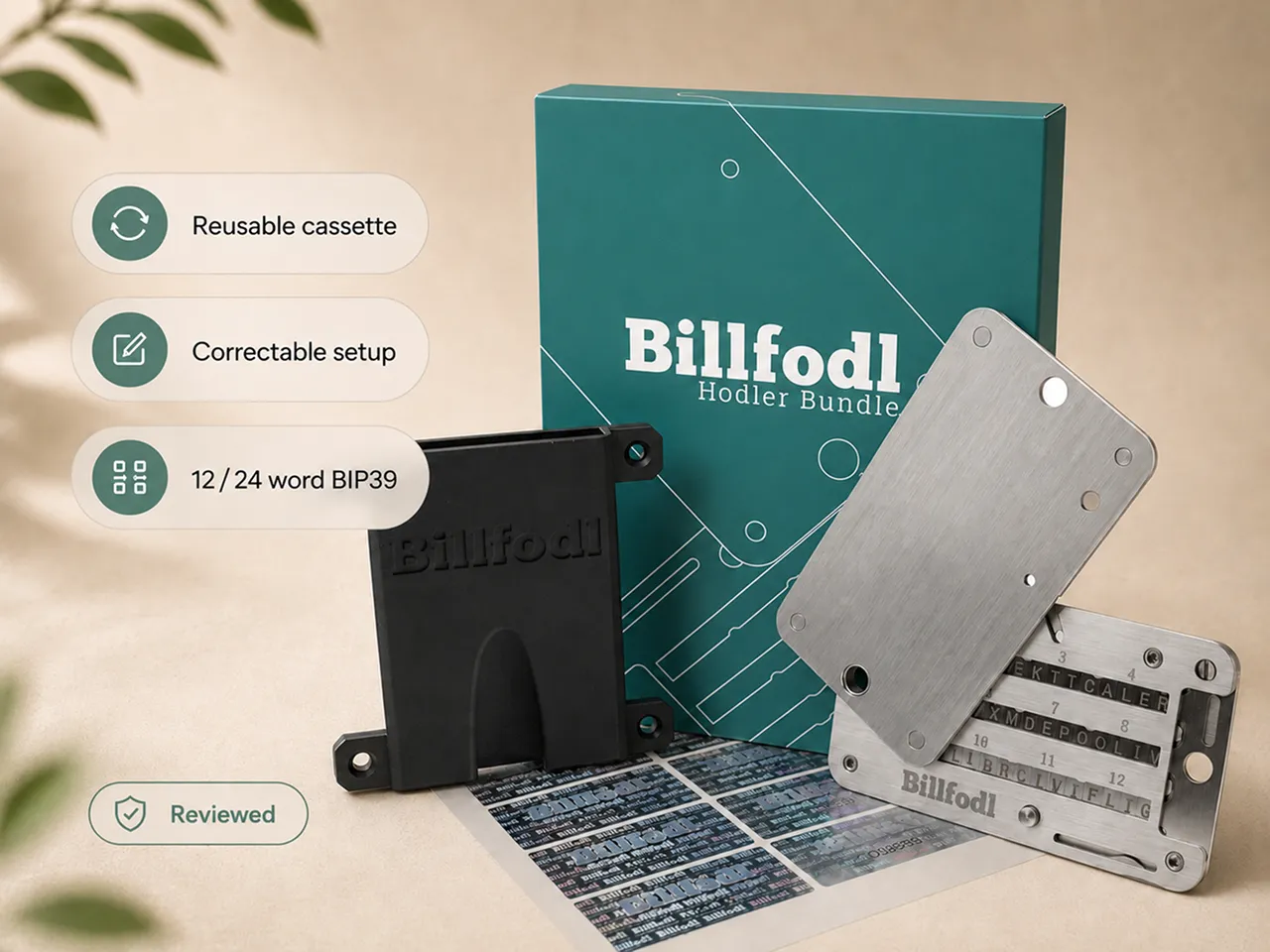
Billfodl stores the first four letters of BIP39 seed words with removable engraved character tiles held in numbered cassette positions.
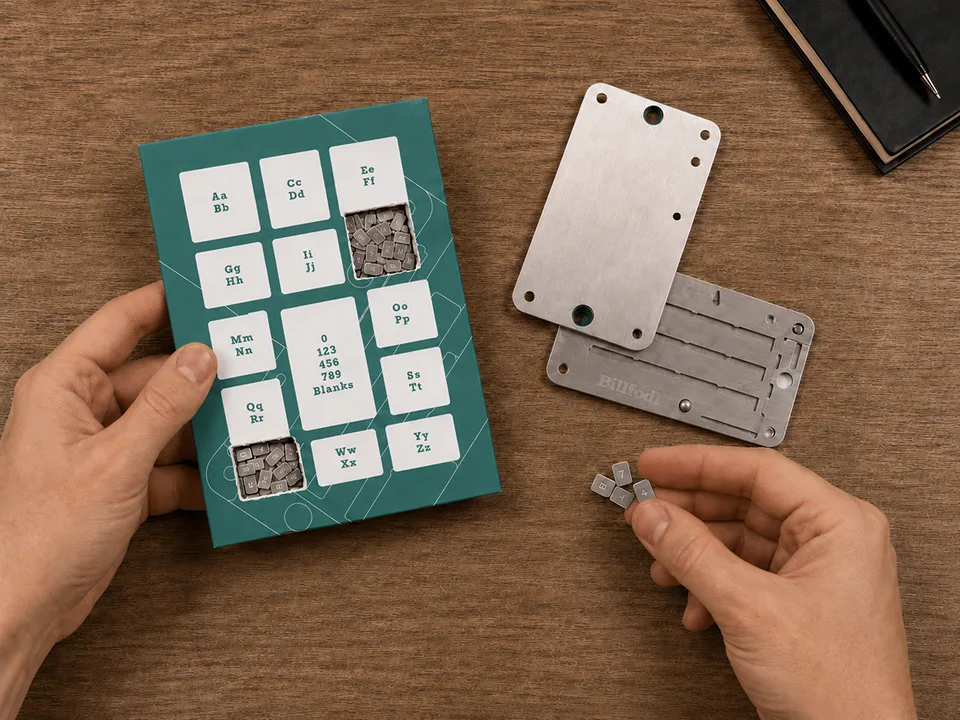
The product's value comes from reversibility. A wrong character can be removed before reliance, and the cassette can be reused after a deliberate wallet change. That is a real advantage over permanently punched metal.
The trade-off is structural: recovery order depends on the cassette continuing to retain many small characters in their original numbered positions.
How Bitcoin Plaster tested Billfodl
Frederick Staunch purchased, set up, handled, and documented the Billfodl used for this Bitcoin Plaster review.
The Bitcoin Plaster evidence set includes:
- complete manual tile setup;
- loading and closing both sides of the cassette;
- tile handling, orientation, and privacy cleanup;
- three days of water exposure;
- an approximately six-meter drop series;
- about two hours of fire exposure on the previously damaged unit;
- vice pressure and repeated hammer impacts;
- a hands-on comparison with another tile-cassette workflow.
Frederick's first complete setup took about 45 minutes. Familiarity reduced the active loading time, but the privacy cleanup remained a meaningful part of the process.
Bitcoin Plaster reports the conditions and observed results rather than turning them into universal claims. The publication does not recommend recreating destructive tests. Fire, crushing, and impact testing can cause injury, expose recovery data, and destroy the only valid backup.
Setup experience
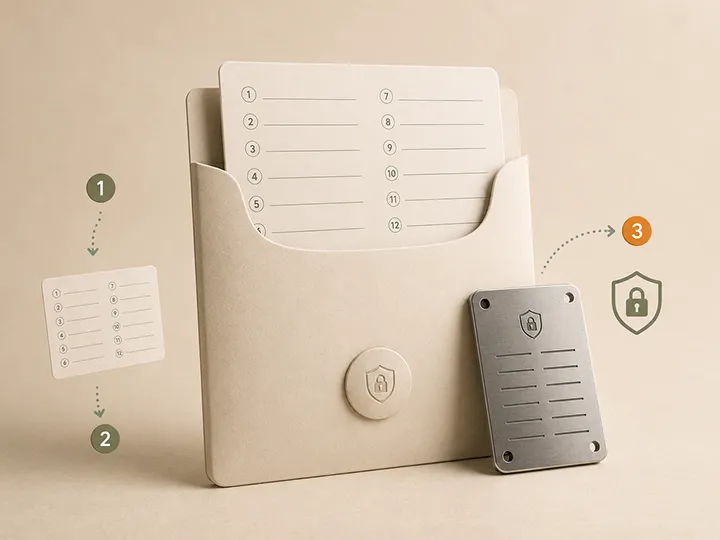
The workflow is easy to understand:
- Confirm that the seed belongs to the intended wallet.
- Work offline on a clean private surface.
- Separate positions 1 through 12 from positions 13 through 24.
- Identify the first four letters of each BIP39 word.
- Pre-arrange the characters before inserting them.
- Open the cassette and slide each character into the numbered position.
- Check spelling, orientation, blanks, side, and word order.
- Close and secure the cassette.
- Handle the perforated sheets and temporary material as sensitive residue.
- Complete a legitimate recovery check before relying on the backup.
None of these steps is technically advanced. The risk comes from repetition, small parts, and the possibility that one wrong or reversed tile remains unnoticed for years.
The main setup advantage: mistakes can be corrected
Permanent stamped, engraved, and center-punched products create an irreversible setup problem. A wrong mark can be difficult or impossible to remove cleanly.
Billfodl lets you correct:
- reversed letters;
- a word placed in the wrong position;
- an upside-down tile;
- a missing blank for a three-letter word;
- a character selected from the wrong row;
- a phrase-side ordering mistake.
For a user uncomfortable with permanent metal marking, this is Billfodl's strongest argument.
The main setup weakness: many small parts
Correction is possible because the data is modular. That introduces character sheets, individual tiles, channels, latches, a locking mechanism, and two working sides.
Do not assemble a real recovery phrase while rushed, tired, observed, or surrounded by cameras and connected screens. Use a clean surface where a dropped tile can be found immediately.
How the four-letter format works
Standard BIP39 seed words have unique first-four-letter prefixes within the correct word list. Billfodl uses that property to reduce the number of characters required.
The requirements remain exact:
- the correct word list must be used;
- each position must remain numbered and ordered;
- the first four letters must be accurate;
- three-letter words require the product's specified blank treatment.
This rule does not apply to an arbitrary optional passphrase, PIN, password, custom word list, or private abbreviation.
A correctly closed cassette can still contain the wrong seed. The locking mechanism proves only that the cassette is closed. It does not prove that the recorded information restores the expected wallet.
Use how to verify your seed phrase backup before considering setup complete.
The privacy issue most reviews miss
Billfodl supplies characters on perforated metal sheets. That makes the required letters easy to find, but the remaining sheet preserves a pattern of missing characters.
That pattern may reveal:
- which letters were selected;
- how many copies of a letter were removed;
- partial information that narrows possible words.
The sheet does not automatically reveal the complete ordered seed. It is still sensitive setup residue.
The setup is not complete when the cassette closes. The user must also account for:
- remaining character sheets;
- unused tiles;
- temporary paper;
- handwritten drafts;
- packaging and work surfaces;
- any organization aid used during setup.
Do not discard intact punched sheets in ordinary waste. Avoid improvising a cleanup method that risks injury or exposes the recovery information. The objective is to prevent the missing-character pattern from remaining casually accessible.
Durability results
Water: strong result
Frederick submerged Billfodl for three days. After removal and drying, he observed no visible rust or structural damage, and the characters remained readable.
This is a meaningful result for leaks, flooding, moisture, and storage environments that would quickly damage paper. It is not proof of unlimited resistance to every liquid, depth, duration, or chemical environment.
Fire: characters remained readable
Frederick exposed the previously drop-damaged unit to fire for approximately two hours. The metal characters remained readable afterward.
The correct conclusion is limited: the recorded characters survived the documented test conditions. The result does not justify calling the complete product universally fireproof or assuming the enclosure remained mechanically unchanged.
High drop: the decisive failure
The most important limitation appeared during an approximately six-meter drop series.
The cassette survived the first major impact. After the second, the structure opened and tiles began falling out.
This reveals the difference between two kinds of survival:
- Material survival: the metal characters still exist and may remain readable.
- Data-structure survival: every character remains in its original numbered position.
A seed backup fails when the letters survive but the order is lost.
Vice and hammer: durable, not indestructible
Sufficient mechanical force bent and destroyed the cassette structure in Frederick's vice and hammer testing.
That exceeds ordinary passive storage, but it confirms that stainless steel does not remove the need for a stable, crush-protected location.
Durability verdict
Billfodl performed well against prolonged water exposure and substantial heat. Its main failure mode is loss of tile retention after severe structural damage.
Billfodl is a water-and-fire-resistant metal seed backup whose recovery integrity still depends on the cassette preserving tile order.
Billfodl versus Trezor Keep Metal
| Factor | Billfodl | Trezor Keep Metal |
|---|---|---|
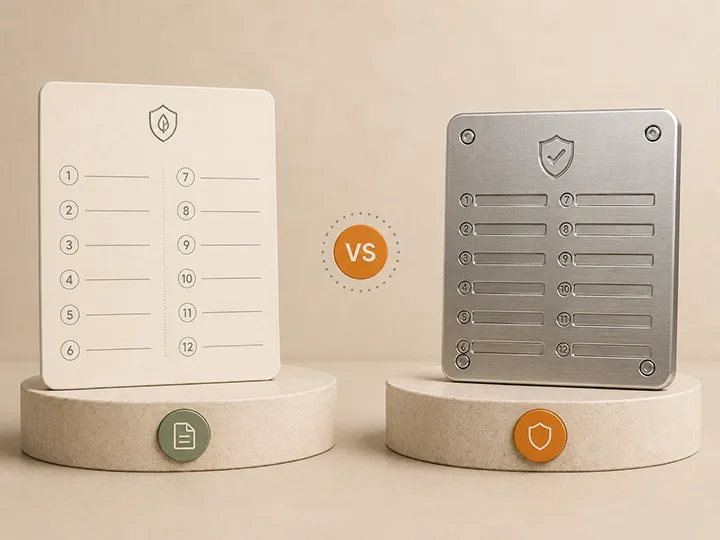
| Recording method | Removable engraved tiles | Permanent punched marks |
| Correction | Easy before closure | Difficult after permanent marking |
| Reusable | Yes | No |
| Character stamping | Not required | Manual punch workflow required |
| Finished-state loose-part risk | High | Lower |
| Main strength | Correctable, reusable setup with strong water and fire results | Permanent data and the strongest overall stress-test record in our comparison |
| Main limitation | Cassette opening and tile displacement | Permanent errors and harder access after severe deformation |
| Best fit | Reusability-first buyer | Durability-first buyer |
Choose Billfodl when correction and reusability are decisive.
Choose Trezor Keep Metal when the recovery record being permanently attached to the metal matters more than future editing.
Billfodl versus Coinplate Alpha
Billfodl is better when:
- quieter setup matters;
- you want to avoid repeated hammer impacts;
- correction before closure matters;
- a compact reusable cassette is easier to manage.
Coinplate Alpha is better when:
- fewer moving components matter;
- a heavy flat plate fits the storage plan;
- permanent center-punch marks are preferred;
- structural simplicity matters more than compactness.
Billfodl reduces irreversible setup risk. Coinplate reduces dependence on a tile-retention mechanism.
The failure mode that controls the recommendation
Billfodl performed strongly in the documented Bitcoin Plaster water and fire scenarios, but the high-drop test showed that material survival and recovery survival are not the same thing. The steel characters can remain readable while the cassette opens and the phrase order begins to disappear.
That makes stable, crush-protected storage more important than the alloy alone. The cassette should not be placed where severe impact or uncontrolled mechanical force is plausible.
Setup also creates sensitive residue. Perforated tile sheets and unused organized characters can reveal information about the phrase and should be handled as recovery-related material, not ordinary packaging.
Who Billfodl fits, and who should skip it
Billfodl is best for a holder who:
- already understands wallet recovery;
- has confirmed the active seed;
- wants to replace a paper-only backup;
- prefers tiles to permanent marking;
- values correction and reusability;
- has a private setup environment;
- can manage the perforated-sheet cleanup;
- has a stable, access-controlled, crush-protected storage location;
- considers water or fire more likely than catastrophic impact.
Skip Billfodl when:
- you want our best overall metal backup;
- you prefer permanent data with fewer loose components;
- the backup may face severe crushing or separation;
- you cannot manage small tiles reliably;
- you cannot complete a private offline setup;
- you need the backup format to be obvious to an authorized successor without instructions;
- you expect metal to provide confidentiality rather than physical durability.
Before purchasing, confirm the current official model, package contents, supported formats, price, shipping, warranty, and return terms. No verified Bitcoin Plaster reader discount is currently claimed.
Setup and storage checklists
Setup checklist
- [ ] Confirm the seed belongs to the intended wallet.
- [ ] Confirm the word count and supported standard.
- [ ] Prepare a private offline working area.
- [ ] Remove cameras, connected computers, and observers.
- [ ] Separate positions 1 through 12 and 13 through 24.
- [ ] Pre-arrange the first four letters.
- [ ] Use the correct blank treatment for three-letter words.
- [ ] Verify tile orientation and every numbered position.
- [ ] Close and inspect both sides.
- [ ] Complete the perforated-sheet privacy cleanup.
- [ ] Use a legitimate recovery-check workflow.
- [ ] Record a neutral backup identifier and verification date.
- [ ] Protect the cassette from severe falls and crushing.
- [ ] Store it away from the hardware wallet when the threat model requires it.
Storage checklist
A suitable Billfodl location should be:
- stable and access-controlled;
- unlikely to experience severe crushing or a long fall;
- independent from the only hardware wallet when appropriate;
- recoverable through the authorized continuity plan;
- periodically reviewed without exposing the phrase.
Use seed phrase storage at home and seed phrase storage outside the home to choose the location.
Sources and test notes
- Bitcoin Plaster hands-on setup notes for the purchased Billfodl cassette, character sheets, loading sequence, closure, and privacy cleanup.
- Bitcoin Plaster test records for three-day water exposure, the approximately six-meter drop series, fire on the damaged unit, vice pressure, and hammer impacts.
- Official Billfodl product information is used for compatibility, materials, and package contents, not as evidence that the exact Bitcoin Plaster test conditions were reproduced by the manufacturer.
- Comparisons with permanent-mark products use their own observed results and remain separate from the Billfodl evidence set.
Final verdict
Buy Billfodl when you want:
- a reusable tile cassette;
- no character stamping;
- correction before closure;
- strong water and fire performance in Bitcoin Plaster tests;
- a compact physical backup.
Skip it when you want:
- the lowest possible number of mechanical failure points;
- recovery data permanently attached to the primary metal record;
- the strongest response to crushing and structural separation;
- the overall winner from our metal-backup comparison.
Billfodl's strongest feature and biggest weakness come from the same design decision.
The removable tiles make setup easier to correct. They also make successful recovery dependent on the cassette keeping those tiles in place.
Buy Billfodl for reusable, hammer-free setup. Choose Trezor Keep Metal instead when permanent data retention is the higher priority.
Official Billfodl store affiliate link. We may earn a commission at no extra cost to you.
Frequently asked questions
Why does Billfodl store only four letters per word?
Standard English BIP39 words are uniquely identified by their first four letters within the correct word list. Recovery still depends on correct word order and an unambiguous layout.
Is Billfodl reusable?
Yes. The tiles can be rearranged, which makes correction and later reuse possible. Reopening also exposes the phrase again and requires complete re-verification.
What did the water and fire tests show?
The tested unit spent three days in water without visible rust or unreadable characters. The previously drop-damaged unit also retained readable characters after about two hours of fire. These are bounded observations, not universal guarantees.
What happened in the high-drop test?
After the second major impact in an approximately six-meter drop series, the cassette opened and tiles began falling out. The metal survived, but recovery order was at risk.
What should I do with the perforated tile sheets?
Treat them as sensitive residue because removed letters and patterns may reveal information about the phrase. Store or destroy them according to the same privacy standard used during setup.
What is Billfodl Multishard?
It is a separate workflow and should not be confused with the standard single-cassette backup reviewed here. Confirm the exact recovery architecture before buying or splitting data.
Does Bitcoin Plaster offer a Billfodl discount?
No verified reader discount is currently confirmed. A tracking token or affiliate URL label is not proof of customer savings.