
Bitcoin tax software limitations
Check the failure modes that make polished output look more complete than the records underneath.

Enter your email to receive the free PDF checklist.
Read our Privacy Policy. For subscriber questions or corrections, use the Contact & Corrections page.
Bitcoin tax software boundary
Bitcoin tax software can be useful. It can organize transaction history, calculate from supplied records, and turn scattered exchange and wallet data into something easier to review. For a holder with clean records, clear labels, and complete source history, that removes real manual work.

Bitcoin tax software can be useful. It can organize transaction history, calculate from supplied records, and turn scattered exchange and wallet data into something easier to review. For a holder with clean records, clear labels, and complete source history, that removes real manual work.
But software is not the source of truth. The core distinction is simple: tax software can organize and calculate from supplied records; it cannot know missing facts, verify ownership, read intent, decide treatment, or replace qualified judgment.
This is the capability-model page for the lane - it explains what each part of a tool's job actually is and where responsibility sits at each stage. It is not the failure-mode page; for the deeper list of how software goes wrong, see Bitcoin tax software limitations. It is educational only, not tax, legal, or financial advice; rules differ by jurisdiction and change over time. For the scope of the lane, read the Bitcoin tax disclaimer; for the map, start at the hub.
How this section is written: the descriptions below come from product-neutral patterns observed across published documentation, pricing, setup-flow review, and hands-on use only where explicitly stated, not from any single vendor's marketing. No tool is named, ranked, or recommended here.
A clean way to understand Bitcoin tax software is to separate the work into five stages:
Software can help most with the middle three. It does not own the whole process, and knowing which stages it owns is the key to using it well. The holder owns source completeness and context - exchange records, wallet history, transaction IDs, cost-basis inputs, labels, purpose notes, fees, and wallet-ownership context. Qualified review owns interpretation when facts are unclear, records are missing, or treatment questions exceed a software workflow. In between, software organizes and calculates. The single sentence that holds the whole model together: software computes; it does not know.
Import brings records into the tool, from exchange exports, account statements, wallet history, transaction IDs, or manual entry. This page stays source-agnostic and gives no platform-specific steps.
The responsibility boundary at this stage is completeness. Import is only as complete as the sources included: if an exchange is missing, the tool does not see purchases made there; if a wallet is missing, it does not see later self-custody movement; if a transaction ID is missing, a movement is harder to connect. A pattern worth stating plainly from reviewed workflows is that import paths behave differently - API connections, CSV files, wallet imports, and manual entry each carry different friction - but which sources to include, and confirming they all made it in, is the holder's responsibility, not the tool's. Software can import records; it cannot know which records you failed to import. (For assembling a complete export set, see export Bitcoin transaction history.)
Classification assigns meaning: incoming, outgoing, fee, withdrawal, deposit, transfer, or another type. This is where many holder problems begin, because classification depends on facts and labels the tool did not generate. The responsibility boundary here is context: a movement may need review when one side of a transfer is missing, a wallet is unlabeled, a receiving destination is unidentified, a transaction ID is not tied to its source record, a withdrawal and a wallet receipt are unmatched, or a purpose note is absent. Automatic categorization tends to be most reliable for standard activity - ordinary buys and sells - and needs more review for anything non-standard. (For the movement boundary itself, see wallet transfer vs taxable event.)
Calculation is where software does real mechanical work: totals, summaries, and reports from supplied amounts, dates, values, fees, and classifications. That is genuinely valuable after recurring buys or several years of activity. The responsibility boundary is that calculation inherits everything upstream of it: a calculation can be precise and still rest on incomplete inputs, a clean table can hide a missing source record, and a total can look final while old acquisition context is absent. The mechanics are the tool's job; the quality of the inputs those mechanics run on is yours. (For the cost-basis input layer, see Bitcoin cost basis basics.)
Consider a common situation. A holder buys Bitcoin on an exchange, withdraws it to self-custody, later moves it to a second wallet, and later still sends some back to an exchange and sells. If the tool is only given the later part of that history - the second wallet and the final exchange - it can see coins arriving with no known acquisition price. The output then shows a disposal with missing cost basis, even though the earlier movement was a transfer between the holder's own wallets, which is not, by itself, the same as a purchase.
The tool is not broken. It is doing exactly what it can: computing from what it was given. The gap is that the first exchange and the first wallet were never connected. A recurring lesson across reviewed workflows follows directly: complete source history matters more than a polished dashboard, and a tool can flag the missing-basis entry, but flagging is not fixing - the holder still has to supply the earlier source and connect it. This page decides how none of those movements are treated; it shows why a report can look finished while the record story is not.
Review is where the holder checks whether the output reflects the actual history - because output is not self-validating. A practical review asks: are all exchanges and wallets included; are acquisition records present and connected to later movements; are withdrawals matched to wallet receipts; are wallet labels clear, fees preserved, and transaction IDs attached where available; are duplicate-looking records explained and timestamp differences understood; are unclear movements marked "needs review"; and can each number be traced to a source record? Software may produce warnings, flags, or report notes that help here - but those are prompts, not fixes. A warning is not a treatment conclusion; a clean-looking report is not a guarantee; and the absence of a warning does not prove the record set is complete. (For common input problems, see common Bitcoin tax record mistakes.)
Interpretation is not the software's job. It means applying rules to facts under your situation - which can involve missing records, unclear ownership, non-standard acquisition, payment or business context, older gaps, or formal contact from a tax authority. This page gives no tax advice, filing instructions, audit-response steps, or treatment conclusions. When the question becomes interpretation, the safer route may be qualified review. (See when to use a tax professional.)
Can help with: collecting imported records into one workspace, organizing a timeline, calculating from supplied data, surfacing entries that need review, generating summaries, and preparing material a holder or professional can review. These capabilities are real, and conditional on records, labels, source completeness, and review. No claim here is that every tool does these things automatically, reliably, or universally.
Cannot know: facts that were never supplied - an exchange you forgot, a wallet you did not include, an acquisition record you lost, a fee you did not preserve, a label you never wrote, a wallet-ownership context you did not document, or an uncertainty that exists only in your memory. Software works from data; it cannot replace missing facts.
(For the Bitcoin-only record structure that feeds all of this, see Bitcoin-only tax recordkeeping.)
A Bitcoin transaction shows movement on-chain. It does not, by itself, prove that both sides were yours, or explain why the movement happened - and no amount of calculation produces those facts, because they are context, not arithmetic. Ownership context comes from wallet labels, exchange withdrawal records, receiving-wallet records, transaction IDs, and notes written near the time. Purpose comes from labels such as "transfer between my wallets," "withdrawal to cold storage," "wallet migration," "deposit back to exchange," "payment sent/received," "gift," or "fee." A label is a factual note, not a tax conclusion - but software often needs it before a record can be reviewed confidently. (For the labeling system, see wallet labeling for tax records.)
This page does not recommend or compare software. At criteria level, think about inputs before features: which sources you need to include, whether you have recurring buys, whether you moved into self-custody, whether your wallet movements are labeled, whether you can review output against source records, and whether unresolved questions can be exported for qualified review. The strongest tool choice still depends on the records going in - a product cannot make missing facts exist. (For the full evaluation framework, see Bitcoin tax software evaluation criteria.)
Bitcoin tax software can import records, structure a history, calculate from supplied data, and produce output for review. It cannot know missing facts, verify ownership, read intent, decide treatment, validate every label, confirm completeness, or replace qualified judgment. Across the five stages, the holder owns clean records and context, software helps with organization and calculation, and qualified review handles interpretation when facts or rules exceed a software workflow. Software computes; it does not know.
For the full tax-scope boundary, see the Bitcoin tax disclaimer.
What can Bitcoin tax software do? It can help organize records, calculate from supplied data, and produce summaries or reports from the records included. It is useful when inputs are complete, labels are clear, and the output can be reviewed against source records.
What can it not do? It cannot know missing facts, verify wallet ownership by itself, read intent, decide treatment, or replace qualified judgment. If the record set is incomplete, the output may need review.
Can tax software tell whether a wallet transfer is taxable? This page gives no taxable or non-taxable conclusions. Software may help organize the movement record, but treatment depends on facts and rules outside this page. A wallet-transfer record preserves what happened; it does not decide treatment.
Can software fix missing cost basis? It can calculate from cost-basis inputs it is given. It cannot reliably replace acquisition records you never preserved. If acquisition context is missing or uncertain, the record needs review.
Does software know which wallets are mine? Not by itself. Ownership context comes from your records, labels, wallet history, exchange withdrawals, transaction IDs, and notes. A transaction ID confirms movement; it does not prove ownership alone.
Are software warnings automatic fixes? No. Warnings, flagged entries, and report notes are prompts for review. The safer response is to check the source records and context behind the issue.
When should software output go to qualified review? When records are missing, wallet ownership is unclear, acquisition context is incomplete, output cannot be explained, or treatment questions exceed a software workflow.
Check the failure modes that make polished output look more complete than the records underneath.
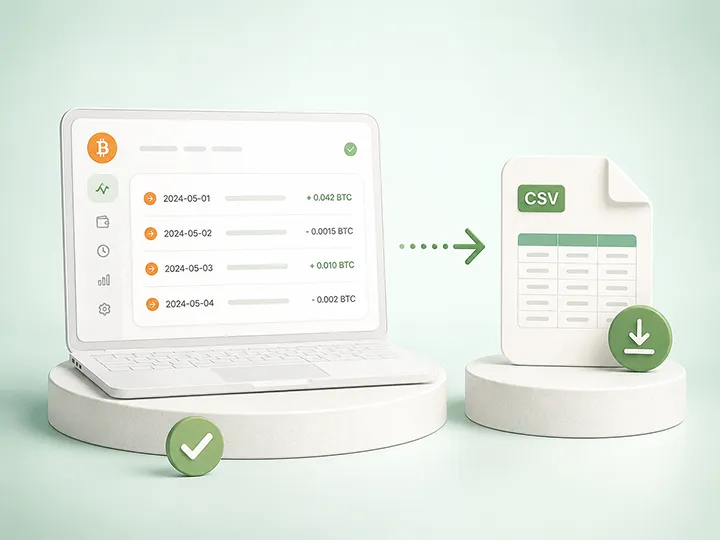
Assemble a complete export set before importing records into tax software.

Preserve ownership, purpose, source, destination, and uncertainty without recording wallet secrets.

Use reviewability as the evaluation lens instead of a scorecard, ranking, or product verdict.