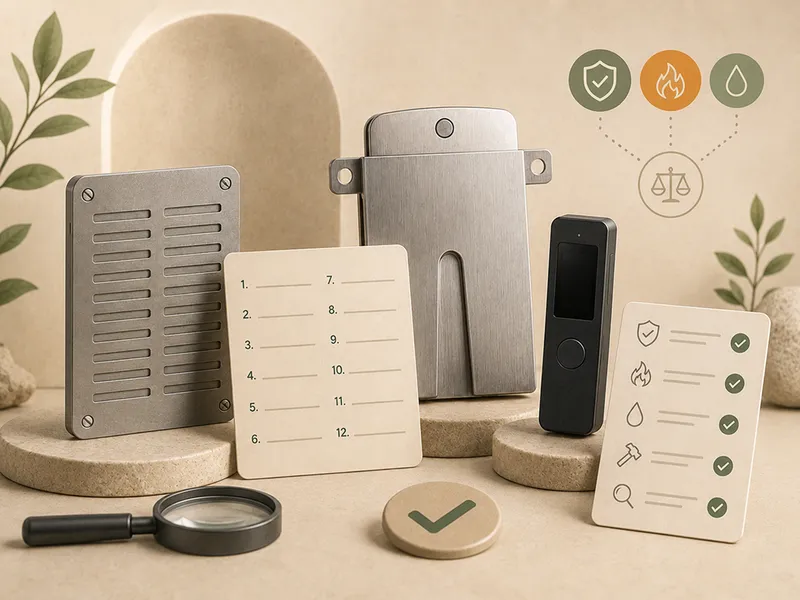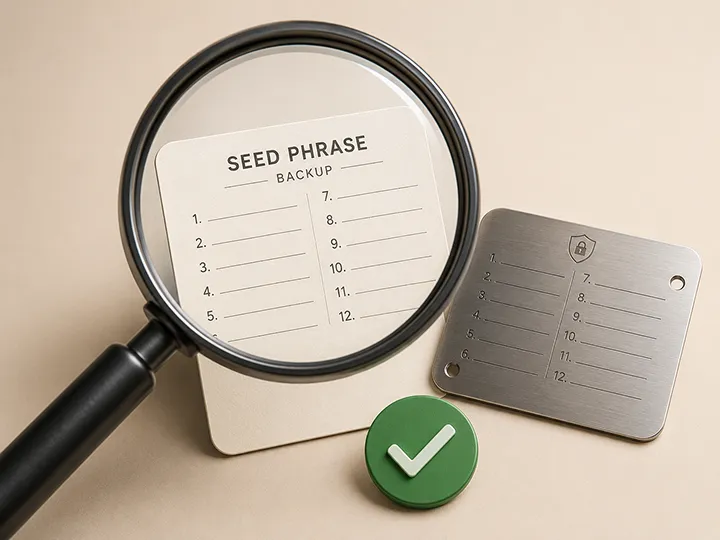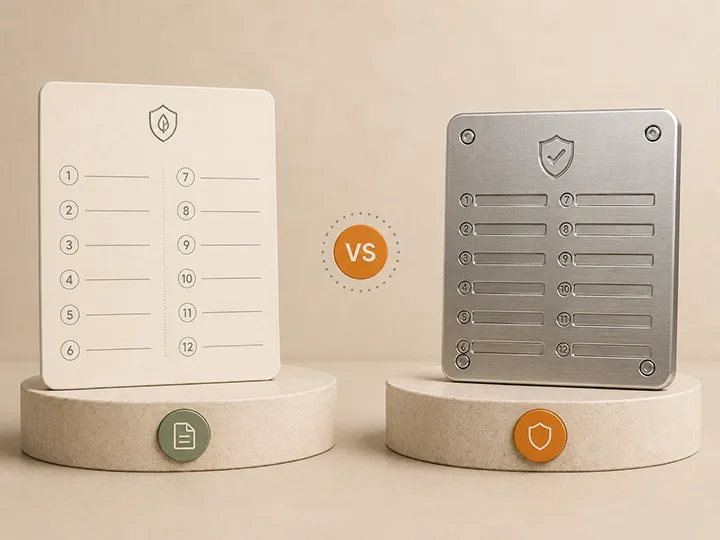
Seed phrase fire and water risk

A seed phrase backup does not need to disappear completely to fail. Heat, water, humidity, corrosion, contamination, impact, cleanup, or loss of word order can make one position unreadable and break recovery.
When these hazards are credible, a verified metal record is the stronger long-term primary medium. The decision still depends on the actual environment and whether the surviving data remains accessible and understandable after the event.
The decision at a glance
| Environment or condition | Primary concern | Recommended response |
|---|---|---|
| One paper copy in the same home as the wallet | One local event can remove both device and recovery path | Verify the backup, move the primary record to suitable metal, and create location independence where justified |
| Dry indoor storage with low flood exposure | Fire, disposal, abrasion, and access after structural damage | Prioritize permanent readable marks and post-damage access |
| Basement, humid, or leak-prone storage | Moisture, mold, staining, corrosion, and long-term degradation | Avoid paper as the only primary record and evaluate the complete material system |
| Flood-prone location | Soaking, movement, burial, contamination, and loss of location | Plan for retention and findability, not only water resistance |
| Coastal or salt-exposure environment | Accelerated corrosion and interaction between different materials | Confirm alloy suitability, mark depth, and periodic condition review |
| High fire consequence | Heat, smoke, cooling, water suppression, deformation, and seized enclosures | Favor permanent data with few weak components and keep another recovery path outside the same event |
The real success standard
A backup succeeds only when the correct recovery information is still:
- present and complete;
- preserved in the correct order;
- readable without guessing;
- reachable after deformation, corrosion, or contamination;
- identifiable as the active backup;
- usable in a legitimate recovery workflow.
Some surviving metal is not enough. A durable but inaccessible or unordered record is still a recovery failure.
Fire risk
Fire protection is not a melting-point contest. A backup can fail before the main metal melts because paper inside burns, labels disappear, marks become ambiguous, screws seize, plates warp, tiles escape, or the object becomes buried in debris.
Evaluate the complete sequence: heat, smoke, structural impact, cooling, water suppression, cleanup, and opening afterward. The most useful questions are whether the data remains readable and whether the enclosure can still be accessed.
Water, humidity, and corrosion risk
Water risk includes more than immersion. Leaks, condensation, damp basements, floodwater, mold, salt, chemicals, and repeated wet-dry cycles can degrade the record or make the location inaccessible.
Ask five separate questions:
- Does the recording remain readable?
- Does the construction preserve word order?
- Does the material resist the actual water and corrosion environment?
- Does the object remain in the known location?
- Can it be safely cleaned, opened, and interpreted afterward?
Combined events matter more than isolated ratings
Real disasters stack conditions. A fire may be followed by water suppression, collapse, cooling, contamination, forced entry, and cleanup. A flood may move the object, fill an enclosure with sediment, or create corrosion after the water recedes.
Do not treat a single temperature, immersion, or alloy claim as proof of complete recoverability. Evaluate data retention, order retention, access, and findability across the combined sequence.
How metal backups still fail
- Shallow marks: the plate survives while the characters become unreadable.
- Lost order: tiles or components survive but move, escape, or rotate.
- Seized enclosure: the data survives but cannot be reached without destructive work.
- Weak reference layer: labels, numbering, orientation, or a companion legend disappear.
- Wrong material for the environment: corrosion attacks the marks or fasteners over time.
- Location loss: the object survives but is carried away, buried, discarded, or never found.
- Input error: the wrong recovery phrase survives perfectly.
Match protection to the storage environment
Choose the storage location before the product. A compact enclosure may fit a concealed indoor location. A large plate may be better for a substantial fixed location. A reusable tile system may be easier to correct during setup but requires stronger component-retention controls.
Use the metal backup selection criteria to evaluate the recording method, complete construction, and post-damage access. Use home storage and off-site storage to design the location.
What safes and containers can and cannot do
A safe or container may add organization, theft resistance, concealment, and bounded fire or water protection. It does not automatically provide unlimited heat resistance, flood protection, post-collapse access, secrecy from an authorized opener, or geographic separation.
Read the documented rating, understand the installation conditions, and assume that access after the event may be harder than access before it.
Keep recovery paths outside one disaster zone
The hardware wallet is the signing device. The seed phrase is the recovery path when that device is unavailable. Keeping both together allows one fire, flood, theft, collapse, or disposal event to remove the device and its recovery path.
A second copy earns its extra exposure only when it creates genuine independence. Two objects in the same drawer, safe, building, or property may still share the same failure domain.
What to fix first
- Possible exposure: move funds to a new uncompromised wallet before optimizing physical durability.
- Accuracy: verify the active recovery data before permanent recording.
- Paper concentration: remove the single point of failure when one paper copy is the only path.
- Environmental fit: choose the recording method and material for the actual hazards.
- Location independence: prevent one event from removing the wallet and every backup.
- Post-disaster usability: preserve findability, access, order, readability, and instructions.
Final verdict
For serious long-term primary backup use, paper loses when fire, water, humidity, corrosion, and combined disaster events are credible.
Metal is the stronger medium, but only when the marks, order, enclosure, material, location, and recovery workflow remain usable after the event. Choose by complete recovery performance, not by a generic fireproof or waterproof label.
Product fits after the hazard is defined
Trezor Keep Metal is our current overall winner when the exact variant matches the wallet recovery format. Coinplate Alpha is the heavy-duty alternative when a large permanent plate fits the location better than a compact enclosure.
Official Trezor and Coinplate store affiliate links. We may earn a commission at no extra cost to you.
Review the evidence and trade-offs in Best metal seed phrase backups, including post-damage access and setup-error limits.
Frequently asked questions
Can fire destroy a paper seed phrase backup?
Yes. Paper can burn, char, become brittle, or lose enough ink contrast to make one or more words unreadable. Complete destruction is not required for recovery failure.
Can water ruin a seed phrase backup?
Yes. Water can smear ink, warp paper, create mold, stick pages together, or make characters ambiguous. Humidity can produce similar damage more slowly.
Is paper safe inside a metal container?
It may receive some protection, but it remains paper. The result depends on the container rating, heat duration, internal temperature, water intrusion, and whether the record stays readable after the complete event.
Is a metal seed backup fireproof?
Do not treat any metal backup as universally fireproof. Products use different alloys, thicknesses, marks, seals, enclosures, and fasteners. Evaluate the documented conditions and whether the recovery data remained ordered, readable, and accessible.
Is a waterproof metal backup safe in a flood?
Not automatically. It may resist water while being carried away, buried, contaminated, or made inaccessible. Flood recoverability includes material survival, location retention, and findability.
Which recording method is strongest for fire and water protection?
Deep permanent punching or stamping is the strongest general starting method because the marks are difficult to erase and there are few movable components. The recovery information must be verified before permanent marking.
Are tile-based metal backups unsafe?
No. They can perform strongly against heat and water and allow corrections during setup. Their main weakness is enclosure dependence: severe impact or crushing can release or reorder components.
Does a fire-rated safe make paper sufficient?
A safe with documented ratings may improve protection, but the outcome depends on internal temperature, duration, water intrusion, installation, structural damage, and access afterward. It should remain one layer rather than the entire recovery plan.