What a seed phrase actually is

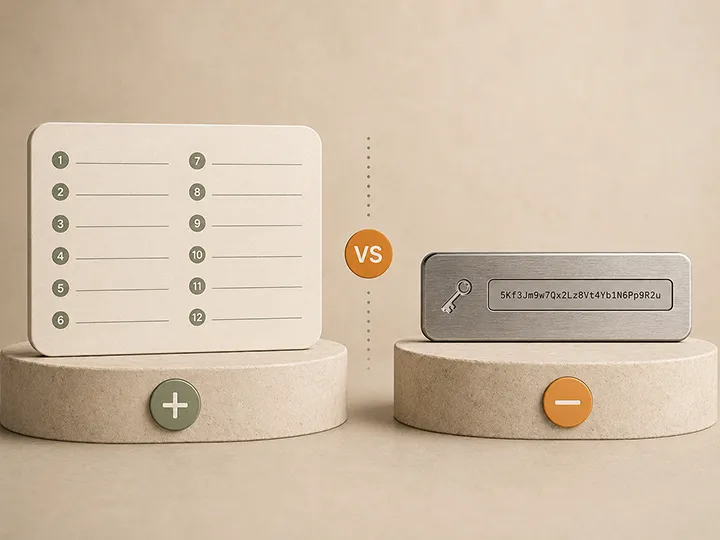
A seed phrase is an ordered list of words generated by a compatible Bitcoin wallet as its recovery backup. The wallet uses those words to recreate the seed from which its keys and addresses are derived. If the original wallet is lost, damaged, reset, or replaced, the correct phrase can restore control through a compatible recovery process.
A seed phrase is not a normal password, a support code, or a list of individual private keys. It is exact recovery data. Anyone who obtains the complete phrase may be able to recreate the wallet and spend the bitcoin it controls.
The essential rule: The wallet device is replaceable. The recovery information may not be. Keep the phrase offline, private, complete, readable, and in the exact original order.
Short answer
A seed phrase is the master recovery backup for a Bitcoin wallet.
It usually appears as 12 or 24 words during wallet setup. Those words allow compatible wallet software or hardware to recreate the same underlying wallet keys later. The phrase does not contain bitcoin. Bitcoin remains recorded on the Bitcoin network. The phrase restores the keys that authorize spending.
That creates two responsibilities at the same time:
- Do not lose it. Without a usable recovery backup, a failed or missing wallet device can become a permanent loss of access.
- Do not expose it. Anyone with the complete phrase may be able to recover the wallet somewhere else, without your original device or PIN.
What to do after a wallet gives you a seed phrase
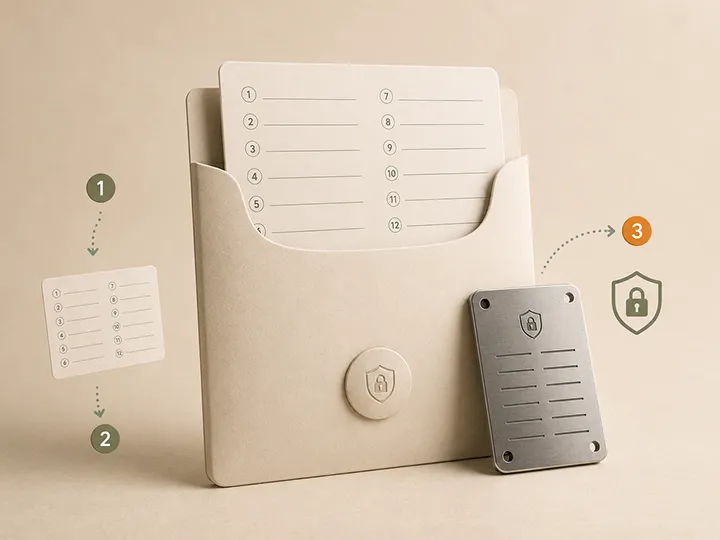
Use this sequence:
- Record it offline and exactly as shown. Preserve every word and its numbered position.
- Do not photograph, scan, upload, email, paste, or type it into a connected service.
- Verify the backup through a safe process before depending on it.
- Store it separately from the wallet you use every day.
- Choose a storage medium that can survive the physical risks you actually face.
The complete process is covered in How to store a seed phrase.
The seed phrase is the backup, not the wallet
A hardware wallet protects keys and approves transactions during normal use. The seed phrase has a different job. It preserves the recovery information needed to rebuild the wallet when the original device is no longer available.
That distinction matters because protecting the device without protecting the phrase is an incomplete self-custody setup.
- A damaged hardware wallet can usually be replaced.
- A lost phone or computer can be replaced.
- Wallet software can be reinstalled.
- A missing, exposed, unreadable, or incorrect seed phrase can remove the recovery path or give it to someone else.
The device protects everyday signing. The seed phrase protects recovery. Neither replaces the other.
How a list of words can recreate a wallet
The words are a human-readable way to preserve recovery data that would otherwise be difficult to record accurately.
Many Bitcoin wallets use the BIP39 mnemonic standard. A BIP39 wallet commonly generates 12 or 24 words from a fixed word list. The complete phrase, in its exact order, is converted into a binary seed. The wallet then derives a deterministic hierarchy of keys and addresses from that seed.
“Deterministic” means that the same valid recovery data can recreate the same underlying wallet keys and addresses instead of generating an unrelated wallet.
The seed phrase primarily backs up key material. It may not restore every label, note, account name, transaction annotation, or interface setting from the original app.
For the difference between the recovery phrase and the keys derived from it, read Seed phrase vs private key.
Why the phrase can matter more than the physical device
A hardware wallet can isolate keys from ordinary internet-connected devices, but the recovery phrase can bypass the original hardware entirely. A person with the correct phrase may be able to import it into another compatible wallet and recreate control.
That produces two opposite failure modes.
If the phrase is lost
The wallet may continue working until the device fails, is reset, or disappears. The problem can remain hidden for months or years. When recovery is finally needed, there may be no usable backup.
If the phrase is exposed
The physical wallet may still be in your hand and protected by a PIN while another person uses the copied phrase elsewhere. A PIN on the original device does not protect against recovery from a stolen seed phrase.
No legitimate support agent needs your words. A request to share, photograph, upload, “validate,” “synchronize,” or “secure” a seed phrase is a serious warning sign.
Seed phrase, private key, PIN, passphrase, address, and hardware wallet
These terms are related, but they are not interchangeable.
| Item | What it does | What it does not do |
|---|---|---|
| Seed phrase | Recreates the wallet seed and the keys derived from it | It is not a resettable account password |
| Private key | Authorizes spending for a specific derived key or address | It is not normally the beginner-facing backup for the whole wallet |
| Hardware-wallet PIN | Restricts local access to one physical device | It does not replace or protect an exposed seed phrase |
| Optional passphrase | Combines with the seed phrase to derive a separate wallet | It is not the same as the device PIN, and a different entry can open a different valid wallet |
| Bitcoin address | Receives bitcoin | It is not secret recovery information |
| Hardware wallet | Protects key use and transaction signing during normal operation | It does not remove the need for a recovery backup |
An optional passphrase creates additional recovery responsibility. A lost or mistyped passphrase can make the intended wallet inaccessible, and a different passphrase may derive a different wallet without displaying an obvious “wrong password” error.
Read Passphrase vs seed phrase and Hardware-wallet PIN and passphrase basics before changing an existing setup.
The words are exact data, not a memory aid
A seed phrase is not “close enough” when most words are right. Recovery depends on the exact words, their exact sequence, and any additional recovery factor used by the original wallet.
These errors can turn a physically intact backup into a failed backup:
- one incorrect word;
- correct words in the wrong order;
- a skipped or duplicated position;
- letters that are too faint or ambiguous to read;
- a phrase copied from the wrong wallet;
- personal shorthand that makes sense today but not years later;
- a missing optional passphrase;
- a second plate or component that can no longer be matched to the first.
A durable object can preserve incorrect information perfectly. Recording the phrase and verifying the backup are separate jobs.
What Bitcoin Plaster's seed-backup testing found
Bitcoin Plaster has bought, handled, and set up Billfodl, Coinplate Alpha, ELLIPAL Seed Phrase Steel, Keystone Tablet, Trezor Keep Metal, and SecuX XSEED backup systems. Their designs differ, but the same practical lessons appeared repeatedly.
A closed backup is not necessarily a correct backup
Locking a tile-based device or sealing a metal backup confirms that its parts are retained. It cannot confirm that the correct letters were selected or that every word was placed in the correct position.
The material stores what you enter. It does not know whether you copied the correct phrase from the correct wallet.
Permanent marking should come after preparation and checking
Punching, stamping, or engraving is difficult to undo. The safer sequence is:
Prepare, mark temporarily, verify, then make the record permanent.
Once a letter is deeply marked into metal, correcting a mistake may require replacing the backup.
Clever substitutions create future ambiguity
A visually similar letter or improvised notation may feel obvious during setup. Years later, under stress, it can become a guess. A reliable backup should be understandable without requiring the future user to remember an exception.
Physical survival and practical recovery are different tests
A backup has not succeeded merely because the object still exists after damage. The recovery information must remain readable, ordered, accessible, and understandable.
In Frederick Staunch's Trezor Keep Metal testing, a punched metal record remained readable after overnight fire exposure while a paper phrase stored inside the unit did not. In a separate deformation test, the record remained visible, but the damaged enclosure became harder to open.
The broader lesson is that durability should be judged by recoverability after damage, not by whether the object can still be found.
Why some metal backups store only four letters
For the English BIP39 word list used by many wallets, the first four letters uniquely identify each word. A compatible backup can therefore store the first four letters instead of the complete word. Three-letter words are stored in full.
This saves space, but it does not reduce the need for accuracy:
- the first letters must be correct;
- each entry must remain attached to the correct word number;
- the correct BIP39 word list must be used;
- the person recovering the wallet must understand the abbreviated format.
Do not assume that a four-letter method applies to every wallet standard, recovery format, language, or custom word list. Use only the format explicitly supported by the wallet and backup system you are using.
A real seed phrase should stay offline
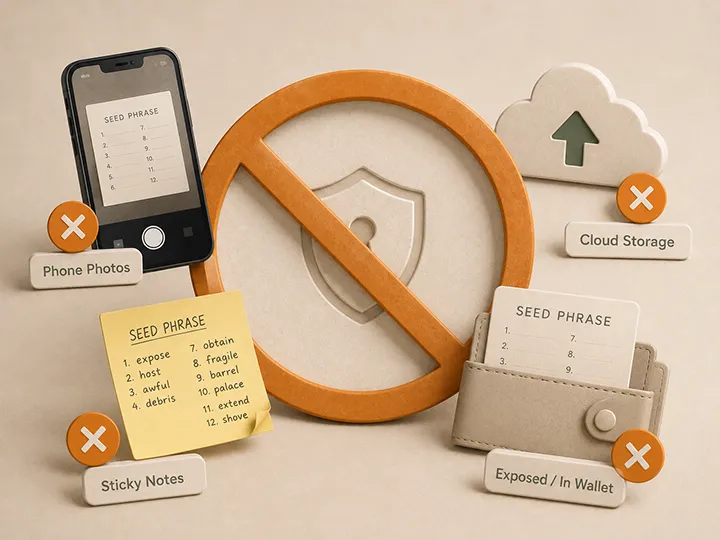
Do not turn a seed phrase into a digital convenience item.
Do not store it in:
- phone photos or screenshots;
- scanned documents;
- cloud notes or synced files;
- email drafts or messages;
- password managers;
- browser forms;
- ordinary computer files;
- chat apps or shared documents;
- AI prompts or AI tools;
- online “seed checkers” or recovery websites.
Do not enter it into a phone, computer, website, or app merely to “test” it. Recovery and verification should be performed only through a deliberately chosen process appropriate to the wallet.
Read Where not to store a seed phrase before creating additional copies.
Paper or metal for long-term storage?
Our recommendation: Use an offline paper card or the wallet’s supplied recovery sheet to capture the phrase accurately during setup, but do not automatically treat paper as the final long-term backup for meaningful savings.
Paper is simple, readable, and inexpensive. It is also vulnerable to fire, water, fading, tearing, insects, and accidental disposal.
A well-designed metal backup can provide stronger long-term protection against those physical threats, but only when the phrase is recorded accurately and the finished object is stored privately. Metal improves durability. It does not improve secrecy, fix transcription errors, or guarantee that a damaged backup will be easy to open and read.
Use this sequence:
- Capture the phrase accurately offline.
- Verify that the backup matches the wallet.
- Evaluate the physical threats to the storage location.
- Use a properly tested metal backup when fire, water, corrosion, or long-term deterioration would make paper-only storage an unacceptable single point of failure.
- Keep secrecy, access control, and recovery usability separate from durability.
Compare the trade-offs in Paper vs metal seed phrase backup.
A safer beginner sequence
1. Understand what the phrase controls
Treat the seed phrase as the wallet’s recovery source, not as a password or support code.
2. Preserve the exact words and order
Number every position clearly. Do not rely on memory, spelling guesses, or personal shorthand.
3. Keep the real phrase offline and private
Do not photograph, upload, scan, paste, or share it. Avoid exposing it to an ordinary connected keyboard for convenience.
4. Verify before trusting the backup
A backup that looks complete may still contain the wrong information. Use a safe verification process appropriate to the wallet.
Continue with How to verify your seed phrase backup.
5. Store it separately from the everyday device
Keeping the wallet and its only backup together allows one theft, fire, flood, or access event to affect both. Separation should reduce shared failure risk without making the backup impossible to find.
6. Choose the long-term medium deliberately
Paper may be sufficient for a temporary or carefully protected copy. For meaningful long-term savings exposed to realistic fire, water, or deterioration risk, a verified metal record is the stronger storage medium.
7. Make the plan understandable in the future
The backup should remain usable under stress and, where appropriate, by a trusted person following a carefully designed inheritance or continuity plan. Do not confuse secrecy with obscurity that even the intended user cannot decode.
Common seed phrase mistakes
Treating the phrase like a password
Passwords are typed frequently and may be reset. A seed phrase should be used rarely and may have no recovery authority capable of replacing it.
Protecting the device but neglecting the backup
A strong PIN and an intact hardware wallet do not help when the only seed copy was lost, burned, exposed, or recorded incorrectly.
Assuming metal solves every threat
Metal addresses physical durability. It does not prevent theft, unauthorized viewing, incorrect transcription, missing word order, or an inaccessible passphrase.
Creating copies that share one failure event
Multiple copies in the same drawer, building, or obvious storage location may fail together. Redundancy works only when the copies do not share the same realistic threat.
Skipping verification
The most expensive backup is still unreliable if nobody confirmed that it contains the correct recovery data.
Plain-English takeaway
A seed phrase is the human-readable recovery backup for a Bitcoin wallet. It allows compatible wallet software or hardware to recreate the seed from which the wallet’s keys and addresses are derived.
Treat it as exact recovery data, not as a password or reminder. Keep it offline. Preserve every word and position. Verify the finished backup. Store it separately from the everyday wallet device. Use a physical medium that can survive the risks your recovery plan is designed to handle.
For meaningful long-term savings, do not leave the only recovery path dependent on an unverified paper-only copy.
Move from understanding the seed to protecting it
Do not choose a metal backup until the wallet has generated the real recovery phrase, you know the exact recovery format, and you have a safe way to verify the finished record. A product cannot correct an unknown word count, wrong phrase, or unverified copy.
When those basics are settled, Billfodl is the correction-first next step on this page. Its reusable tile workflow lets you correct the record before closure, but it still requires private setup, controlled storage, and wallet-level verification.
Official Billfodl store affiliate link. We may earn a commission at no extra cost to you.
Start with How to store a seed phrase, or compare all reviewed formats in Best metal seed phrase backups.
Common questions about seed phrases
Are seed phrases always 12 or 24 words?
Many BIP39 wallets use 12 or 24 words, but other recovery formats and word counts exist. Use exactly the recovery format generated and supported by your wallet. Do not convert it into a different scheme casually.
Can I recover a wallet without the original device?
Usually, yes, when you have the correct recovery data and use a compatible, trusted recovery process. The replacement interface may not restore every label or application setting, but it can recreate the underlying keys and addresses when compatibility requirements are met.
Is the seed phrase the same as the hardware-wallet PIN?
No. The PIN protects local access to one device. The seed phrase can recreate the wallet on another compatible device. Changing or losing the PIN is a different problem from losing or exposing the recovery phrase.
Why must the word order remain the same?
The numbered position is part of the recovery data. Reordering the same words changes the input and will not recreate the intended wallet.
Can wallet support recover or reset my seed phrase?
No legitimate support process can reset a self-custody seed phrase for you. Never give the words to a person claiming they need them to unlock, verify, synchronize, or repair the wallet.