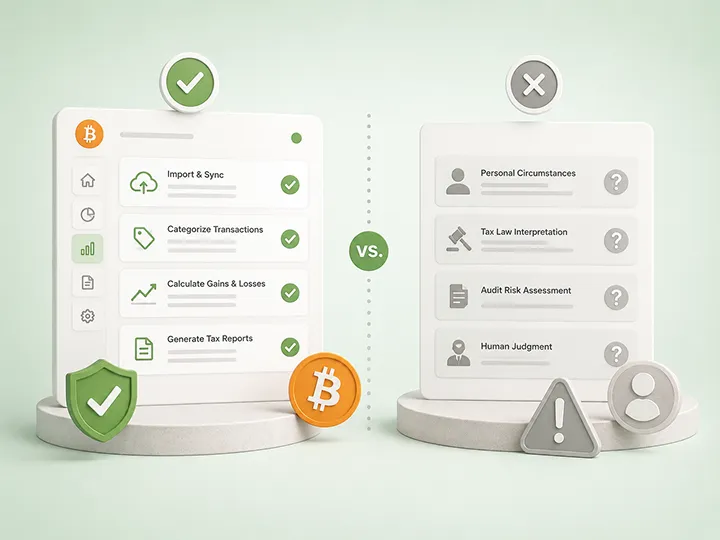
What tax software can and cannot do
Use the five-stage model to separate import, classification, calculation, review, and interpretation.

Enter your email to receive the free PDF checklist.
Read our Privacy Policy. For subscriber questions or corrections, use the Contact & Corrections page.
Bitcoin Tax Software
A Bitcoin tax software page should not begin with a product. It should begin with the job.


A Bitcoin tax software page should not begin with a product. It should begin with the job.
If your records are clean, complete, and easy to review, software can help organize and calculate from them. If your records are incomplete, unlabeled, duplicated, or disconnected across exchanges and wallets, the output can look polished while still needing review. So the evaluation question is not "which tool looks best?" - it is what job does this software need to do for my Bitcoin records, and can I review whether it did that job?
The core distinction is simple: these criteria are a neutral yardstick; this page does not recommend, rank, compare, endorse, score, review, or route to any product. It is educational only, not tax, legal, or financial advice; rules differ by jurisdiction and change over time. For the scope of the lane, read the Bitcoin tax disclaimer; for the map, start at the hub.
How this section is written: the review prompts below reflect patterns that recur across published documentation, pricing, setup-flow review, and hands-on use only where explicitly stated, rendered product-neutral. No tool is named, scored, or recommended.
A score can create false confidence - a tool can look strong on a checklist while still failing the one thing that matters most for your records. So treat every item below as a question you can answer against your own history, and keep responsibility where it belongs: records preserve facts, software organizes and calculates from supplied records, you review output against source records, and qualified review handles interpretation when facts or treatment questions exceed software.
Underneath every area sits one lens that is worth stating on its own, because it is the most useful evaluation idea on this page: reviewability matters more than automation. A tool that automates a great deal but hides its workings is harder to trust than one that automates less but lets you see and correct what it did. A recurring lesson across reviewed workflows makes this concrete - a tool can flag a problem, such as a missing-basis entry or an unmatched transfer, but flagging is not fixing, and complete source history matters more than a polished dashboard. So the strongest criteria do not ask "how automated is it?" They ask "can I see what it did, see what it could not do, and fix the gaps?"
A tool cannot be judged fairly if the records going in are weak. Ask first:
A tool given incomplete inputs can still produce a clean-looking output - which does not prove it is complete. (For the record foundation, see Bitcoin tax records; for the Bitcoin-only framework, see Bitcoin-only tax recordkeeping.)
Import paths behave differently - API connections, CSV files, wallet imports, and manual entry each carry different friction, and a misconfigured connection or partial import quietly degrades the report. So the evaluation question is not "how many integrations does it have?" but:
Import fit is a record-source fit question, not a feature count. (For assembling a complete export set, see export Bitcoin transaction history; for import problems, see CSV import errors.)
A holder with self-custody history usually has records across more than one system - the exchange shows purchases and withdrawals, the wallet shows receipts and later movement, the blockchain shows transaction IDs, and labels explain ownership and purpose. A tool should help you review those together:
The goal is not to trust one perfect file - it is to make scattered records reviewable. This page decides no treatment for any movement. (For reconciling sources, see exchange CSV vs wallet history; for the movement boundary, see wallet transfer vs taxable event.)
Cost basis is an input, not a verdict, and it is the single most common place a clean report hides an incomplete record. This page recommends no cost-basis method. Ask:
A tool that makes missing or uncertain inputs visible is easier to review than one that makes them disappear - this is the reviewability lens applied to the numbers most likely to be wrong. (For the concept, see Bitcoin cost basis basics.)
Wallet labels are not cosmetic; they preserve ownership context, purpose, source and destination context, and uncertainty. Software may need that context; it should not be assumed to validate labels, confirm ownership, read intent, or choose treatment. Ask:
A label should describe a fact, not a treatment. (For the labeling system and the wallet-secret safety rule, see wallet labeling for tax records.)
This is the difference between a report you can inspect and one you can only trust blindly - and it is where the reviewability lens matters most. Ask:
A polished report is not enough; the output should stay connected to the factual record. (For common record problems, see common Bitcoin tax record mistakes; for the deeper limits, see Bitcoin tax software limitations; for the professional boundary, see when to use a tax professional.)
Do not let broad-crypto feature lists define the evaluation. This page is not about altcoins, DeFi, NFTs, staking, lending, bridges, or smart contracts - those are out of scope. For a Bitcoin-only holder, practical fit means the tool helps review the records that actually exist in a Bitcoin history: exchange purchases, recurring buys, withdrawals to self-custody, wallet receipts, wallet migrations, deposits back to exchanges, transaction IDs, fees, labels, source/destination context, and cost-basis inputs. Judge a tool by whether it helps with your Bitcoin record job - not by complexity you do not have.
Keep this high-level; this is not a wallet-security, privacy, or account-access guide. Ask what record information the tool needs, whether it explains why, whether it lets you review what is being used, and whether it turns tax records into an unnecessary wallet-security risk.
Do not share seed phrases, private keys, backup words, passphrases, PINs, signing secrets, recovery details, or account credentials for tax-software evaluation, and do not share extended public keys or account credentials with any tool or person. Recordkeeping should not create wallet risk.
Do not turn this into a point system. Use the areas above as review prompts: what records do I have, what sources must be included, which movements need context, which labels are missing, which acquisition records are uncertain, which fees or values need review, which import issues appear, which parts of the output I can trace to source, and which questions exceed software and need qualified review. The goal is not to rank products - it is to avoid trusting output before the record job is defined. A tool that scores well on features but hides its workings can still be the wrong choice; a tool that scores modestly but keeps everything reviewable can still be the right one.
Evaluation stops when the question is no longer about records, imports, labels, reviewability, or output clarity. Qualified review may be appropriate when records are missing, wallet ownership is unclear, acquisition context cannot be connected, business or payment context is involved, an older gap affects the current review, output cannot be explained, or there is formal contact from a tax authority. This page gives no tax advice, treatment conclusions, or professional referrals.
Evaluate the job before the tool. Judge Bitcoin tax software by whether it helps you organize and review the records you actually have - sources, wallet history, transaction IDs, labels, transfers, cost-basis inputs, fees, value context, CSV files, uncertainty notes, and output you can trace back to source. Criteria are a neutral yardstick, not a verdict, and reviewability matters more than automation. Records preserve facts; software organizes and calculates; qualified review handles interpretation when the question exceeds the software layer.
For the full tax-scope boundary, see the Bitcoin tax disclaimer.
What are Bitcoin tax software evaluation criteria? Neutral questions for judging whether a tool fits your record job - records readiness, import fit and visibility, self-custody movement and reconciliation, cost-basis/fee/value visibility, labels and ownership context, output reviewability, limit disclosure, and professional handoff. They do not recommend or rank products.
Should I choose software before organizing my records? No. Start with the record job. Software can organize and calculate from supplied records, but it cannot know facts that were never preserved.
Does this page recommend Bitcoin tax software? No. It gives a vendor-neutral framework for evaluating any tool against your Bitcoin record needs - no ranking, scoring, comparison, or endorsement.
What should Bitcoin holders look for at a high level? Source fit, import reviewability, wallet-history context, self-custody movement review, cost-basis input visibility, fee and value context, label support, output traceability, limit disclosure, and professional-handoff usefulness - as review prompts, not a scorecard.
Can software decide whether a wallet transfer is taxable? No. This page gives no taxable or non-taxable conclusions. A wallet label or tool choice does not decide treatment.
What if a tool gives a clean-looking report? A clean-looking report is not enough by itself. The output should be reviewable against source records - check that all relevant exchanges, wallets, acquisition records, transaction IDs, fees, labels, and uncertainty notes are present and understandable.
When should software evaluation become qualified review? When records are missing, wallet ownership is unclear, cost-basis inputs are incomplete, output cannot be explained, business or payment context is involved, older gaps exist, or treatment questions exceed software.
Use the five-stage model to separate import, classification, calculation, review, and interpretation.

Check the failure modes that make polished output look more complete than the records underneath.
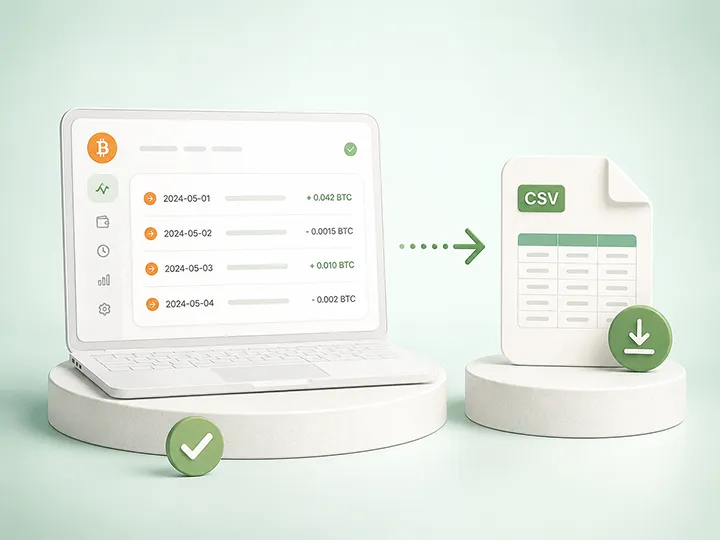
Assemble a complete export set before importing records into tax software.
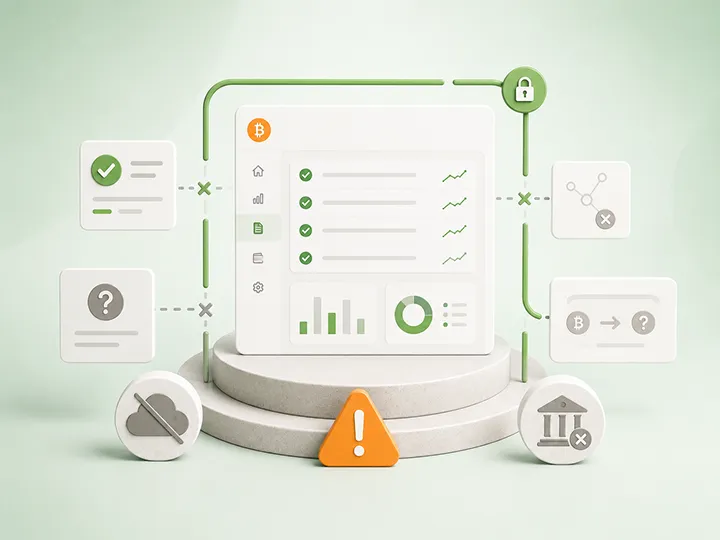
Separate recordkeeping work from judgment questions that may need qualified review.