Seed Phrase Storage

Seed Phrase Storage Threat Model: What Are You Actually Protecting Against?

Build a practical seed phrase storage threat model. Identify exposure, loss, physical damage, digital leakage, recovery failure, and family recovery risks.

Seed phrase storage threat model thumbnail showing Bitcoin seed phrase risk categories, recovery planning, and security boundaries.
Frederick Staunch avatar

Bitcoin Plaster guide

Reviewed as threat-model and decision-framework guidance.

Published June 2026. Educational Bitcoin self-custody safety guidance only. Not legal, tax, estate, probate, inheritance, executor, court, creditor, divorce, banking, insurance, law-enforcement, forensic, incident-response, asset-concealment, financial, personalized security, wallet-specific recovery, or technical setup advice.

Bitcoin self-custody and key control

Hardware wallet setup and testing

Recovery and backup planning

Bitcoin-only product evaluation

Bitcoin tax-record workflows and tax-software evaluation

Money literacy and sound money

Holder psychology and volatility

Quick answer

A threat model names the risk before choosing the method.

The goal is recoverable secrecy: the wrong person cannot use the backup, and the right person can recover under the conditions you actually expect.

Exposure means the wrong person sees, copies, photographs, uploads, or uses the seed phrase.

Loss means the right person cannot recover because the backup is missing, damaged, unreadable, forgotten, inaccessible, or too confusing.

The goal is recoverable secrecy: the wrong person cannot use the backup, and the right person can recover under the conditions you actually expect.

1

What am I protecting?

Name the seed phrase, passphrase, wallet backup, private key, PIN, exact recovery path, or exact storage-location record before choosing a storage method.

2

What could realistically go wrong?

Separate exposure, loss, physical damage, digital leakage, recovery failure, family recovery failure, and added complexity.

3

What will I do about it?

Reduce, remove, shift, or accept each risk intentionally instead of accepting it by accident.

Safety boundary

Threat modeling should not create a new copy of the secret.

Do not type, photograph, scan, upload, email, cloud-store, password-manager-store, AI-tool-enter, digitize, or paste your real seed phrase while building a threat model.

Do not digitize seed material

  • a website
  • a phone camera
  • a computer file
  • an online document
  • cloud storage
  • email
  • chat apps
  • AI tools
  • connected software

Do not route secrets through normal documents

  • a legal document
  • a will document
  • a trust document
  • a password manager
  • an online note
  • a shared note
  • a family instruction document
  • a professional document

Do not use unsafe help paths

  • random recovery tools
  • seed checkers
  • recovery services
  • unknown support agents
  • public forums
  • banks casually
  • institutions casually
  • storage services casually

Framework spine

Most seed phrase advice stops at one word: safe.

Keep it safe. Store it somewhere safe. Do not let anyone see it. That advice is directionally correct, but it is not a plan. Safe against what?

A seed phrase can fail because the wrong person sees it. It can also fail because the right person cannot find it. It can be destroyed by fire or water, exposed by a digital copy, made useless by a transcription error, hidden so well that future-you cannot recover, or made too complex for family recovery.

A seed phrase storage threat model is a simple way to name those risks before you choose storage locations, backup materials, passphrases, split backups, or emergency instructions.

This page is the map for the seed phrase storage cluster. It frames the risks and routes you to the right deeper page. It does not give hiding places, product recommendations, legal advice, storage-location rankings, wallet setup steps, or recovery walkthroughs.

Definition

What a seed phrase threat model is

A threat model is a structured way to think about risk. It replaces vague fear with specific decisions.

Protect

The recovery secret that can restore the wallet.

  • Start by naming what the storage plan must protect.

Threaten

People, physical damage, digital exposure, loss, confusion, and recovery failure.

  • Specific risks are easier to handle than vague fear.

Fail

Someone else can use it, or the right person cannot.

  • Every decision sits between exposure risk and loss risk.

Control

Better storage, verification, redundancy, instructions, or simplicity.

  • The right control depends on the risk you named first.

Planning boundary

Why somewhere safe is not a plan

Somewhere safe hides too many different problems inside one phrase.

A location can be private but physically fragile. A backup can be durable but too easy to find. A storage method can reduce theft risk but increase loss risk. A setup can feel advanced while becoming impossible for your family to recover.

Safe from a visitor is different from safe from fire. Safe from fire is different from safe from forgetting. Safe from forgetting is different from safe from digital leakage. Safe for you is different from recoverable by someone else if you are unavailable.

This is why threat modeling comes before storage decisions.

Do not start with “where should I hide it?” Start with “what can realistically go wrong?”

Core tension

The two failure poles: exposure and loss

Every seed phrase storage decision lives between two failure poles.

Failure pole 1

Exposure

  • Someone reads, copies, photographs, finds, receives, uploads, enters, or uses the seed phrase.
  • Exposure can lead to theft and uncertainty because you may not know whether a copy exists.

Failure pole 2

Loss

  • The backup is missing, unreadable, damaged, forgotten, unverified, incomplete, inaccessible, or too confusing.
  • Loss can be just as final as theft because the right person cannot recover.
Illustrated seed phrase storage thumbnail with notebook, hardware wallet, and security elements.

Recoverable secrecy

Secrecy and recoverability pull against each other.

More secrecy can reduce exposure risk, but it can increase loss risk. More copies, more people, and more instructions can reduce loss risk, but they can increase exposure risk.

That is the storage problem. The goal is not maximum secrecy. Maximum secrecy can become self-denial.

The goal is recoverable secrecy: protected from the wrong person and recoverable by the right person under the right conditions.

  • If you optimize only for secrecy, future-you may forget the location and family recovery may fail.
  • If you optimize only for recoverability, too many people or systems may touch the secret.
  • Instructions can help recovery, but they can also become a map to the secret if handled badly.

Risk response

The four responses to any risk

The problem is not accepting risk. Everyone accepts some risk. The problem is accepting risk by accident.

  1. Reduce

    Make the risk smaller. Example: improve storage so casual discovery is less likely.

  2. Remove

    Eliminate the risk category. Example: keep the seed phrase entirely offline.

  3. Shift

    Move the risk to a better-controlled place or process. Example: use a second controlled backup location to reduce single-location loss.

  4. Accept intentionally

    Keep the risk knowingly. Example: use a simpler setup because added complexity creates bigger recovery risk.

Threat categories

Name the category before choosing the control.

These modules summarize the main risk categories and route each one to deeper support pages.

Threat category 1

People who can see or copy it

  • Ask who has normal access to the space, who could find the backup accidentally, who could copy it, and whether instructions reveal too much.
  • If the phrase may already have been seen, copied, photographed, uploaded, or found, use the exposure scenario page.

Threat category 2

Physical destruction or degradation

  • Ask whether the backup can survive realistic physical risks and remain readable.
  • This page does not provide fire ratings, water ratings, material grades, product claims, safe ratings, or durability verdicts.

Threat category 3

Digital exposure

  • No photos, screenshots, scans, cloud notes, online documents, email, chat messages, password manager entries, AI prompts, seed checkers, recovery tools, forums, or support messages.
  • A seed phrase should stay offline.

Threat category 4

Future-you cannot recover

  • Ask whether the backup is complete, readable, verified safely, findable, and understandable after a long delay.
  • A backup that works only because today-you remembers every detail is fragile.

Threat category 5

Family or heirs cannot recover

  • The safe family-recovery model separates awareness, non-secret instructions, professional guidance, and secret material.
  • Do not put secret material into normal documents or family instruction documents.

Threat category 6

Passphrases, split backups, and added complexity

  • Complexity can shift risk. It can also create new failure paths.
  • This page does not teach passphrase setup, seed splitting, Shamir setup, multisig setup, thresholds, device steps, or wallet recovery flows.

Storage-location tradeoffs

Home storage and outside-home storage are not universal verdicts.

They are tradeoffs. This page will not tell you the best place to store a seed phrase.

Home storage

Easier access and control can share the same disaster risk.

  • A home backup may be easier to access and easier to control.
  • It may share the same disaster risk as the wallet or every other recovery item.

Outside-home storage

Single-location loss risk can trade for access and exposure risk.

  • An outside-home backup may reduce single-location loss risk.
  • It may introduce access delays, third-party exposure, institutional constraints, service dependency, documentation risk, and family recovery complexity.

Location questions

Ask these before deciding where an offline backup belongs.

These questions preserve the final-copy boundary: no hiding places, no rankings, no place-by-place instructions.

Location tradeoff questions

  • What event is this location meant to survive?
  • Who can access it?
  • Can you reach it when needed?
  • Can the right person reach it if you cannot?
  • Could the wrong person reach it too easily?
  • Does any record point too directly to the secret?
  • Is the seed phrase still fully offline?

Routing table

How to identify your main risk

You do not need to solve every category at once. Start by naming the weakest point in your current plan.

  1. Someone may find or copy the phrase

    Start with the exposure scenario page and avoid creating new exposure while checking risk.

    Read exposure guide
  2. You do not know where to keep it at home

    Use the home storage principles page. It gives criteria, not exact hiding places.

    Read home storage guide
  3. You are considering an off-site copy

    Use the outside-home storage tradeoff page before adding a second exposure point.

    Read off-site guide
  4. Fire, water, or physical damage

    Use the fire and water risk page to think about durability and legibility without product claims.

    Read physical risk guide
  5. You may have made unsafe digital copies

    Review common backup mistakes and the red lines around digital seed phrase exposure.

    Read backup mistakes
  6. You are unsure the backup is correct

    Use the verification safety model and the scannable checklist before relying on the backup.

    Read verification guide
  7. You want a practical backup review

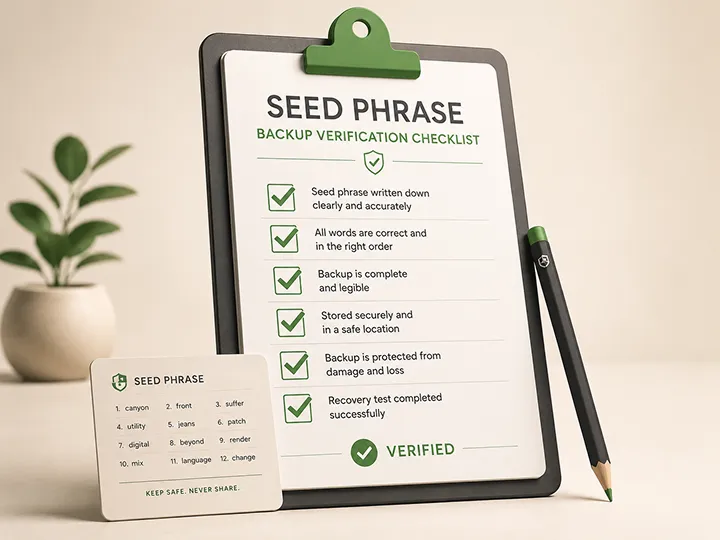
    Use the seed phrase backup verification checklist without typing or digitizing the phrase.

    Use checklist
  8. You want to rehearse without exposing secrets

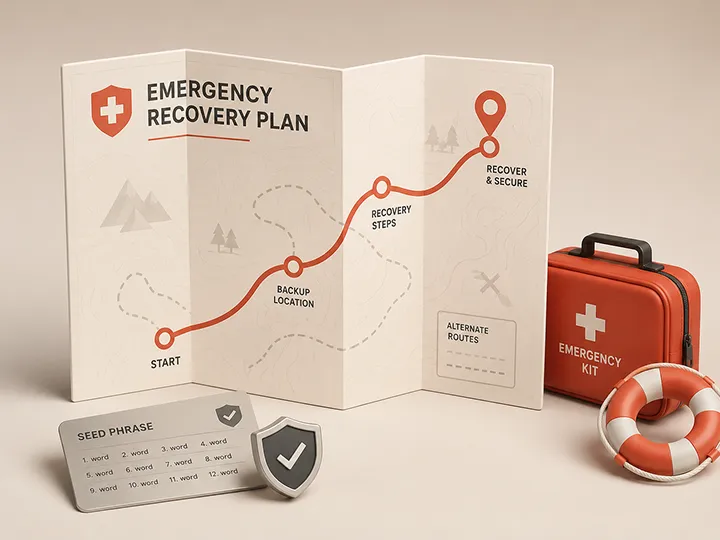
    Use a recovery drill to test readiness, logistics, and instructions without turning it into a live restore tutorial.

    Read recovery drill
  9. You worry about future loss

    Use the lost seed phrase scenario page to separate missing backup from missing wallet access.

    Read loss guide
  10. Family recovery is unclear

    Use family recovery instructions and Bitcoin inheritance basics to separate awareness, instructions, professional guidance, and secret material.

    Read family instructions
  11. You are considering a passphrase

    Understand how a passphrase can add protection while creating a second recovery-critical secret.

    Read passphrase guide
  12. You are considering splitting the backup

    Understand why splitting can reduce one exposure risk while creating new recovery fragility.

    Read split-backup guide

Simple worksheet

A simple threat-model worksheet without secrets

Use these questions without writing, typing, photographing, or exposing your seed phrase.

Step 1: name the asset

  • The seed phrase
  • Any passphrase
  • Any wallet backup
  • Any private key
  • Any wallet PIN
  • Any exact recovery path
  • Any exact storage-location record that could reveal the secret

Step 2: name the realistic risks

  • Someone sees or copies it
  • A household person finds it
  • It is stored too obviously
  • It is hidden too cleverly
  • It is destroyed by fire, water, or physical damage
  • It becomes unreadable
  • It is accidentally discarded
  • It is stored digitally
  • The backup has never been verified
  • Future-you forgets the location or setup
  • Family cannot recover
  • A passphrase is missing or misunderstood
  • A split backup is incomplete
  • An advanced setup is too complex to recover

Step 3: choose a response

  • Reduce
  • Remove
  • Shift
  • Accept intentionally
  • Do not leave the answer blank. A blank answer usually means you are accepting the risk by accident.

Worksheet step 4

Pick the next page

Use the routing table above. Go to the page that owns the weakest point in your current setup.

Do not jump to products, rankings, or clever methods before you know what problem you are solving.

Common mistakes

Avoid making the plan more dramatic instead of more deliberate.

The fix is not to make the plan more dramatic. The fix is to make it more deliberate.

Mistakes that create false confidence

  • Treating safe as one thing
  • Optimizing only for theft and ignoring loss
  • Optimizing only for loss and creating exposure
  • Choosing a storage location before naming the threat
  • Treating metal backup material as the whole strategy

Mistakes that create exposure

  • Storing the seed phrase digitally just in case
  • Giving family casual access to secret material
  • Putting exact recovery paths into normal documents
  • Creating more copies before knowing the risk

Mistakes that create loss

  • Hiding the backup so well that future-you cannot recover
  • Adding a passphrase without a recovery plan
  • Splitting a seed phrase without understanding the recovery tradeoff
  • Building a plan that only works when you are calm and present

Where this fits

A threat model comes before storage decisions.

It tells you what the storage plan must protect against. Once you know that, the next steps become clearer.

  1. Verification before reliance

    A backup should be checked safely before it becomes the foundation of a long-term plan.

  2. Physical durability before long-term storage

    Legibility and survivability matter before a storage medium can support recovery.

  3. Location tradeoffs before off-site copies

    Home and outside-home storage are tradeoffs, not universal verdicts.

  4. Emergency planning before family dependence

    A plan should work when you are unavailable, stressed, injured, incapacitated, or dead.

  5. Selection criteria before product evaluation

    Do not jump from a vague fear to a product decision before naming the risk.

Calm version

Do not ask what is the safest place.

Ask what you are actually protecting against, and whether the right person can still recover.

That is recoverable secrecy.

FAQ

Seed phrase threat model FAQ

Concise answers for the main threat-model concepts without product, legal, or setup advice.

A seed phrase storage threat model is a practical framework for deciding what your backup needs to survive. It helps you name the risks that apply to you, such as exposure, loss, physical damage, digital leakage, recovery failure, family recovery failure, and added complexity.