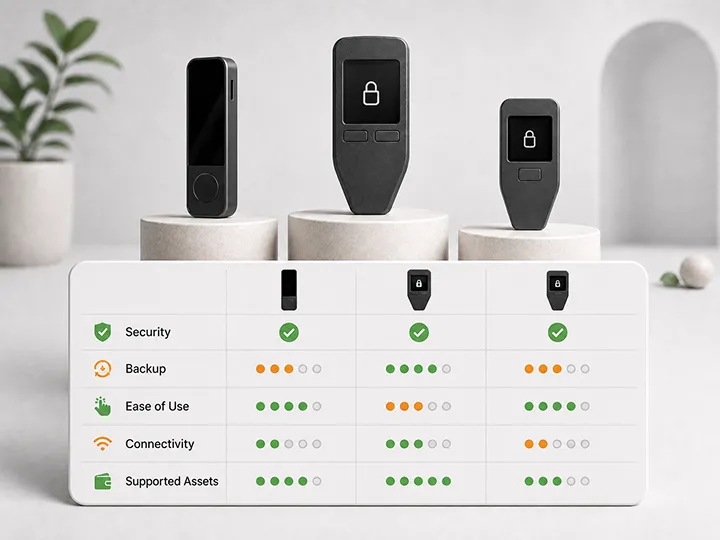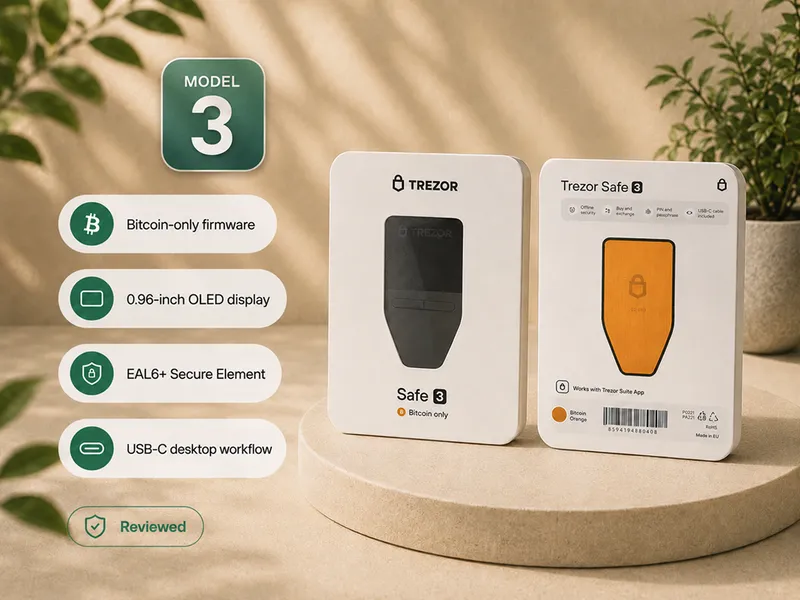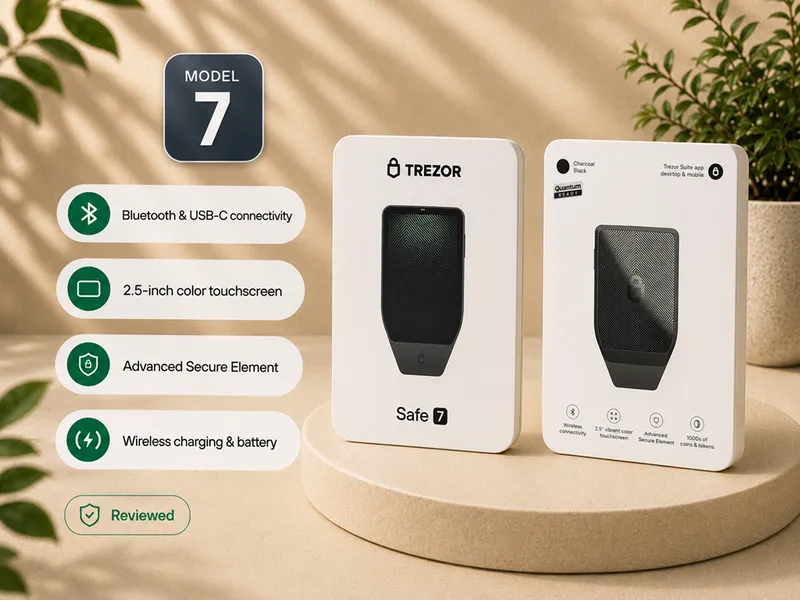
How we evaluate hardware wallets

Hardware wallet reviews are only useful if the reader can see how the judgment was made.
This page explains the Bitcoin Plaster standard for evaluating hardware wallets. It is not a product ranking. It is the method behind later product recommendations, comparison pages, and buyer routes.
A hardware wallet can look strong on a spec sheet and still be a poor fit for a real Bitcoin holder. The real question is not only whether the device has a secure chip, open-source firmware, air-gapped signing, or a polished app. The better question is whether the full custody workflow can be set up, backed up, verified, maintained, and recovered by the person who will rely on it.
Bitcoin Plaster verdict
The winning evaluation method is usable security.
A hardware wallet earns trust when it reduces the right risks for a specific Bitcoin holder and remains operable in real life. That means the device must protect keys, support clear transaction verification, make backup and recovery understandable, keep software and firmware paths maintainable, and avoid hiding trust assumptions behind marketing labels.
Feature count does not win by itself. Price does not win by itself. An affiliate program does not win by itself. A wallet wins a recommendation only when the evidence, reader fit, limitations, and route are clear enough to defend publicly.
| Evaluation posture | Verdict | Why |
|---|---|---|
| Feature-count scoring | Weak | It rewards specs that may not reduce the reader's actual risk |
| Cheapest-device scoring | Weak | A low price is not useful if backup, verification, or maintenance is confusing |
| Affiliate-first scoring | Rejected | Link availability is not editorial approval |
| Purely theoretical security scoring | Incomplete | A model that is hard to operate can fail through user error |
| Usable security scoring | Winner | It asks whether the reader can set up, verify, maintain, and recover the wallet correctly |
This is why Bitcoin Plaster separates methodology, support education, product evaluation, and affiliate routing.
What this page is responsible for
This page is the hardware-wallet methodology page.
It explains how Bitcoin Plaster weighs tradeoffs before a product page asks for trust. It does not replace the individual support pages about hardware wallet threat models, secure element vs open source, air-gapped hardware wallets, supply-chain risk, firmware updates, or backup basics.
It also does not act like a money page. If you want the current buyer route, use best Bitcoin hardware wallets. If you are still choosing your first device by fit, use how to choose your first Bitcoin hardware wallet.
The job here is narrower: show the standard that makes later judgments harder to fake.
The evaluation starts with the reader state
A hardware wallet is not evaluated in a vacuum.
A new holder moving Bitcoin off an exchange has different needs from a technical user building a manual air-gapped setup. A long-term saver has different needs from a mobile-first user. A person who cannot explain recovery should not be pushed into a complex setup simply because it sounds more sovereign.
Bitcoin Plaster starts by asking what kind of reader the device is meant to serve.
| Reader state | What matters most | What can mislead |
|---|---|---|
| First hardware wallet buyer | Clear setup, readable screen, standard backup, calm first withdrawal | Advanced features that add anxiety before the basics are learned |
| Long-term Bitcoin saver | Reliable recovery, low activity, official maintenance, durable workflow | A daily-use app experience that invites unnecessary activity |
| Mobile-first user | Phone compatibility, connection method, app clarity, verification model | A desktop-first device that feels awkward every time it is used |
| Desktop user | Stable desktop software, firmware path, address verification, third-party wallet compatibility | Mobile convenience features that do not matter to the actual workflow |
| Advanced self-custody user | Air-gapped options, multisig readiness, PSBT workflow, documentation discipline | Beginner simplicity that removes too much control |
| Recovery-anxious user | Backup clarity, standard recovery, support documentation, passphrase restraint | Complex recovery features that are not understood before funding |
The same device can be excellent for one reader and wrong for another. That does not weaken the evaluation. It makes the evaluation honest.
The six evaluation buckets
Bitcoin Plaster evaluates hardware wallets through six buckets. A product does not need to be perfect in every bucket, but weaknesses must be visible.
| Bucket | What we ask | Why it matters |
|---|---|---|
| Custody fit | Does the device help a Bitcoin holder control keys without unnecessary non-Bitcoin distraction? | The product should serve Bitcoin custody, not generic gadget collecting |
| Verification clarity | Can the user read and confirm the address, amount, fee, and signing intent on the trusted device or through a clear verification model? | A hardware wallet is weaker if the user approves blindly |
| Recovery design | Can the user back up, store, and later recover without relying on memory, luck, or unclear support promises? | Recovery failure is one of the highest-consequence self-custody risks |
| Security architecture | What does the device protect against, and what trust assumptions remain? | Secure elements, open source, air-gapped signing, and Bitcoin-only firmware each answer different questions |
| Software path | How does the companion app, third-party wallet support, firmware process, and broadcast path work? | The app shapes daily experience even when keys stay on the device |
| Lifecycle reliability | Can the setup remain understandable after months or years of low use? | A hardware wallet is a long-term operating object, not a one-day purchase |
These buckets are not a decorative checklist. They are the frame used to avoid product pages that sound confident without showing the basis for that confidence.
What usable security means
Usable security means the safer path is also a path the reader can follow.
That does not mean the simplest product always wins. It means complexity must earn its place. Air-gapped signing, passphrases, multisig, manual firmware files, third-party wallet software, and open-source verification can all be valuable. They can also become liabilities when a user chooses them before understanding recovery and maintenance.
The practical test is simple:
| Question | Pass signal | Concern signal |
|---|---|---|
| Can the user initialize the device calmly? | Setup flow is clear and the user knows when a fresh seed is generated | Setup requires guessing, importing an old hot-wallet seed, or trusting unclear prompts |
| Can the user verify a receive address? | Device-side verification is understandable | The app screen becomes the user's only source of confidence |
| Can the user approve a send transaction deliberately? | Amount, fee, and destination can be checked before signing | The workflow encourages tapping through prompts |
| Can the user protect recovery material? | Backup instructions are clear and compatible with long-term storage | Backup method is vague, proprietary, or easy to misunderstand |
| Can the user maintain the device? | Official update path and documentation are findable | Firmware prompts create panic or push the user toward fake links |
| Can the user recover later? | Recovery is explainable before funding | Recovery depends on unstated company behavior, memory, or a forgotten passphrase |
A product with stronger theoretical security can score lower if its workflow makes ordinary mistakes more likely.
How we handle hardware architecture
Hardware architecture matters. It just does not settle the whole evaluation by itself.
A secure element can improve resistance against some physical extraction attacks. Open-source firmware can improve inspectability and public review potential. Air-gapped signing can reduce direct communication paths. Bitcoin-only firmware can reduce unrelated software scope. A guided companion app can reduce beginner mistakes.
Each signal is useful only when paired with its boundary.
| Architecture signal | What it can support | What it does not prove |
|---|---|---|
| Secure element | Stronger resistance to some physical-device attacks | Full transparency, safe backup, or honest app behavior |
| Open source | Public inspection and review potential | Reviewed code, reproducible builds, or physical attack resistance |
| Air-gapped workflow | More manual transaction movement and fewer direct communication paths | Correct transaction intent or safe recovery handling |
| Bitcoin-only firmware | Narrower software scope for Bitcoin custody | Good engineering, active maintenance, or easy setup |
| Screen and buttons | Independent verification and deliberate approval | Safety if the user does not read the screen |
| Companion app | Guided setup, easier updates, and lower friction | Final signing truth or freedom from vendor trust |
This is why product evaluations should not use one label as the verdict.
How we handle companion apps and software paths
The hardware wallet is the signing device. The app is the interface.
The app may show balances, generate receive addresses, prepare transactions, coordinate firmware updates, broadcast signed transactions, and guide the user through setup. That makes the app part of the experience and part of the trust model.
Bitcoin Plaster looks at three software questions.
| Software question | Why it matters |
|---|---|
| Is the official setup path understandable? | First setup is where many serious mistakes begin |
| Can the device work with third-party Bitcoin wallet software where appropriate? | App independence can matter for advanced users and long-term resilience |
| Is the update path calm and official-source disciplined? | Firmware maintenance should not push the user into phishing or panic behavior |
A polished app is not automatically bad. A manual setup is not automatically better. The real test is whether the software path makes the custody boundary clearer or more confusing.
How we handle recovery design
Recovery design receives high weight because it is where self-custody often fails.
A hardware wallet can be well-built and still create a weak outcome if the reader cannot recover from loss, theft, damage, firmware issues, forgotten passphrases, or device replacement.
Bitcoin Plaster evaluates recovery through practical questions:
| Recovery question | Good sign | Risk sign |
|---|---|---|
| How is the seed phrase generated? | Freshly generated during the user's setup | Prewritten, preloaded, imported from a previously hot wallet, or unclear |
| How is backup verified? | User confirms the backup before meaningful funding | Backup is skipped, partial, photographed, or treated like a casual password |
| Is passphrase framed correctly? | Optional advanced layer with serious recovery consequences | Presented as a simple upgrade without explaining lockout risk |
| Is recovery portable? | Standards and compatible recovery paths are understandable | User depends entirely on one app or company without knowing the exit path |
| Is recovery realistic under stress? | User can explain what to do if the device is lost | User would improvise after the problem happens |
A device does not get credit for making recovery look easy if the recovery model quietly moves trust to a service, app, or forgotten credential the reader does not understand.
How we handle evidence
A product page should not make the reader guess what the judgment is based on.
Bitcoin Plaster separates evidence types.
| Evidence type | What it can support | What it cannot support by itself |
|---|---|---|
| Official documentation | Features, supported workflows, stated update process, published support path | Real-world ease of use or independent verification |
| Direct use | Setup friction, screen clarity, app experience, transaction workflow | Long-term reliability unless used over time |
| Public security disclosures | Known issues, mitigations, update history | Complete absence of unknown issues |
| Independent technical review | Stronger claims about architecture or vulnerabilities | Universal safety for every reader state |
| Community experience | Repeated friction patterns, support pain, ownership annoyances | A controlled technical audit |
| Affiliate route availability | Whether a monetized route can be implemented | Editorial approval or product quality |
If evidence is limited, the page should say less. A strong methodology is comfortable with restraint.
How winner-first works in hardware wallet content
Winner-first does not mean payout-first.
For commercial-intent pages, Bitcoin Plaster should name the winner when the evidence supports a winner. A best-of page, comparison page, or product-selection page should not hide behind fake neutrality when readers came for a decision.
But the winner must be earned.
A winner-first hardware-wallet page should:
- name the winner for a specific reader state;
- explain why it wins;
- state who should choose it;
- state who should not choose it;
- show the evidence and tradeoffs;
- disclose the affiliate relationship when one exists;
- route qualified readers only through approved tracking paths.
This methodology page does not name a product winner because its job is to define the standard. The buyer layer lives at best Bitcoin hardware wallets. The first-wallet decision layer lives at how to choose your first Bitcoin hardware wallet.
What affiliate availability means here
Affiliate availability is commercial infrastructure. It is not recommendation authority.
If a product has a live affiliate route but fails the evaluation standard, it should not be recommended. If a product has no affiliate route but is relevant to the decision, it should not disappear from the evaluation just because it is harder to monetize.
Bitcoin Plaster handles affiliate incentives through boundaries:
| Boundary | Standard |
|---|---|
| Editorial judgment comes first | The product must be useful in a defined reader context before revenue is considered |
| Weaknesses stay visible | A product's limits should not be softened because a link exists |
| No hidden winners | If a page recommends a product, the recommendation should be stated openly |
| No unsupported claims | Product claims should match the evidence available |
| No trust/support overreach | Pure methodology and safety pages should route readers, not force affiliate clicks |
The commercial layer is allowed to exist. It is not allowed to decide the verdict.
The scoring model
Bitcoin Plaster uses a trade-off score, not a universal leaderboard.
The question is not: which wallet has the highest total number?
The question is: which wallet is strongest for the reader state and decision context?
| Score area | Weight in judgment | What a strong result looks like |
|---|---|---|
| Recovery safety | Very high | The user can back up and recover without mystery, panic, or hidden dependency |
| Verification clarity | Very high | The user can understand what is being approved before signing |
| Reader fit | Very high | The device matches the user's experience level and actual workflow |
| Security architecture | High | The design reduces meaningful threats and states remaining trust assumptions |
| Software path | High | Setup, wallet app, firmware, and third-party compatibility are understandable |
| Supply-chain discipline | High | Purchase and first setup do not require blind trust in unsafe sources |
| Maintenance burden | Medium-high | The device can be kept usable over time without constant tinkering |
| Price and availability | Medium | Cost matters after the wallet passes custody, backup, verification, and fit checks |
| Affiliate availability | Not a scoring factor | A link can help route qualified readers only after the editorial decision is made |
This scoring model protects readers from two opposite errors: choosing the easiest product without understanding trust assumptions, and choosing the most advanced product without being able to operate it.
Review triggers
Hardware wallet evaluations are living responsibility objects. They should change when material evidence changes.
Reassessment is appropriate when any of these changes:
| Trigger | Why it matters |
|---|---|
| Security disclosure or vulnerability | The risk model may change |
| Firmware or companion-app change | Setup, signing, updates, or recovery may change |
| Product revision or discontinuation | The device being evaluated may no longer be the same product |
| Recovery model change | Backup, passphrase, service recovery, or portability assumptions may change |
| Supply-chain or authenticity issue | First-setup safety may change before funding |
| Affiliate route or disclosure state | Monetized routing may need to be paused or updated |
| Evidence improves or weakens | The confidence level of the page should change with the evidence |
Changing an evaluation is not a failure. Failing to update a stale evaluation is the failure.
Where this methodology routes you
Use this page to understand the standard. Then move to the page that matches your current decision.
| Reader need | Next page |
|---|---|
| I want the current buyer shortlist | Best Bitcoin hardware wallets |
| I am choosing my first device | How to choose your first Bitcoin hardware wallet |
| I want to understand security labels | Hardware wallet security models |
| I want to compare secure element and open source | Secure element vs open source |
| I want to understand air-gapped tradeoffs | Air-gapped hardware wallets |
| I want to avoid unsafe purchase paths | Hardware wallet supply-chain risk |
| I want a criteria checklist | Hardware wallet comparison criteria |
| I need backup and recovery clarity | Hardware wallet recovery risks |
Do not start with the loudest ranking. Start with the evaluation method, then choose the decision page that matches your state.
Final takeaway
Bitcoin Plaster evaluates hardware wallets as complete self-custody workflows.
The device matters. The firmware matters. The app matters. The recovery model matters. The purchase path matters. The verification habit matters. The user's ability to operate the setup matters.
A product recommendation should show those tradeoffs before asking for trust.
That is the standard.
FAQ
Does this page recommend a specific hardware wallet?
No. This page defines the evaluation method. Product recommendations and buyer routes belong on commercial-intent pages where the evidence and routing gates can be stated clearly.
What is the most important hardware wallet evaluation criterion?
Recovery safety and verification clarity carry the highest weight because they affect whether the user can keep access and avoid approving the wrong action. Reader fit is equally important because a theoretically strong workflow can fail if the user cannot operate it correctly.
Does Bitcoin Plaster use affiliate links in hardware wallet content?
Yes, where a product has an approved route and the reader intent supports it. But affiliate availability is not editorial approval. A link follows the recommendation. It does not create the recommendation.
Does winner-first mean every page should push a product?
No. Winner-first applies to buyer, review, best-of, and comparison intent. Trust and support pages should explain the decision context and route readers to the right buyer page instead of forcing a product CTA too early.
Can a wallet score well without being Bitcoin-only?
Possibly, depending on context. Bitcoin-only scope is a meaningful plus for Bitcoin holders because it can reduce irrelevant software and product noise. But the label does not prove engineering quality, recovery clarity, maintenance, or usability.
Is open source required for a hardware wallet to pass the standard?
Not automatically. Open source improves inspectability, but the full evaluation also considers hardware resistance, firmware process, device-screen verification, recovery model, support, and usability. Open source is a strong signal, not the only signal.
Is a secure element required for a hardware wallet to pass the standard?
Not automatically. A secure element can matter for physical-device risk, but it does not answer every question about firmware, app trust, backup, recovery, supply chain, or user behavior.
Why is usability treated as security?
Because many self-custody failures come from user behavior: skipped backup checks, careless approvals, misunderstood passphrases, fake update paths, and recovery panic. A safer design on paper can be worse in practice if the user cannot operate it correctly.
What evidence should a product page show?
It should show the basis for its judgment: official documentation, direct use where applicable, public technical information, community friction patterns, known limitations, and any reason the recommendation is conditional.
When would Bitcoin Plaster update a hardware wallet evaluation?
When material evidence changes: firmware, product revisions, security disclosures, recovery model changes, supply-chain concerns, route changes, or improved evidence that changes confidence in the original judgment.