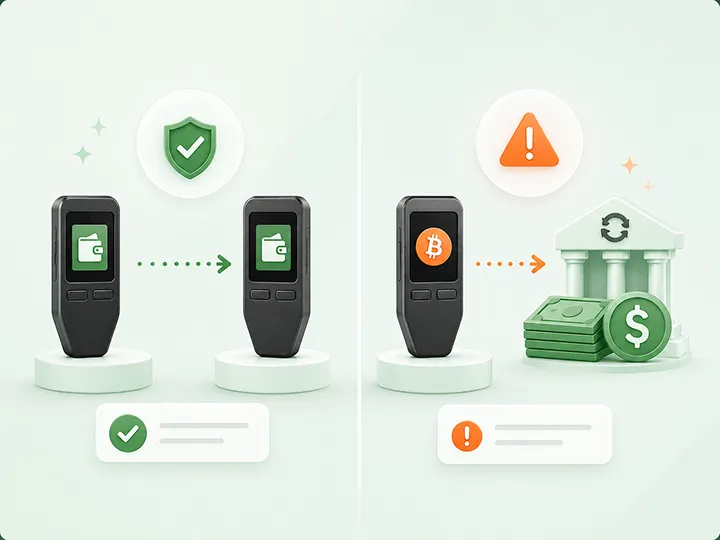
Wallet transfer vs taxable event
Preserve the facts a wallet movement needs without turning records into treatment conclusions.

Enter your email to receive the free PDF checklist.
Read our Privacy Policy. For subscriber questions or corrections, use the Contact & Corrections page.
Bitcoin Tax Software
A Bitcoin address can show where coins moved; a transaction ID can prove that movement happened. Neither explains why the movement happened, who controlled each side, or how it should be reviewed later. That is what wallet labels are for.
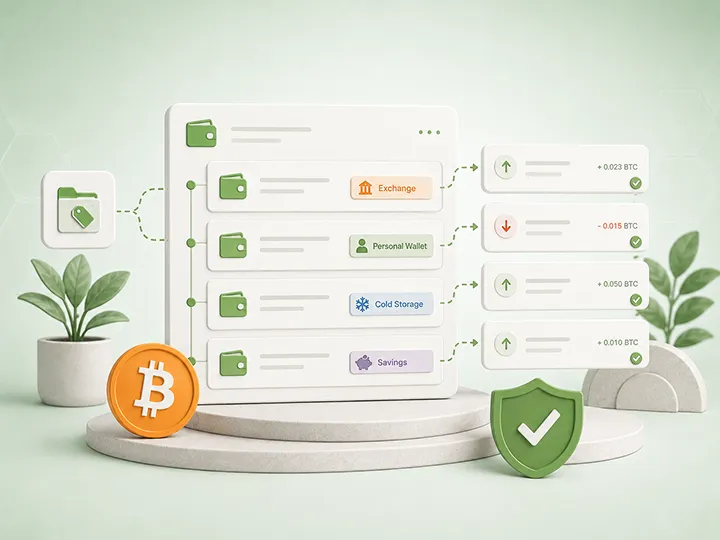

A Bitcoin address can show where coins moved; a transaction ID can prove that movement happened. Neither explains why the movement happened, who controlled each side, or how it should be reviewed later. That is what wallet labels are for.
A wallet label is a factual note attached to a wallet, account, address group, or transaction. It preserves ownership context, source and destination context, purpose, and uncertainty - and it makes exchange records, wallet history, transaction IDs, and personal notes easier to review together. The core distinction is simple: wallet labels preserve factual context; they do not decide, prove, or change tax treatment, and they do not replace qualified review. This page is educational only, not tax, legal, or financial advice; rules differ by jurisdiction and change over time. For the scope of the lane, read the Bitcoin tax disclaimer; for the map, start at the hub.
A label tells a future reader what a wallet or movement meant in your records: which wallet was yours, what it was used for, which exchange a withdrawal came from, where a receipt belongs in the trail, why coins moved, and whether anything is uncertain.
A transaction ID is a useful anchor - it can show that an on-chain movement happened and tie down time, amount, addresses, and fee - but it does not prove purpose or ownership, show whether a destination was yours, or decide treatment. An address has the same limit: it identifies a destination technically but does not explain what it meant in your records. This is the gap labels close. Public on-chain data can tell you that something happened; only your label tells you what it was. A transaction ID plus a label is a readable record; a transaction ID alone is a puzzle you will have to solve again later, from memory, when the memory is gone.
Keep labels plain and factual. Six that carry real context:
None of these is a treatment conclusion. "Transfer between my wallets" preserves the factual claim that both sides were yours; it does not decide whether any rule applies. And an honest "uncertain, needs review" is almost always better than a confident label that hides doubt - a marked uncertainty tells a reviewer exactly where to look, while a wrong-but-confident label quietly misleads.
At wallet level: a name, ownership context, purpose, approximate active period if known, the related exchange or account if relevant, any old-wallet/new-wallet relationship, and an uncertainty note if ownership or purpose is unclear.
At transaction level: date and time, transaction ID if on-chain, amount, fee, sending source, receiving destination, a label for each side, a purpose note, the related exchange or wallet record, and an uncertainty note if the movement is unclear.
A useful label is factual, not dramatic - it describes what happened, not what you want the treatment to be.
Labels do their most important work by preserving ownership context: a movement between places you control and a movement to someone else are different factual situations, and if your records do not show which is which, a later reviewer needs more information. For each wallet, answer factually: was it mine, what was it for, old or new, and can I connect its movements to an exchange withdrawal, wallet receipt, or transaction ID? If you are unsure whether a wallet was yours, label the uncertainty rather than resolving it with a guess.
Labels also connect source and destination across systems (the exchange shows coins leaving, the wallet shows them arriving, the transaction ID confirms movement - the label tells the story that ties them together), carry a short purpose note written close to the event (the longer you wait, the more the reason becomes a guess), and keep fees from disappearing (preserve the amount, date, transaction ID if relevant, and the event the fee belongs to). None of these decides treatment. (For reconciling exchange and wallet sources, see exchange CSV vs wallet history; for the movement boundary, see wallet transfer vs taxable event.)
A holder may retire an old wallet, replace a device, reorganize storage, or consolidate - and later struggle to identify the old wallet if it was never labeled. It is the single most common reconstruction headache in a Bitcoin history. Preserve an old-wallet label and a new-wallet label, the approximate active period, the reason for the move, the transaction IDs and fees involved, source and destination context, and uncertainty notes. "Old wallet" is better than nothing, but a label noting what it was used for and how it connects to the new trail is far more useful - and it is trivial to write at the moment you retire the wallet, and painful to reconstruct years later.
Wallet labeling should never require wallet secrets, and this boundary is not optional. Do not put private keys, seed words, backup phrases, passphrases, PINs, signing secrets, or recovery details into tax records, spreadsheets, cloud notes, software imports, emails, or files shared for review - and do not share them with tax software, professionals, or anyone else as labeling evidence.
A tax record needs only non-secret, factual context: the transaction ID, the public address involved, a wallet label, source and destination records, a fee record, a purpose note, and an uncertainty note. If a record needs to show that a wallet was yours, use that non-secret context - never signing authority or recovery material. A secret does not make a tax record stronger; it only makes the wallet less safe. Recordkeeping and wallet security are separate jobs, and a tax file is exactly the kind of document that gets copied, emailed, uploaded, and shared - which is precisely why it must never contain anything that could move your coins.
Software may use supplied labels and records to organize and calculate, and good labels help connect withdrawals to receipts, receipts to later movements, old wallets to new, fees to their events, and transaction IDs to purpose notes. They especially help with silent CSV problems, where a row shows a withdrawal or receipt but not whether the wallet was yours or which movement it connects to. (For loud and silent import problems, see CSV import errors.)
But software should not be assumed to validate labels, confirm ownership, read intent, reconcile wallets, or choose treatment - labels improve context; they do not remove the need to review output. And labels have hard limits: they cannot decide, prove, or change treatment, recreate a missing source record, transaction ID, or acquisition record, or turn an uncertain record into a certain one. A label preserves context; it cannot create facts that were never recorded - which is exactly why an unclear record should be marked uncertain rather than covered up. (For what software can and cannot do, see what tax software can and cannot do; for how it goes wrong, see Bitcoin tax software limitations.)
Some labeling problems are routine - name an old wallet, connect a withdrawal to a receipt, add a purpose note, preserve a transaction ID. Others may need qualified review: ownership context is unclear, an old wallet cannot be identified, acquisition records are missing, sources do not line up, output cannot be explained, business, payment, gift, or donation context is involved, prior-year gaps exist, or treatment questions exceed recordkeeping. This page gives no tax advice or treatment conclusions; it helps preserve facts. (See when to use a tax professional.)
When a meaningful movement happens, record - while the context is fresh - what moved, when, from where, to where, whether the destination was yours, someone else's, or uncertain, the transaction ID if on-chain, the fee, the wallet labels, a purpose note, the related exchange or wallet record, and an uncertainty note if needed. A label written at the time is far more useful than a reconstruction months later. (For the Bitcoin-only framework, see Bitcoin-only tax recordkeeping; for the full field guide, see Bitcoin tax records.)
Wallet labels preserve context - which wallets were yours, why Bitcoin moved, which records connect, what fee belongs to a movement, which transaction ID supports it, and which facts remain uncertain. They do not decide, prove, or change treatment, and they do not replace missing records or qualified review. Use factual labels, keep wallet secrets out of tax records, mark uncertainty honestly, and treat software output as something to review against source records - not something that magically knows context you never preserved.
For the full tax-scope boundary, see the Bitcoin tax disclaimer.
What is a wallet label for Bitcoin tax records? A factual note explaining what a wallet, account, address, or movement meant in your records - ownership context, purpose, source and destination, transaction IDs, fees, and uncertainty. It does not decide treatment.
Does labeling a wallet transfer change how it is taxed? No. A label does not change, prove, or decide treatment. It preserves the facts and context software or a professional may need to review the movement.
Why do wallet labels matter for self-custody? Self-custody splits records across exchange exports, wallet history, on-chain data, fees, labels, and notes. Labels connect those sources so a later review can see which wallet was yours, why the movement happened, and which records belong together.
What should a useful wallet label include? Wallet name, ownership context, purpose, approximate active period if known, source and destination context, transaction IDs, fee context, related records, purpose notes, and uncertainty notes - factual, not a tax conclusion.
Should I put seed words or private keys in tax records? No. Never include seed words, private keys, backup phrases, passphrases, PINs, signing secrets, or recovery details, and never share them as labeling evidence. Use public transaction IDs, public addresses, labels, source and destination records, and non-secret notes instead.
Can tax software understand wallet labels automatically? Behavior varies. Software may use supplied labels to organize and calculate, but it should not be assumed to validate labels, confirm ownership, read intent, reconcile wallets, or choose treatment. Labels improve context; they do not remove the need to review output.
When should unclear wallet labels go to qualified review? When ownership is unclear, old wallets cannot be identified, acquisition records are missing, output cannot be explained, business or payment context is involved, prior-year gaps exist, or treatment questions exceed recordkeeping.
Preserve the facts a wallet movement needs without turning records into treatment conclusions.
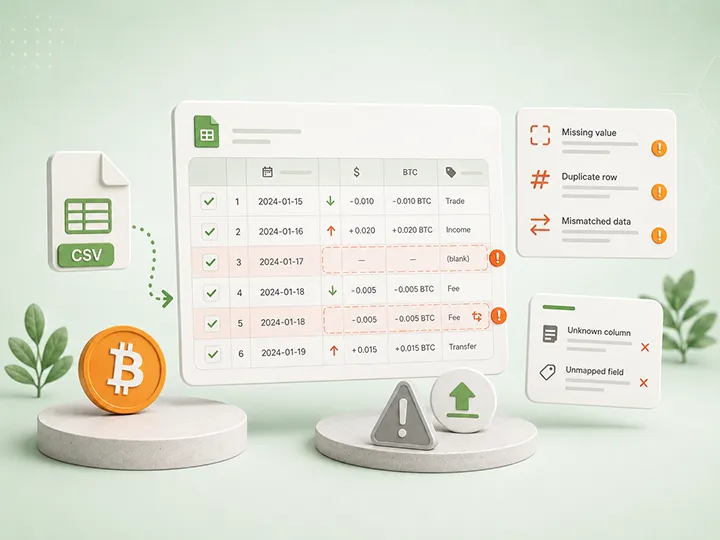
Read CSV import issues as data-quality signals before trusting clean-looking output.
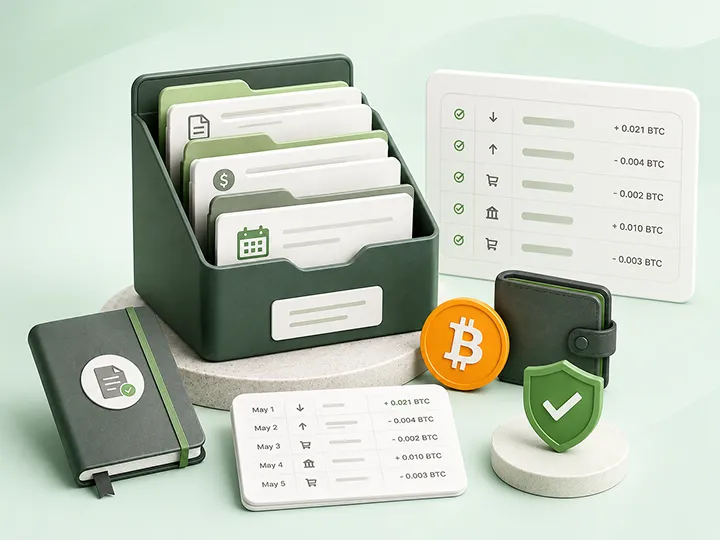
Use the field guide and checklist for the facts every Bitcoin record should preserve.
Separate recordkeeping work from judgment questions that may need qualified review.