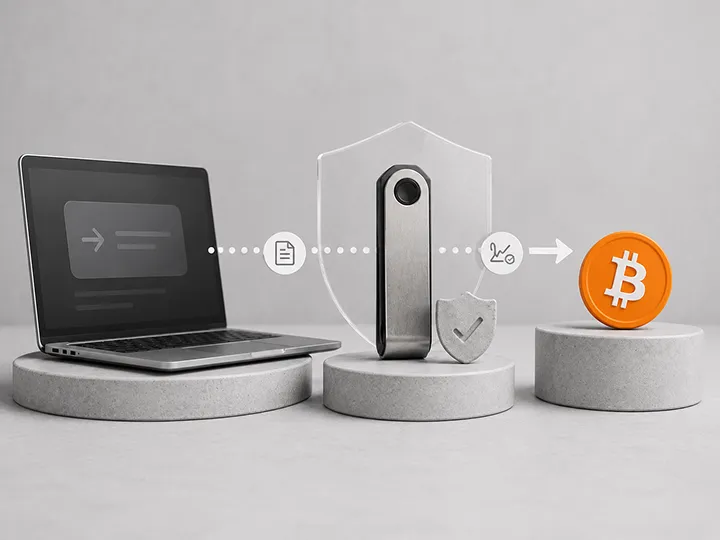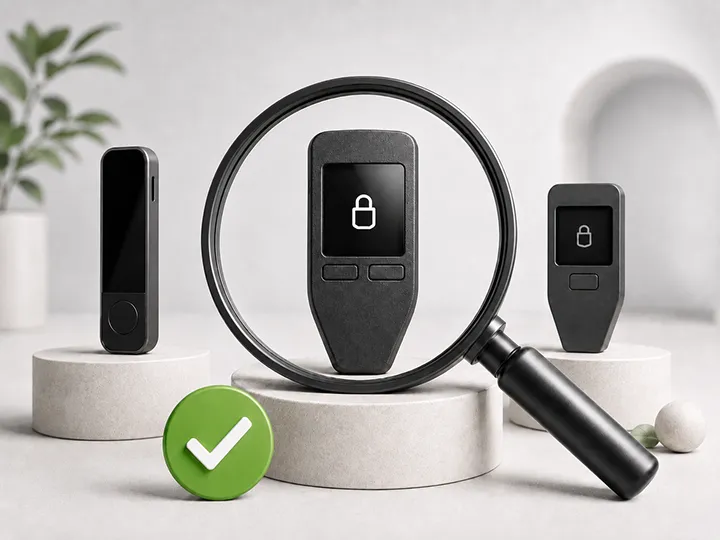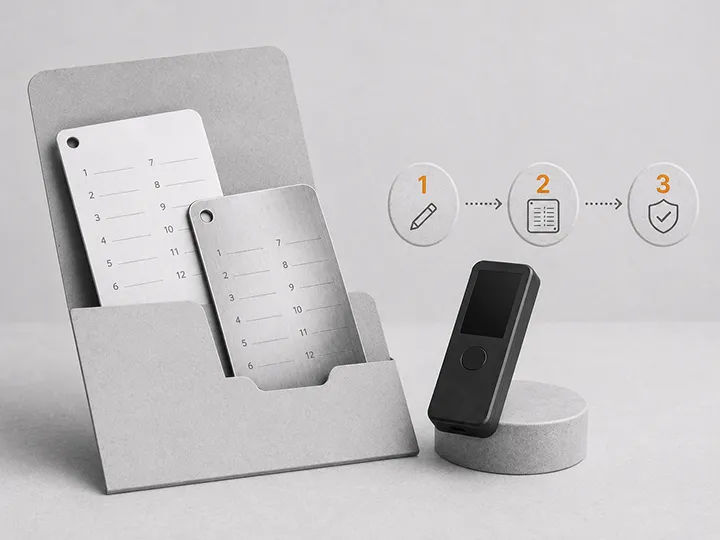
Hardware wallet before or after buying Bitcoin

The timing question sounds simple: should you buy Bitcoin first, or buy a hardware wallet first?
The safer answer is not a universal shopping order. It is a custody sequence. A small learning amount can be used to understand buying, withdrawals, addresses, and wallet behavior. Meaningful savings should not stay in a custodial account by default, and they should not be rushed into a hardware wallet setup you do not understand.
This page helps you decide the next step without panic, product pressure, or pretending a hardware wallet solves responsibility by itself.
Bitcoin Plaster verdict
The timing winner is staged readiness.
For a tiny learning amount, buying Bitcoin first and leaving it in a withdrawal-friendly service while you learn can be reasonable. For meaningful Bitcoin savings, prepare the hardware wallet path before the amount grows too large to treat casually.
| Your situation | Best next move | Why |
|---|---|---|
| No Bitcoin yet, still learning | Learn wallets and buying paths first | There is no urgent key risk until there are coins to protect |
| Small learning amount | Use it to practice withdrawal logic, then prepare self-custody | The amount can teach the process before the stakes are high |
| Meaningful exchange balance | Prepare a hardware wallet setup calmly, then withdraw in stages | Exchange convenience becomes a larger custody tradeoff as the balance matters more |
| Hardware wallet already bought | Set it up, verify backup, test receive, then scale slowly | The device is useful only after the custody workflow is proven |
| Setup feels confusing | Pause before moving serious funds | Confusion during setup often becomes recovery risk later |
The winner is not buy wallet first or buy Bitcoin first in isolation. The winner is: small amount to learn, hardware wallet for meaningful long-term storage, and no serious transfer before backup and verification are ready.
What this page is responsible for
This page is responsible for sequencing. It does not tell you when to buy Bitcoin, how much Bitcoin to buy, or which product to purchase.
Use it when you are asking:
- Can I buy a small amount before I have a hardware wallet?
- At what point does an exchange balance become a custody issue?
- Should the first transfer to a new hardware wallet be small?
- What needs to be ready before meaningful Bitcoin moves?
- Which adjacent guide should I read next?
For the product decision, use best Bitcoin hardware wallets and how to choose your first Bitcoin hardware wallet. For the withdrawal flow, use withdraw Bitcoin to a hardware wallet.
The first question is not purchase order. It is amount at risk.
A hardware wallet is most useful when the Bitcoin amount is meaningful enough that losing access would matter. The exact threshold is personal. The principle is not.
If the amount is small enough that the main value is learning, the priority is understanding the workflow. If the amount is large enough that loss would feel serious, the priority shifts toward prepared self-custody.
| Amount type | Reasonable custody posture | Common mistake |
|---|---|---|
| Tiny learning amount | Use it to learn buying, addresses, withdrawal fees, and wallet confirmation behavior | Buying a complex setup before understanding what problem it solves |
| Small but real amount | Start preparing hardware wallet custody if long-term holding is the plan | Leaving it in a custodial account indefinitely because setup feels annoying |
| Meaningful savings | Use a clean hardware wallet setup with verified backup and staged withdrawal | Rushing the full amount into a new wallet before the backup is proven |
| Growing stack | Upgrade the custody process before the amount outgrows the current setup | Waiting until anxiety forces a rushed decision |
For the separate question of whether you need a device at all, read do you need a hardware wallet for Bitcoin?
Buying Bitcoin first can be reasonable when it is a learning amount
A beginner does not always need to buy a hardware wallet before ever buying a small amount of Bitcoin. A tiny amount can make the concepts real: receiving, waiting for confirmation, seeing fees, understanding addresses, and learning the difference between a custodial balance and self-custody.
The key is honesty about what that small amount is doing. It is not long-term savings custody. It is a learning balance.
| Good use of a small amount | Bad use of a small amount |
|---|---|
| Learning how a buying service works | Assuming the buying account is the same as self-custody |
| Checking whether withdrawals are supported | Using a service that traps Bitcoin inside the app |
| Practicing with a small receive transaction | Sending a full meaningful balance as the first withdrawal |
| Learning wallet language before buying hardware | Delaying custody planning after the balance grows |
A small amount can start in a custodial or software environment while you learn. That does not mean serious savings should remain there. It means the learning stage should stay small enough that mistakes are survivable.
Buying the hardware wallet first can be better when the goal is calm preparation
Buying the hardware wallet before meaningful Bitcoin arrives can be a strong move if it gives you time to learn without pressure.
This path works best when you use the empty-wallet stage properly:
- Buy from a clean source.
- Inspect the package and use the official setup path.
- Create a fresh device-generated seed.
- Write and verify the backup offline.
- Learn the PIN, seed phrase, and optional passphrase difference.
- Practice receiving a small test amount.
- Move larger funds only after the process is clear.
The device-first path fails when the hardware wallet sits unopened in a drawer or gets treated like a magic safety object. The benefit comes from setup readiness, not ownership.
Do not turn exchange risk into rushed self-custody risk
Leaving meaningful Bitcoin on an exchange, broker, payment app, or custodial account is a custody tradeoff. The user depends on that company for access, withdrawal availability, account security, compliance decisions, and operational reliability.
But panic withdrawal can create a different failure mode. A rushed hardware wallet setup can expose the seed phrase, skip backup verification, ignore the device screen, or send too much as the first transaction.
| Risk | What it looks like | Better sequence |
|---|---|---|
| Exchange risk | Meaningful Bitcoin remains under someone else's custody | Prepare self-custody, then withdraw deliberately |
| Setup risk | A new wallet is funded before seed backup and verification are understood | Set up while empty, verify backup, then test receive |
| Address risk | The first withdrawal uses an address copied from a screen the user did not verify | Confirm the receive address on the hardware wallet screen where supported |
| Recovery risk | The user cannot explain how funds would be recovered if the device failed | Learn backup and recovery basics before scaling |
The safer move is not delay forever. It is staged withdrawal after the hardware wallet setup is ready.
Use this sequencing checklist
This sequence works whether you bought Bitcoin first or the hardware wallet first.
| Step | What to confirm | Route if unclear |
|---|---|---|
| 1. Decide whether the amount is still a learning amount | You are honest about the downside if something goes wrong | Do you need a hardware wallet? |
| 2. Choose a withdrawal-friendly buying path | You can withdraw Bitcoin to an external address you control | Move Bitcoin off exchange |
| 3. Choose a hardware wallet if the amount is meaningful | The device fits your setup, backup, app, and recovery ability | Choose your first wallet |
| 4. Set up the wallet while the stakes are low | The seed is fresh, offline, verified, and not supplied by anyone else | Set up a hardware wallet |
| 5. Send a small test receive transaction | The address, withdrawal flow, and confirmation behavior make sense | Withdraw to a hardware wallet |
| 6. Move meaningful funds only after the process is clear | You understand backup, recovery, firmware, and ongoing maintenance | Use the maintenance checklist |
The first large transfer should never be the first time you learn the receive workflow.
Before buying Bitcoin, check whether withdrawal is possible
The buying service matters because some services make withdrawal easy, some make it hard, and some do not support normal external Bitcoin withdrawals at all.
If the plan is long-term Bitcoin holding, the buying path should eventually support self-custody. A clean hardware wallet does not protect coins that cannot be withdrawn to it.
| Buying-service question | Why it matters |
|---|---|
| Can I withdraw Bitcoin to an external wallet? | Without withdrawal support, the balance remains a custodial app balance |
| Are withdrawal fees and limits understandable? | Fees, minimums, and limits affect small tests and staged movement |
| Does the service use normal Bitcoin addresses and network behavior? | The withdrawal flow should not feel like a trapped internal transfer |
| Can I do a small test withdrawal first? | Testing reduces address, workflow, and confidence risk before scaling |
If withdrawal is not supported, the hardware wallet timing question is not solved. You may own a device, but the coins are still not under that device's control.
Before buying the hardware wallet, know what you are willing to operate
A hardware wallet creates responsibility. That responsibility is worth it for many long-term holders, but it should not be treated as a one-click upgrade.
Before buying a device, make sure you are willing to operate the basics:
- buy from a clean source;
- reject pre-written seed words;
- use the official setup path;
- write the seed phrase offline;
- verify the backup before funding;
- check receive addresses and signing details on the device where supported;
- avoid typing seed words into websites, apps, emails, chats, or cloud notes;
- maintain firmware and recovery readiness without panic.
If that list feels overwhelming, do not jump straight into advanced hardware wallet features. Start with what a hardware wallet does, what a hardware wallet does not solve, and hardware wallet backup basics.
A practical path for most beginners
Most beginners do not need a dramatic one-day migration. They need a clean ramp.
| Phase | Goal | Do not do this |
|---|---|---|
| Learn | Understand exchange custody, software wallets, hardware wallets, seed phrases, and withdrawals | Confuse a custodial app balance with self-custody |
| Small amount | Practice buying and basic wallet language while the stakes are low | Let the balance grow without a custody plan |
| Device preparation | Buy, inspect, set up, back up, and verify the hardware wallet calmly | Fund the wallet before backup verification |
| Test transfer | Withdraw a small amount and confirm the receive process | Send the full balance first |
| Scale | Move meaningful funds only when the routine is repeatable | Skip maintenance after the first successful withdrawal |
This is the same principle behind the broader Bitcoin Plaster hardware wallet cluster: custody should become stronger as the amount and seriousness increase.
When to route to the buyer page
This page does not pick a product winner. It tells you when product selection becomes the next logical step.
Go to the buyer layer when:
- you know the Bitcoin will be held long term;
- the amount is already meaningful or likely to become meaningful;
- you are ready to set up a fresh seed and protect a backup;
- you want a device that fits your real workflow, not a spec-sheet fantasy;
- you understand that hardware wallet ownership is not the same as self-custody readiness.
Use best Bitcoin hardware wallets for the current winner page, hardware wallet comparison criteria for the evaluation framework, and how Bitcoin Plaster evaluates hardware wallets for the methodology behind recommendations.
Hard stops before moving meaningful Bitcoin
Regardless of whether you bought Bitcoin first or the hardware wallet first, stop before a serious transfer if any of these are true:
- the device came with pre-written seed words;
- the device was already initialized;
- you bought it second-hand and cannot verify a clean source path;
- the setup flow asks you to type the seed phrase into a website or connected app;
- you have not verified the backup;
- you do not understand whether a passphrase is being used;
- you have not tested a small receive transaction;
- you cannot explain what you would do if the device were lost or wiped.
Those are not signs that self-custody is bad. They are signs that the timing is not ready yet.
FAQ
Should I buy a hardware wallet before buying any Bitcoin?
Not always. If you are only learning with a tiny amount, you can understand the buying and withdrawal process first. If you already know you plan to hold meaningful Bitcoin long term, buying and learning the hardware wallet before the balance grows can be a calmer path.
Can I keep a small amount on an exchange while I learn?
Yes, as a learning stage, as long as you understand it is custodial. The mistake is letting a small learning balance quietly become meaningful savings without improving the custody setup.
When should I move Bitcoin to a hardware wallet?
When the amount is meaningful to you and you are ready to manage the backup, recovery, device-screen verification, official software path, and test-transfer process. The amount should not move before the setup is ready.
Is a software wallet enough before buying a hardware wallet?
For small learning amounts, a software wallet can teach basic self-custody concepts. For long-term savings or larger balances, a hardware wallet is usually the stronger storage layer because the private keys are not managed by the everyday phone or computer in the same way.
What is the safest beginner sequence?
Learn first, keep the first amount small, choose a withdrawal-friendly buying path, buy a clean hardware wallet when the amount becomes meaningful, set it up with a fresh seed, verify the backup, send a small test, then scale only after the workflow is clear.