Passphrase vs seed phrase

A seed phrase is the core recovery backup for a Bitcoin wallet. An optional passphrase is a separate, exact input that combines with the seed to derive a different wallet. A hardware-wallet PIN normally protects access to one device.
The practical consequence is simple:
A correct seed phrase without the correct passphrase will not recover the passphrase-protected wallet you intended to open.
Our recommendation is not to add a passphrase by default. Use one only when it solves a defined seed-exposure threat and you can preserve, separate, verify, and recover the second secret as reliably as the seed.
Choose a seed-only setup for now when your current backup is unverified, you still confuse the seed, passphrase, and PIN, you would rely on memory, or another authorized person could not recover the system without you.
Consider a passphrase-protected wallet when you already understand normal seed recovery, physical discovery of the seed is a meaningful threat, both recovery components can remain separate, and the exact seed-plus-passphrase combination has reproduced the expected wallet.
Seed phrase vs passphrase vs PIN
| Question | Seed phrase | Optional passphrase | Hardware-wallet PIN |
|---|---|---|---|
| Primary function | Recreates the wallet's core recovery material | Changes the wallet derived from the seed | Controls access to a specific device |
| Who creates it? | Usually generated during wallet setup | Chosen or generated by the user | Chosen by the user for the device |
| Typical format | Ordered recovery words from a supported standard | An exact character string | Usually a short numeric or device-supported code |
| Needed after replacing the device? | Yes | Yes, when the funds use a passphrase-protected wallet | Usually no; the replacement device gets a new PIN |
| What happens when it is wrong? | Recovery fails or does not produce the expected wallet | A different wallet may open without a clear error | The device rejects access or applies its failed-attempt policy |
| Main failure risk | Exposure, destruction, loss, or incorrect transcription | Forgetting, weak construction, exact-entry errors, or missing recovery instructions | Device lockout or unauthorized device access |
These elements solve different problems. Treating them as interchangeable creates a recovery plan that can appear secure while failing under stress.
What a seed phrase does
A seed phrase, also called a recovery phrase or mnemonic phrase, is the core physical backup for many self-custody wallets. Anyone who obtains the complete phrase may be able to restore the wallet without the original device.
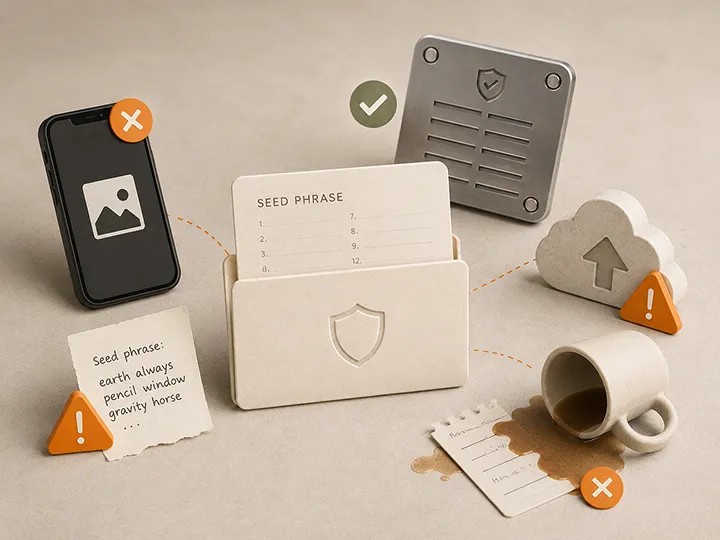
A reliable seed backup must remain:
- complete and in the correct order;
- accurately recorded;
- private and entirely offline;
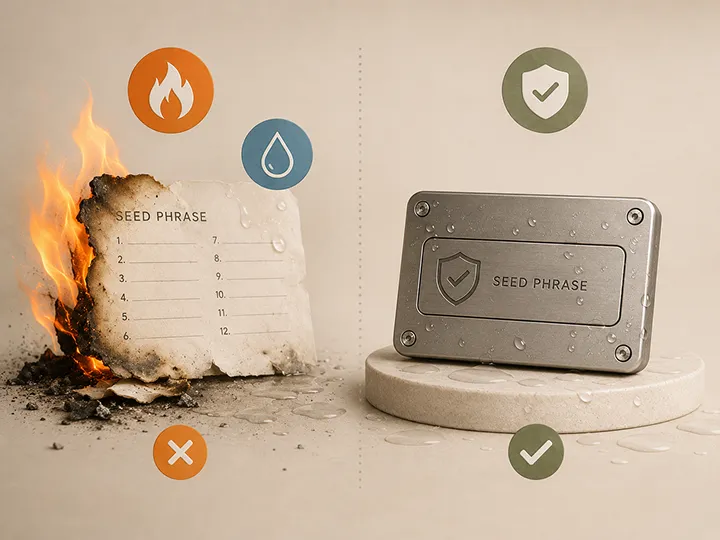
- physically durable enough for its storage environment;
- verified through a legitimate wallet workflow;
- understandable and recoverable by the intended person.
Some physical backups store only the first four letters of each BIP39 seed word because those prefixes uniquely identify words in the standardized list. That shortcut applies to BIP39 seed words. It does not apply to an optional passphrase.
A durable seed record protects only the seed component. It does not automatically preserve, validate, or recover a passphrase.
What an optional passphrase does
An optional BIP39 passphrase is a separate input used with the seed during wallet derivation. It is not simply a password placed in front of an existing wallet. It helps determine which wallet the seed creates.
| Recovery input | Result |
|---|---|
| Seed with no optional passphrase | Seed-only wallet |
| Same seed + passphrase A | Passphrase wallet A |
| Same seed + passphrase B | Passphrase wallet B |
| Same seed + a typo in passphrase A | Another derived wallet, often appearing empty |
The passphrase must be reproduced exactly. Capitalization, spaces, punctuation, word order, and a single changed character can produce a different wallet.
There is no company reset that recreates the same wallet after the passphrase is forgotten. While you still have access, you can move funds to a new recovery setup. After access is lost, the original wallet requires the exact seed and exact passphrase that created it.
Why “25th word” is misleading
A passphrase is often called a “25th word,” but that nickname is incomplete. A passphrase:
- is not another numbered seed word;
- does not need to come from the BIP39 word list;
- does not need to be one word;
- may contain spaces and other supported characters;
- cannot be shortened using the first-four-letter rule;
- must be preserved as the exact input used for wallet derivation.
The safer mental model is: the seed is the primary recovery secret, and the passphrase is a separate recovery secret that changes the wallet derived from that seed.
Why a wrong passphrase can look valid
A normal website knows which account you are trying to access and can reject the wrong password. A BIP39 wallet does not maintain a central record of the passphrase you intended.
A different passphrase can derive a different, valid wallet instead of producing a “wrong passphrase” warning. That wallet may appear empty because it is not the wallet that holds your funds.
During recovery, an unexpected empty wallet can mean:
- the passphrase was omitted;
- the passphrase was entered differently;
- the wrong passphrase record was paired with the seed;
- the seed belongs to another wallet;
- the expected account or derivation context has not been selected;
- the seed-only wallet was opened instead of the protected wallet.
Do not respond by trying random variations in connected software. Return to the documented recovery plan and use the wallet maker's current official workflow. Identify the expected wallet in advance with a non-secret reference such as a known receive address, wallet fingerprint, or another safe identifier supported by the setup.
Passphrase vs PIN
A PIN usually protects the physical hardware wallet from immediate unauthorized use. The passphrase affects the wallet derived from the seed.
If the device is destroyed or reset, recovery normally requires the seed and, when used, the exact passphrase. The old device PIN is generally not part of that recovery.
Some devices can associate different wallets with different PIN workflows. Those implementations are device-specific. Do not assume a PIN-linked setup works the same way across wallet brands.
What a passphrase can protect against
The strongest case for a passphrase is a threat model in which someone may discover or copy the seed while the passphrase remains secret and separately recoverable.
Examples include:
- an off-site seed location where another person or institution affects physical access;
- a home backup that could be exposed during burglary or unauthorized entry;
- multiple seed copies that increase the number of locations containing the core backup;
- a higher-consequence wallet where discovery of one physical object should not be sufficient for recovery;
- a storage model where tamper evidence may reveal access but cannot prevent copying.
In those cases, someone who obtains only the seed does not automatically obtain the intended passphrase-protected wallet.
What it does not protect against
A passphrase does not:
- make it safe to photograph, upload, or casually store the seed;
- restore a lost or destroyed seed;
- correct wrong seed words or word order;
- prevent loss when the passphrase is forgotten;
- make an obvious human phrase difficult to guess;
- protect secrets entered into an unsafe connected device;
- replace physical access control, backup verification, or an emergency plan;
- guarantee safety in theft, coercion, legal, or interpersonal situations.
Once an attacker has the seed, one complete recovery factor is already exposed. The remaining protection depends on the passphrase and the attacker's ability to guess it. The seed must remain private even when a passphrase is used.
The security gain comes from separation
A passphrase helps only when the seed and passphrase do not fail together.
A sound separation model should ensure that:
- finding the seed does not reveal the passphrase;
- finding the passphrase does not reveal the seed location or complete recovery path;
- the device PIN is not written beside either secret;
- non-secret instructions explain that two components exist without reproducing them;
- an authorized person can eventually locate both through a controlled plan;
- one fire, flood, burglary, cleanout, or access event does not remove every recovery component.
Storing the seed and passphrase on the same plate, in the same envelope, or in the same unlocked location removes much of the benefit.
The opposite failure is hiding the passphrase so well that no legitimate recovery is possible. Security improves only when separation and recoverability are designed together.
Memory may serve as an additional copy. It should not be the only copy. Time, stress, illness, exact-character errors, owner incapacity, or death can all break a memory-only plan.
For location design, compare seed phrase storage at home with seed phrase storage outside the home.
Should you use a passphrase?
| Use seed-only for now when | Consider a passphrase when |
|---|---|
| You have not verified the seed backup | You have already verified normal seed recovery |
| You confuse the seed, passphrase, PIN, or app password | You understand that the passphrase creates a different wallet |
| You would keep the passphrase only in memory | You can preserve the exact passphrase offline |
| You cannot maintain two separate recovery paths | The seed and passphrase can remain physically separate |
| Family recovery depends on you being present | Emergency and family plans account for both components |
| You are adding complexity because it sounds more secure | A defined seed-exposure threat justifies the second secret |
| You have no safe way to identify the expected wallet | The exact combination has reproduced the expected wallet |
A well-protected and verified seed-only setup is not inferior. It is safer than a passphrase setup built on memory, ambiguous notation, or an untested recovery path.
How strong should a passphrase be?
Never submit a real passphrase to an online strength checker.
Use these principles instead:
- avoid famous quotations, lyrics, slogans, sayings, and personally obvious sentences;
- do not assume length alone makes a familiar phrase difficult to guess;
- use a method that produces unpredictability rather than personal meaning;
- make the result practical enough to enter exactly on the trusted device;
- preserve the exact result offline;
- verify the resulting wallet before relying on it;
- never weaken seed protection because the passphrase seems strong.
The goal is not maximum complexity. The goal is enough guessing resistance for the threat model, combined with exact long-term recoverability.
Back up both recovery components
The seed and passphrase require separate but coordinated backup plans.
Seed backup requirements
The seed should be:
- recorded offline in the correct order;
- checked for transcription errors;
- protected from physical damage and unauthorized reading;
- independently verified before temporary notes are destroyed;
- associated with the correct wallet without sensitive labels on the backup itself.
Passphrase backup requirements
The passphrase should be:
- preserved as the complete, exact character string;
- stored offline and physically separate from the seed;
- recorded so case, spaces, punctuation, and word order are unambiguous;
- recoverable without relying only on memory;
- clearly identifiable to the authorized user without exposing the complete wallet map;
- included in the emergency and family-recovery design.
Do not abbreviate the passphrase using the BIP39 four-letter rule. Do not replace characters with private symbols you expect to remember. Do not store the seed, passphrase, device PIN, and exact wallet map together.
A non-secret recovery document can state that a passphrase exists, that the seed alone opens a different wallet, who may initiate recovery, where the controlled instruction path begins, and how the expected wallet is identified. It should not contain the seed or passphrase.
Build that coordination layer with the Bitcoin emergency recovery plan and family recovery instructions.
Verify the exact wallet before relying on it
A passphrase setup is incomplete until the recovery path has been verified.
The verification should establish that:
- the seed backup is accurate;
- the passphrase record is available and exact;
- the seed-only wallet and protected wallet are understood as different wallets;
- the exact combination opens the expected wallet;
- a known address, wallet fingerprint, or another safe identifier matches;
- the process can be repeated through the wallet maker's legitimate workflow;
- another authorized person understands that two components are required when continuity is part of the plan.
Do not enter a real seed or passphrase into a website, ordinary desktop form, random app, AI tool, or online checker. Use the current official recovery-check feature when the hardware wallet provides one. Otherwise follow the wallet maker's current recovery documentation in a controlled workflow appropriate to that device.
Start with how to verify your seed phrase backup, then run a broader recovery drill that confirms the complete process.
Passphrase decision checklist
Do not move meaningful funds into a passphrase-protected wallet until the relevant statements are true.
Understanding
- [ ] I understand that the seed and passphrase are different recovery secrets.
- [ ] I understand that the passphrase is not the device PIN.
- [ ] I understand that a different passphrase may open a different wallet without an error.
- [ ] I know how I will identify the expected wallet after recovery.
- [ ] I have defined the threat the passphrase is meant to address.
Seed and passphrase backups
- [ ] The seed is offline, complete, ordered, private, and verified.
- [ ] The seed remains protected even though a passphrase exists.
- [ ] The passphrase is preserved as the complete exact character string.
- [ ] Case, spacing, punctuation, and word order are unambiguous.
- [ ] The passphrase does not exist only in memory.
- [ ] The seed and passphrase are stored separately.
- [ ] Neither secret is stored with the device PIN or a complete wallet map.
Recovery
- [ ] The exact seed and passphrase reproduced the expected wallet through a legitimate workflow.
- [ ] A known address or another safe identifier confirmed the wallet identity.
- [ ] My emergency plan states that a passphrase exists without exposing it.
- [ ] An authorized person can recover both components under the intended conditions.
- [ ] The plan remains understandable without private memory tricks.
When several boxes remain unchecked, strengthen the seed-only recovery system before adding another permanent dependency.
Final verdict
Use a passphrase only when you can protect and recover two secrets better than you currently protect one.
The passphrase wins for a specific threat model: someone may discover the seed, while the separately stored passphrase remains secret and recoverable. It is most useful for experienced self-custody users who can preserve exact recovery data, maintain separate locations, identify the correct wallet, and test the full path.
Seed-only wins when those operational conditions are not yet met. A private, durable, verified, and recoverable seed-only wallet is safer than a passphrase wallet that depends on memory, ambiguous notation, or the owner's continued availability.
The correct sequence is:
- protect and verify the seed;
- define the seed-exposure threat;
- decide whether a second secret materially improves that threat model;
- preserve the passphrase exactly and separately;
- verify the expected wallet;
- connect both components to an emergency recovery plan;
- repeat the drill before the original device becomes unavailable.
Back up the seed without collapsing the two-secret design
Do not add a passphrase and then store it beside the seed. First prove that the exact passphrase is separately recoverable and that the intended wallet can be identified. The physical product below protects only the seed component.
Billfodl is the correction-first option here because the seed record can be checked and corrected before closure. It does not remember the passphrase, protect a memory-only passphrase, or make co-location of both secrets safe.
Official Billfodl store affiliate link. We may earn a commission at no extra cost to you.
Review the full Billfodl evidence, or compare other physical formats in Best metal seed phrase backups.
Frequently asked questions
Is a passphrase the same as a seed phrase?
No. The seed phrase is the wallet's core recovery material. The optional passphrase is a separate exact input that changes the wallet derived from that seed. A passphrase-protected wallet requires both.
Is a passphrase the same as a wallet PIN?
No. A PIN usually protects access to a particular hardware device. A passphrase affects wallet derivation and remains required when recovering on a replacement device.
Is the passphrase really a “25th word”?
That is a popular nickname, not a precise definition. A passphrase is not another numbered BIP39 seed word, does not need to come from the BIP39 list, and must not be shortened using the first-four-letter rule.
What happens if I enter the wrong passphrase?
The wallet may derive a different wallet instead of showing a “wrong passphrase” message. Confirm recovery against a known address, wallet fingerprint, or another safe identifier.
What happens if I forget the passphrase?
The protected wallet may become permanently inaccessible even when the seed is correct. There is no company reset that recreates the original wallet from a forgotten passphrase.
Does a passphrase make an exposed seed safe?
No. It can reduce the consequences when the passphrase remains strong and secret, but the attacker already has one complete recovery factor and can focus on guessing the passphrase. The seed still requires strong protection.
Should I keep the passphrase only in my head?
No. Memory can be an additional copy, but it should not be the only recovery path. Preserve the exact passphrase offline and separately from the seed.
Should the seed and passphrase be stored together?
No, not when the passphrase is intended to protect against seed discovery. Storing both together removes much of the separation benefit. Connect them through non-secret recovery instructions instead.
Does every Bitcoin holder need a passphrase?
No. A passphrase is optional. It is appropriate only when it solves a defined threat and the owner can reliably maintain two separate recovery secrets.
Can I use the first four letters of a passphrase?
No. The four-letter shortcut applies to standardized BIP39 seed words. A passphrase must be reproduced as the complete exact input.