How many hardware wallets do you need

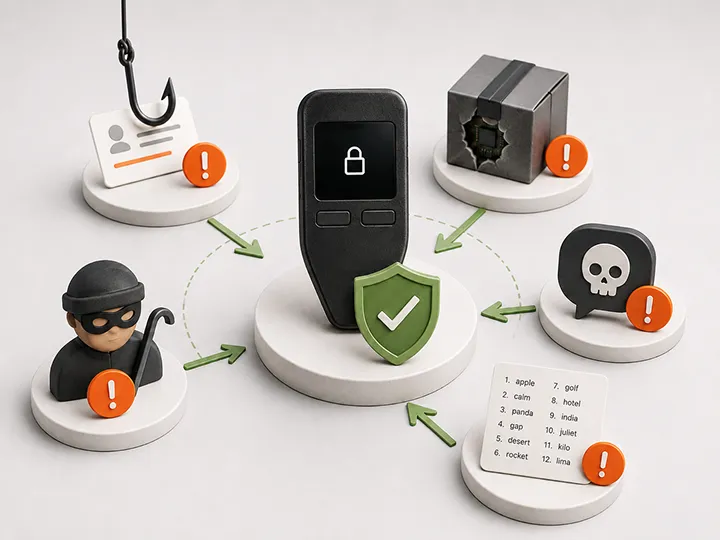
Most Bitcoin holders do not need a drawer full of hardware wallets. They need one hardware wallet they understand, a seed backup they can recover from, and a custody routine that still makes sense under stress.
A second device can be useful. Multiple devices can also create false confidence, more storage decisions, more firmware paths, more forgotten PINs, and more recovery confusion.
This page separates three different ideas that often get mixed together: owning one hardware wallet, separating use cases across more than one wallet, and moving into multisig or multi-key custody.
Bitcoin Plaster verdict
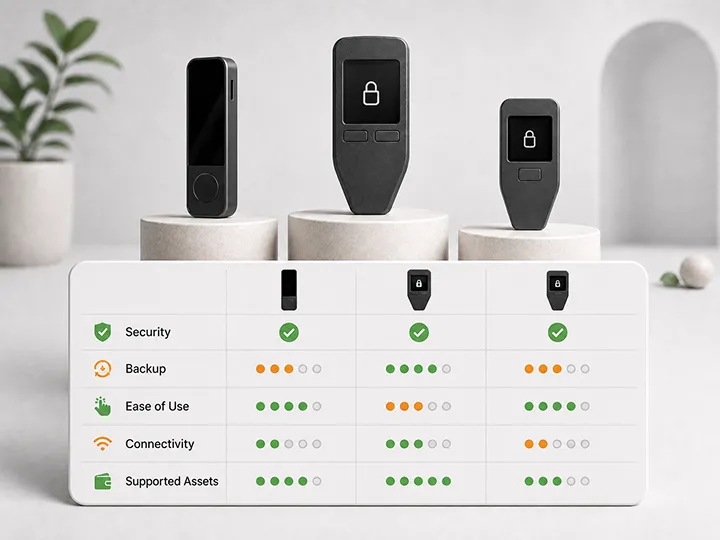
For most individual Bitcoin holders, the winner is one clean hardware wallet setup with a strong offline backup and a recovery plan the user can explain back without guessing.
A second hardware wallet wins only when it has a defined job. Good jobs include spending and savings separation, a spare recovery device, location separation, inheritance preparation, or planned multisig. Bad jobs include vague anxiety, status, copying advanced users, or trying to compensate for a weak seed backup.
| Setup | Best fit | Main risk |
|---|---|---|
| One hardware wallet | Most solo holders, first serious self-custody setup, simple long-term storage | Recovery depends heavily on one seed backup model |
| Two devices using the same seed | Convenience, spare access, controlled recovery practice | Does not create a new security model and adds another object to secure |
| Separate wallets with separate seeds | Spending versus savings separation, different risk zones, different access rules | More backups, more documentation, more chance of confusion |
| Multisig or multi-key setup | Larger balances, shared custody, stronger single-point-of-failure control | Complex recovery, coordination burden, configuration mistakes |
Product winners belong on the best Bitcoin hardware wallets page. This page decides whether more hardware actually improves the custody design.
One hardware wallet is enough for most people
A normal single-key hardware wallet setup can be a strong default when the user understands the setup and recovery process.
The device protects signing from the everyday phone or computer workflow. The backup protects recovery if the device is lost, damaged, wiped, outdated, or unavailable. The user still has to verify addresses, maintain the device, and avoid exposing the seed phrase.
| One-wallet requirement | What it means in practice | Route if unclear |
|---|---|---|
| Clean device origin | You bought from a trusted path and did not accept a pre-initialized wallet | Supply-chain risk |
| Fresh seed generated during setup | The recovery words were created during your setup, not supplied by a seller | Setup guide |
| Offline backup | The seed phrase is not stored in cloud notes, photos, password managers, chats, or email | Backup basics |
| Recovery understanding | You know how access would be restored if the device failed | Recovery risks |
| Device-screen verification habit | You do not rely only on the phone, computer, app, browser, or clipboard for critical details | Security models |
Do not add a second device before the first setup clears those basics. More hardware on top of a weak recovery plan is still a weak recovery plan.
A second device is not the same as a second wallet
People often say two hardware wallets when they mean very different things.
Two devices can hold the same seed, or they can control separate wallets with separate seeds. Those are different custody designs.
| What you own | What changes | What does not change |
|---|---|---|
| Second device with the same seed | You may have a spare signing device if the first breaks or is unavailable | The same seed is still the recovery authority |
| Second device with a different seed | You now have a separate wallet, separate backup, and separate access path | You still need to protect every seed and understand every recovery path |
| Different brands for the same seed | You may reduce some vendor-specific device dependency | You still have one seed and one single-key wallet model |
| Different brands with different seeds | You create operational separation between wallets | You also create more documentation and recovery responsibility |
If the goal is backup confidence, a spare device can help you practice recovery carefully. If the goal is risk separation, separate wallets may be more relevant. If the goal is eliminating one key as a single point of failure, that is a multisig question.
Good reasons to own a second hardware wallet
A second device is easier to justify when it has one job and that job is written down before purchase.
| Second-device job | When it makes sense | Boundary |
|---|---|---|
| Spare recovery device | You want a compatible device ready if the main device fails | It does not replace the seed backup |
| Spending and savings split | You want one smaller active wallet and one colder savings wallet | Do not blur which wallet holds which amount |
| Location separation | You need access or recovery support across two physical places | The second location becomes another security responsibility |
| Family or inheritance planning | A trusted person may need a defined path in an emergency | The device alone is not an inheritance plan |
| Learning and testing | You want to practice restore, firmware, or companion app workflows without risking savings | Keep test funds small and never expose the real seed |
| Multisig preparation | You are intentionally moving toward a multi-key model | Do not fund multisig until recovery and signer coordination are understood |
The strongest reason to add hardware is not that another device sounds safer. It is that the device reduces a named failure mode without creating a larger one.
Bad reasons to buy more hardware wallets
Extra devices can become clutter disguised as security.
| Bad reason | Why it fails | Better move |
|---|---|---|
| The first setup feels unclear | A second setup can double the confusion | Revisit setup, backup, and recovery basics first |
| The seed backup is weak | Another device does not protect a lost or exposed seed | Fix backup quality before buying more hardware |
| Advanced users talk about multisig | Advanced custody is not automatically beginner safety | Understand single-key recovery before escalation |
| The device is on sale | Price does not define custody need | Compare fit, workflow, and maintenance burden |
| You want to feel safer quickly | Anxiety can lead to overcomplicated custody | Name the specific risk and solve that risk directly |
If you are still choosing the first device, use how to choose your first Bitcoin hardware wallet and hardware wallet comparison criteria before buying spares.
Separated wallets can be useful when the roles are clear
Separate wallets can reduce confusion between active use and long-term savings. They can also create more backups, labels, firmware routines, physical storage decisions, and emergency instructions.
The practical question is not whether two wallets are safer than one. The question is whether the separation makes your behavior simpler and more reliable.
| Separated setup | Useful when | Risk if done badly |
|---|---|---|
| Small spending wallet plus savings wallet | You sometimes transact but want savings rarely touched | Accidentally funding the wrong wallet or neglecting backup for one wallet |
| Learning wallet plus real wallet | You want to test workflows without touching savings | Reusing real seed words in the learning environment |
| Personal wallet plus family/emergency wallet | Access responsibilities are intentionally separated | Unclear instructions during stress |
| Different device types for different workflows | One device is mobile-first and another is colder or desktop-first | Choosing devices because of novelty rather than actual workflow fit |
Every separate wallet needs its own backup plan, naming convention, storage rule, recovery explanation, and maintenance routine.
Multisig is a security-model change, not a shopping cart upgrade
Multisig can reduce dependence on one key. A common structure is 2-of-3, where spending requires two of three independent keys. This can help larger balances, shared custody, business funds, inheritance planning, and higher-threat situations.
The tradeoff is complexity. Multisig requires signer coordination, backup separation, wallet configuration records, xpub handling, receive-address verification, and recovery planning that is more demanding than a normal single-key setup.
| Multisig can help with | Multisig can fail through |
|---|---|
| Reducing single-key compromise risk | Losing too many keys or recovery materials |
| Sharing custody across people or places | Unclear signer roles and poor documentation |
| Separating keys across devices and locations | Misconfigured wallet coordinator software |
| Planning for larger balances | Forgetting which devices and backups belong to which wallet |
| Avoiding one physical location as the only failure point | Not knowing how to recover if one signer disappears |
Do not move meaningful Bitcoin into multisig because multisig sounds professional. Move only when the amount, threat model, documentation quality, and user skill justify the added operating load.
Use this escalation ladder
Most holders should climb custody complexity gradually. Skipping levels can make the setup look strong while making future recovery weaker.
| Level | Use this when | Do not move up until |
|---|---|---|
| One device, one seed | You are building a first serious self-custody setup | The backup is offline, verified, and recoverable |
| One device plus strong backup upgrade | The amount is becoming meaningful long term | You understand backup durability, location risk, and recovery steps |
| Second device with same seed | You want access redundancy or controlled restore practice | You know this is not a new security model |
| Separate wallets | You need savings and active-use separation | You can manage separate backups without confusion |
| Multisig | The amount or threat model justifies multi-key custody | You can document, test, and explain signer recovery |
This ladder is not a status hierarchy. The right level is the one you can operate safely.
What a second device does not solve
A second device has limits that should be clear before purchase.
| It does not solve | Why |
|---|---|
| Lost seed phrase | The backup is still the authority when devices fail |
| Exposed seed phrase | More hardware cannot make leaked recovery words private again |
| Forgotten passphrase | A passphrase can create a different wallet that may be unrecoverable if forgotten |
| Fake setup or fake recovery page | User workflow still matters |
| Unclear inheritance plan | A trusted person needs instructions and boundaries, not just a device |
| Rushed large transfer | The first meaningful transaction still needs verification and a staged process |
| Unsupported maintenance | Every device may need firmware, app, cable, battery, or compatibility attention |
For maintenance planning, read hardware wallet maintenance checklist.
Decision checklist before buying another hardware wallet
Use this checklist before buying a second device.
- Can you recover the current wallet from backup without relying on memory?
- Can you explain the difference between PIN, seed phrase, and optional passphrase?
- Have you verified a receive address on the hardware wallet screen where supported?
- Is the second device solving a named failure mode?
- Will the second device use the same seed, a separate seed, or be part of multisig?
- Do you know where each backup will live?
- Do you know who should and should not have access?
- Can you maintain the setup over years, not only during setup week?
If you cannot answer those questions, the next move is not another purchase. It is backup, recovery, and maintenance clarity.
Where to go next
| Reader state | Next page |
|---|---|
| You are choosing the first device | Best Bitcoin hardware wallets |
| You need criteria before buying | Hardware wallet comparison criteria |
| Your backup is the weak point | Hardware wallet backup basics |
| You worry about recovery later | Hardware wallet recovery risks |
| You are considering passphrase complexity | PIN and passphrase basics |
| You are preparing ongoing custody | Hardware wallet maintenance checklist |
FAQ
Do I need a backup hardware wallet?
Usually not as the first priority. In a standard single-key setup, the seed backup is what restores access if the device fails. A spare device can be useful, but it does not replace the backup.
Is two hardware wallets safer than one?
Not automatically. If both devices use the same seed, the second device is mostly access redundancy. If they use different seeds, you now have more backups and more recovery responsibility.
Should I keep one hardware wallet for spending and one for savings?
That can make sense when the roles are clear. A smaller active wallet and a colder savings wallet can separate behavior. It becomes risky if the labels, backups, and recovery rules are unclear.
Do I need multisig?
Most holders do not need multisig as a starting point. Multisig can be powerful for larger balances or shared custody, but it should be a deliberate security-model decision after single-key recovery is understood.
Should two devices use the same seed?
Only if the goal is access redundancy or restore practice. The same seed on two devices does not create two independent keys. It is still one wallet controlled by one recovery phrase.
Should I buy two different brands?
Not by default. Different brands may matter for advanced resilience or multisig planning, but brand variety does not fix weak backup discipline or poor recovery documentation.
What should I fix before adding another device?
Fix seed backup quality, recovery understanding, address verification habits, PIN/passphrase clarity, and maintenance planning before adding more hardware.