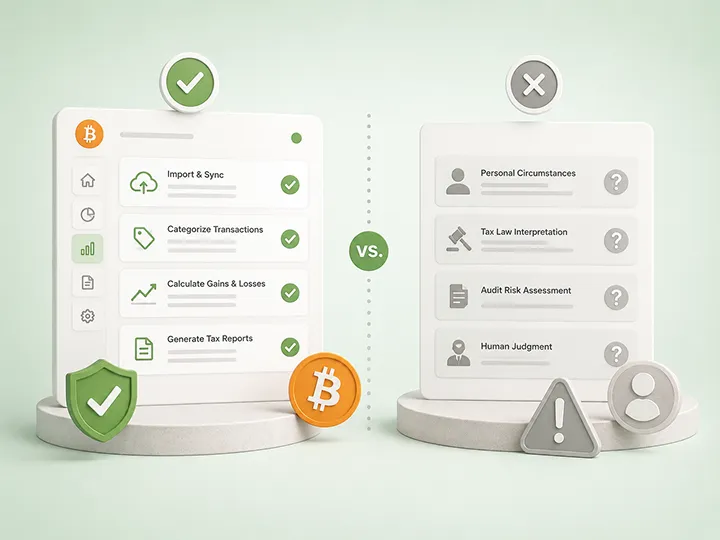
What tax software can and cannot do
Use the five-stage model to separate import, classification, calculation, review, and interpretation.

Enter your email to receive the free PDF checklist.
Read our Privacy Policy. For subscriber questions or corrections, use the Contact & Corrections page.
Bitcoin tax software limits
Bitcoin tax software can be genuinely useful - it can organize a scattered history, calculate from supplied data, and make records easier to inspect. This page is not about that. It is the failure-mode page: where software output goes wrong, why, and what to watch for before you trust it. For the underlying model of what each part of a tool's job is, see the capability page, what tax software can and cannot do. This page assumes that model and catalogues the ways real Bitcoin histories break it.

Bitcoin tax software can be genuinely useful - it can organize a scattered history, calculate from supplied data, and make records easier to inspect. This page is not about that. It is the failure-mode page: where software output goes wrong, why, and what to watch for before you trust it. For the underlying model of what each part of a tool's job is, see the capability page, what tax software can and cannot do. This page assumes that model and catalogues the ways real Bitcoin histories break it.
The core distinction is simple: a limitation is rarely the software failing at its job; it is the software doing its job on incomplete inputs. This is educational only, not tax, legal, or financial advice; rules differ by jurisdiction and change over time. For the scope of the lane, read the Bitcoin tax disclaimer; for the map, start at the hub.
How this section is written: the failure patterns below reflect issues that recur across published documentation, pricing, setup-flow review, and hands-on use only where explicitly stated, rendered product-neutral. No tool is named, and none is claimed to behave identically to another.
The single most important limitation, the one every other failure on this page is a version of: a finished-looking report can still rest on incomplete records. Neat formatting, complete-looking tables, and precise numbers can make output feel more certain than the inputs support - and precision is the trap. A number carried to eight decimal places feels authoritative, but it is only ever as good as the records feeding it; a precise calculation on a missing wallet is still wrong, just wrong with confidence.
The report also rarely shows you which entries rest on complete source records and which depend on missing context, partial imports, or unresolved labels - so nothing on screen distinguishes the solid rows from the shaky ones. A pattern that recurs across reviewed tax-software workflows makes the limit concrete: a tool can flag a problem - a missing-basis entry, an unmatched transfer - but flagging is not fixing, and complete source history matters more than a polished dashboard. Every failure mode below is this one, seen from a different angle.
Software only knows the sources supplied to it. If you used another exchange, another wallet, or an old account, the output depends entirely on whether those are included - and a forgotten source produces no error, just a quietly incomplete picture. Compounding this, import paths behave differently. API connections, CSV files, wallet imports, and manual entry each carry different friction; an API that connects once may not reconnect cleanly, and a misconfigured connection, a duplicated transaction, or a partial import degrades everything downstream. Watch for a missing old or closed account, a wallet that was never imported, missing recurring-buy history, missing deposit/withdrawal history, or missing fee and acquisition records. Completeness is the holder's responsibility, not the tool's. (For the general record guide, see Bitcoin tax records; for gathering a complete export set, see export Bitcoin transaction history.)
Self-custody splits a history across systems, and the tool cannot resolve the ambiguity by itself. It may see coins leaving an exchange and arriving at a wallet without knowing whether the receiving wallet is yours, why they moved, or which acquisition record connects. This is where cost-basis continuity commonly breaks: the acquisition record lives in exchange history, the later movement lives in wallet history, and the transaction ID connects the movement but does not carry the acquisition context. A common concrete result is a wallet receipt that looks like coins arriving with no known cost, even though a transfer between your own wallets is not, by itself, the same as a purchase. A transaction ID confirms that movement happened; it does not prove ownership or purpose. (For the movement boundary, see wallet transfer vs taxable event; for the cost-basis input, see Bitcoin cost basis basics.)
Duplicates appear when the same source is added twice, overlapping exports are imported, or a connection and a file upload cover the same activity - making a history look larger or more complex than it is. Some repeated-looking entries are true duplicates; others are legitimate paired records describing two sides of one movement, which is why deleting on sight is risky. This page gives no product-specific de-duplication steps. The review habit: compare the tool's timeline against source records and look for repeated events with similar dates, amounts, references, or transaction IDs before trusting totals. Software may surface some duplicates; it should not be assumed to catch all of them.
Some records preserve Bitcoin amounts but not the value context a later review needs. A wallet may show amounts and transaction IDs but not the exchange-side acquisition record; an on-chain transaction may show movement but not the local-currency value at the time; a fee may appear in one source but not another; timestamps may follow different conventions across sources. The response is not to guess treatment - it is to preserve the source facts (amount, date and time, transaction ID, fee, sending source, receiving destination, acquisition record, source-shown value if available, and a label) and to mark anything missing as "missing - needs review" rather than let a blank pass silently into a calculation.
Labels are small but carry context software cannot infer. "Withdrawal to cold storage" is easier to review than a blank outgoing movement; "wallet migration" is easier than an unexplained address change; "sent to another person" is different factual context from "transfer between my wallets." Poor or missing labels leave the tool with less context; overconfident labels create a different problem when a label states a conclusion rather than describes what happened. A useful label is plain and factual and does not decide treatment. (For the labeling system and the wallet-secret safety rule, see wallet labeling for tax records.)
The quiet limitation behind all the others is that software makes review easier, which is often misread as making review unnecessary. It does not. The practical response to every failure mode above is to review the inputs before trusting the output. Before relying on a report, check whether all exchanges and wallets are included, old accounts are accounted for, acquisition records are present, withdrawals connect to receipts, transaction IDs are preserved, fees are included, labels explain movement, balances look reasonable against your own records, and unresolved gaps are clearly identified. Automatic categorization tends to be most reliable for standard activity - ordinary buys and sells - and needs more review for anything non-standard, which is precisely where a Bitcoin-only self-custody history tends to live.
A recordkeeping and software-preparation page has limits of its own. The question may need a qualified professional when records are missing, ownership context is unclear, acquisition history cannot be connected to later movements, wallet and exchange histories do not line up, output looks wrong and the cause is unclear, coins were received from another party, outgoing movements may need treatment review, the amount makes guessing irresponsible, or the issue depends on rules this page cannot evaluate. In a more complex situation, the best use of software is often to create cleaner, more organized material for that review. (For the specific signals that separate a recordkeeping problem from a judgment problem, see when to use a tax professional.)
You can lower the risk of every failure mode above without making tax decisions yourself, in two steps. First, gather the records - exchange transaction, deposit, and withdrawal history; wallet history; on-chain transaction IDs; acquisition and fee records; wallet labels; transfer notes; and records connecting withdrawals to receipts. Then review the connections - do withdrawals match receipts, are wallets labeled, are acquisition records connected to later movement, are duplicate-looking entries explained, are fees preserved, are missing records identified rather than ignored, and are unclear events marked for qualified review? This is input-quality work, not filing instruction; it makes the factual record cleaner before any calculation or interpretation depends on it. (For reconciling exchange and wallet sources, see exchange CSV vs wallet history; for common record mistakes and their fixes, see common Bitcoin tax record mistakes.)
Bitcoin tax software can organize records and calculate from supplied data. Its limitations are mostly one limitation wearing different clothes: it does its job on whatever inputs it is given, so incomplete imports, absent sources, ambiguous self-custody movements, duplicates, missing values, and thin labels all surface as output that looks more final than it is. That does not make software bad - it makes it a tool. Used with complete records, clear labels, connected sources, and qualified review when needed, it is useful; trusted blindly, it makes incomplete inputs look settled.
For the full tax-scope boundary, see the Bitcoin tax disclaimer.
Can Bitcoin tax software handle everything for me? No. It can organize and calculate from supplied records, but it cannot know facts you never provide - and it may need exchange history, wallet history, labels, acquisition records, fees, and context before output can be reviewed.
Why can a report look complete but still be wrong? Because the tool formats and calculates from the records it has, which does not prove the record set is complete. A missing exchange, wallet, label, fee, acquisition record, or transfer connection can leave the output needing review - precision on screen is not proof of completeness underneath.
Does tax software know which wallets are mine? Not by itself. Ownership context comes from your records, labels, notes, exchange withdrawals, wallet history, and transaction IDs. A transaction ID confirms movement; it does not prove ownership.
Can software tell whether a wallet movement needs tax review? It may help organize the record, but it cannot decide treatment for your situation. A movement record preserves what happened; whether it has tax consequences depends on facts and rules outside this page.
What records improve software input quality? Exchange transaction history, wallet history, transaction IDs, fee records, acquisition records, wallet labels, transfer notes, and records connecting withdrawals to receipts. Cleaner inputs make output easier to review.
Can tax software replace a qualified professional? No. Software organizes and calculates; a professional interprets facts under the rules that apply to you. Review may be appropriate when records are missing, facts are unclear, amounts are large, or treatment questions exceed a recordkeeping explanation.
Should I use tax software if it has limitations? It can still be useful - the point is realistic expectations. It is strongest when records are complete, labels are clear, and unresolved questions go to qualified review.
Use the five-stage model to separate import, classification, calculation, review, and interpretation.
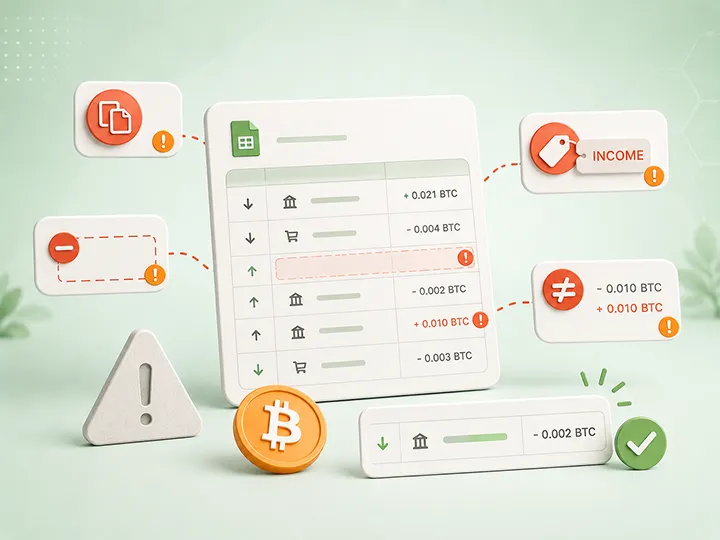
Turn common record gaps into better habits before they become software import problems.
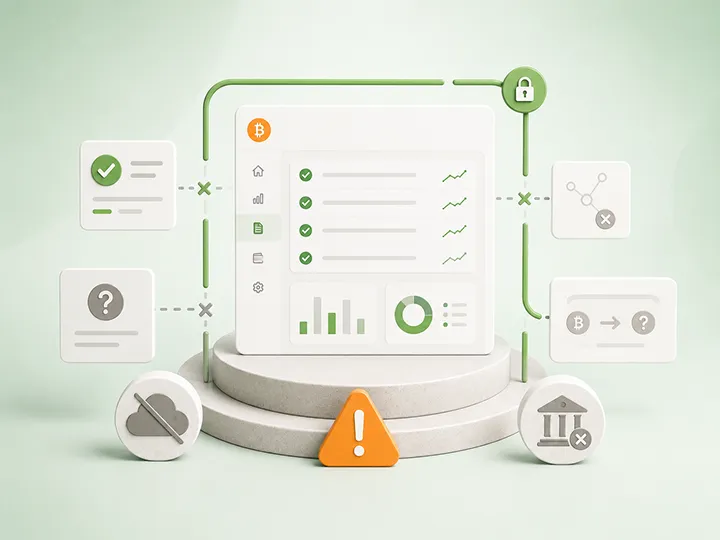
Separate recordkeeping work from judgment questions that may need qualified review.

Use reviewability as the evaluation lens instead of a scorecard, ranking, or product verdict.