Seed Phrase Storage

Seed Phrase Storage at Home: How to Keep It Safe Without Getting Clever

Seed phrase storage at home is a balance of secrecy, durability, and recovery. Learn principles for keeping a Bitcoin backup offline and recoverable.

  • Home storage
  • Safety calibration
  • No hiding-place tactics
Seed phrase storage thumbnail showing a seed phrase card, metal backup plate, hardware wallet, and security icons.
Frederick Staunch avatar

Author and experience

Written by Frederick Staunch

Frederick Staunch is the pseudonymous editor of Bitcoin Plaster. He teaches the Bitcoin Holder Standard: money literacy, the Bitcoin thesis, holder psychology, and self-custody for people who want to hold Bitcoin without expensive mistakes.

Bitcoin self-custody and key control

Hardware wallet setup and testing

Recovery and backup planning

Bitcoin-only product evaluation

Bitcoin tax-record workflows and tax-software evaluation

Money literacy and sound money

Holder psychology and volatility

Quick answer

Home storage is a balance, not a hiding contest.

Can the wrong person be kept out while the right person can still recover when needed?

A good home seed phrase storage plan keeps the backup offline, private, durable, readable, and recoverable by the right person under the right conditions.

Do not make a digital copy, rely on a clever hiding place only you understand, or treat one home location as the whole recovery plan.

The better question is whether the wrong person can be kept out while the right person can still recover when needed.

1

Keep it offline and private

Home storage should reduce exposure. It should not create a new copy in a phone, cloud note, password manager, online document, email, or AI tool.

2

Make it durable and readable

The backup needs to survive realistic physical risk and remain readable without guessing years later.

3

Keep it recoverable

A backup hidden so well that future-you or the right trusted person cannot recover it is not secure. It is a loss waiting to happen.

Safety boundary

Home storage should reduce exposure, not create a new copy in the wrong place.

Do not type, photograph, scan, upload, email, cloud-store, password-manager-store, AI-tool-enter, or paste your real seed phrase while planning home storage.

Do not create digital copies

  • a website
  • a phone camera
  • a computer file
  • an online document
  • a password manager
  • cloud storage

Do not put secrets into normal documents

  • a legal document
  • a will document
  • a trust document
  • an online legal tool
  • an online note
  • a shared note

Do not send secrets to people or services

  • email
  • chat apps
  • AI tools
  • connected software
  • random recovery tools
  • seed checkers
  • unknown support agents
  • public forums
Seed phrase storage thumbnail showing a secure lockbox, backup card, metal plate, and checklist.

Storage tension

Storing a seed phrase at home sounds simple until you think about what the backup has to survive.

It must stay hidden from the wrong person. It must survive physical damage. It must remain readable years later. It must not be thrown away by accident. It must be recoverable by future-you, and possibly by the right trusted person if you cannot act.

Home seed phrase storage is not a puzzle where the cleverest hiding place wins. A backup hidden so well that no one legitimate can recover it is not secure. It is a loss waiting to happen. A backup kept so conveniently that other people can find it is also not secure. It is exposure waiting to happen.

The goal is balance: secrecy, durability, and recoverability. This page explains how to think about seed phrase storage at home without giving exact hiding places, product recommendations, or tactical concealment advice.

Home-storage requirements

A home backup has to satisfy more than one requirement at the same time.

Most home-storage mistakes happen when one requirement is optimized while the others are ignored.

Requirement

Secrecy

  • The wrong person should not find or copy the words.

Requirement

Durability and legibility

  • The backup should survive realistic physical risks.
  • The words should remain readable without guessing.

Requirement

Recoverability

  • The right person should be able to recover under the right conditions.

Requirement

Separation and simplicity

  • One event should not destroy every recovery path.
  • The plan should not depend on clever memory tricks.

Exposure versus loss

Theft is not the only failure mode.

Many readers focus first on theft. That makes sense. If someone reads or copies your seed phrase, they may be able to recover the wallet.

But home storage can also fail through loss. A backup can fail if it is damaged, unreadable, misplaced, forgotten, accidentally discarded, destroyed in a household disaster, hidden in a way future-you cannot remember, or impossible for the right person to locate later.

The outcome can be just as final as theft. The Bitcoin may still exist, but no one can recover it. That is why hide it well is incomplete advice. A home storage plan must protect against exposure and loss.

Convenience versus cleverness

Both obvious convenience and over-clever hiding can fail.

A seed phrase is not ordinary paperwork, and it is not a puzzle that only present-you should understand.

Exposure risk

Obvious convenience

  • A backup that is easy to reach, easy to remember, and stored with ordinary important things can feel organized.
  • The problem is that obvious convenience can make the backup casually visible, casually accessible, or too easy for ordinary household access to discover.

Loss risk

Clever hiding

  • A hiding plan can become so complex that it defeats the wrong person and the right person.
  • A backup no one can find is not a secure backup. It is a lost backup.

Household exposure

Home storage has to account for normal life.

The point is not to distrust everyone. The point is to recognize that exposure risk often comes from normal household access, not a dramatic attack.

  • Normal household access

    Home storage has to account for family, roommates, guests, cleaners, contractors, repair workers, maintenance access, and ordinary movement through the space.

  • Exposure does not require drama

    Exposure risk often comes from normal life, not a dramatic attack. Someone may not know what a seed phrase is, but a readable copy still changes the risk picture.

  • Limit who encounters the words

    A good plan limits who can encounter the words while still allowing the right recovery path to exist.

  • Use threat-model thinking

    The right home-storage plan depends on the risks you are actually planning around, not on a universal hiding rule.

Physical durability

Fire, water, humidity, and physical damage can make a backup fail.

The issue is not only whether the backup physically survives. The issue is whether every word remains readable and in the correct order.

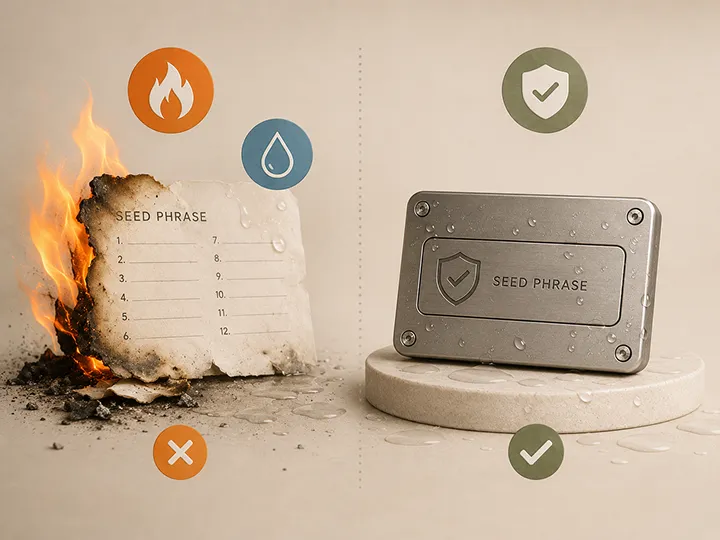
  • Paper is fragile

    Paper is easy to create, but it can be damaged by fire, heat, water, humidity, mold, fading ink, smudging, tearing, handling damage, or ordinary decay over time.

  • Words must remain readable

    The issue is not only whether the backup physically survives. The issue is whether every word remains readable and in the correct order.

  • Durable material is not magic

    Durable materials may reduce some physical risks compared with paper, but they do not solve theft, location choice, transcription errors, passphrase confusion, or emergency recovery.

Seed phrase storage thumbnail showing paper and metal backup materials side by side.

Durability category

Metal backup is a durability category, not a product pitch.

Durable materials may reduce some physical risks compared with paper. That is why many holders eventually consider a metal seed phrase backup for long-term storage.

But metal is not magic. A durable material does not solve theft, poor location choice, household exposure, passphrase confusion, seed phrase transcription errors, inheritance failure, over-clever hiding, or lack of an emergency plan.

The useful question is not which product is best on this page. The useful question is whether your backup medium remains readable, private, and recoverable under the risks you are planning around. When you are ready to evaluate durable materials, use metal backup selection criteria when that route is live. This page will not recommend a specific product.

Recovery model

Home storage should not be the only layer.

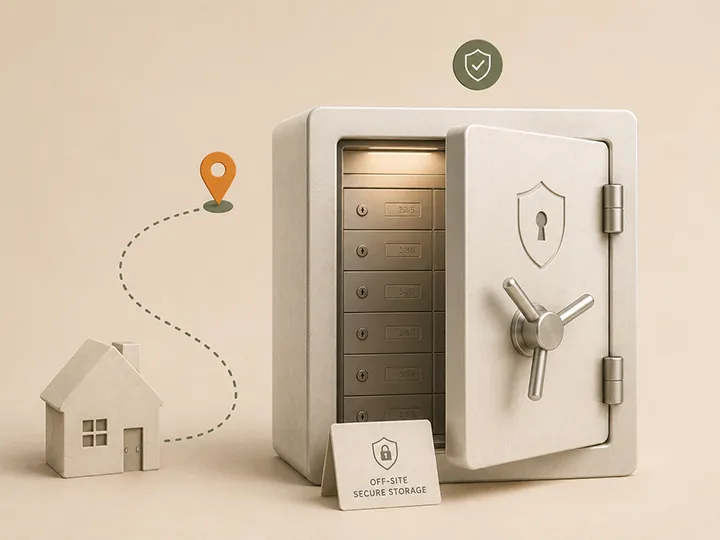
A single home location is a single point of failure. If every recovery item depends on one home, then one event can create a serious recovery problem.

Fire, water, theft, accidental disposal, or restricted access to the home can all affect recovery.

That does not mean scattering copies randomly. Every extra copy creates another exposure point. But it does mean home storage should be considered one part of a wider recovery model.

The companion question is outside-home storage: whether a second controlled location belongs in your plan, and how to think about it without creating new exposure risk. Wire that route when the dedicated page is live.

Offline rule

Keep the seed phrase offline.

This rule is not negotiable. Do not make a digital copy because home storage feels inconvenient.

Do not take a photo, save a scan, write it in a phone note, put it in a password manager, store it in cloud storage, email it to yourself, send it in chat, put it into an online document, ask an AI tool to organize it, or type it into a website or checker.

A digital copy changes the risk. It can sync, back up, spread, index, or become accessible through an account or device compromise.

Home storage should keep the recovery secret offline.

Complexity blocks

Passphrases, split backups, and family recovery add complexity.

These ideas may belong in some plans, but they should not be added because they sound advanced. They must remain recoverable under stress.

Passphrase complexity

  • A passphrase may reduce the risk of someone using the seed phrase alone if the phrase is found.
  • It also creates a second recovery-critical secret.
  • Do not store it casually with the seed phrase, but do not hide it so well that legitimate recovery fails.

Split-backup complexity

  • Casual splitting can create a fragile recovery puzzle.
  • If one part is lost, mislabeled, damaged, forgotten, or misunderstood, recovery may fail.
  • Splitting is not the same as a passphrase, Shamir backup, or multisig.

Family and emergency complexity

  • The right people may need awareness and instructions.
  • They do not need casual access to secret material.
  • Legal documents may handle intent or authority. They should not become seed phrase storage.

Family and emergency recovery

A home backup may need to be recoverable by someone else someday.

That does not mean giving casual access to your seed phrase. It means creating a plan where the right person can find safe instructions, understand what not to do, and get qualified help when needed, without the seed phrase being exposed early.

The right people may need awareness and instructions. They do not need casual access to secret material.

Do not put a seed phrase, passphrase, wallet backup, private key, PIN, or exact recovery path into a will, trust, legal document, online legal tool, cloud file, email, shared note, password manager, or AI tool.

Legal documents may handle intent or authority. They should not become seed phrase storage.

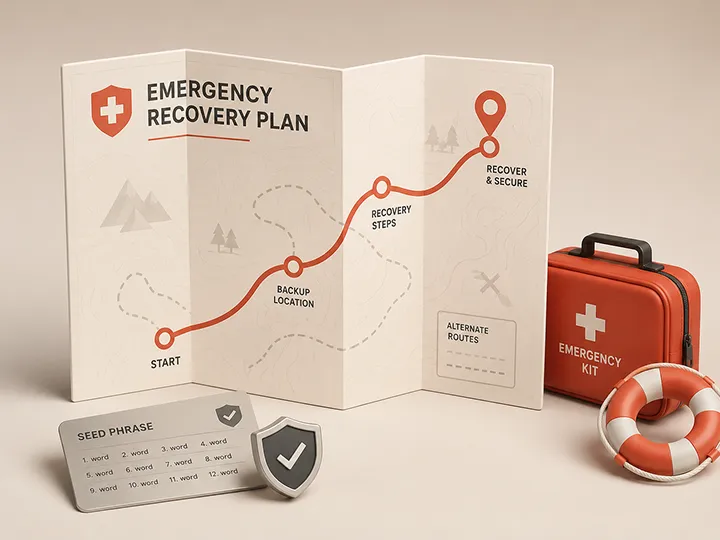
For planning beyond your own recovery, use Bitcoin inheritance basics and the emergency recovery plan. If family recovery instructions become live later, they can support the human side of the plan.

Sanity checklist

Home-storage sanity check

Use this checklist without writing, typing, photographing, or exposing your seed phrase. If several answers are weak, do not look for a more clever hiding place. Improve the storage model.

  1. Is the backup offline?

    Home storage should not create a digital seed phrase copy.

  2. Is it protected from casual discovery?

    The wrong person should not be able to encounter the words through ordinary household access.

  3. Is it protected from ordinary physical damage?

    Think about fire, water, humidity, handling, and accidental disposal without turning the page into a product search.

  4. Will every word remain readable?

    Legibility matters as much as physical survival.

  5. Could the backup be accidentally discarded?

    A backup mistaken for junk is a failed backup.

  6. Does the location depend on memory or a clever trick?

    A clever plan that future-you cannot remember is fragile.

  7. Could a trusted person recover under the right conditions?

    Controlled recoverability matters if you cannot act later.

  8. Is the backup separated from the wallet it protects?

    One event should not take both the wallet and its recovery path.

  9. Is the home copy the only recovery layer?

    A single home location can become a single point of failure.

  10. If a passphrase exists, is it handled deliberately?

    The passphrase is recovery-critical if your setup depends on it.

  11. If the seed is split, is the recovery model actually understandable?

    A split that only you understand may fail later.

  12. Is the plan documented without exposing secret material?

    Instructions can exist without putting the seed phrase into normal documents.

Where this fits

Home storage is one part of the seed phrase plan.

The next step depends on the weakest part of your setup: risk model, physical durability, backup mistakes, emergency recovery, or durable material evaluation.

  1. Clarify risks before choosing locations

    If you do not know what risks you are defending against, start with threat-model thinking before choosing a home storage approach.

  2. Address physical risk separately

    If the backup may fail through fire, water, or physical damage, use fire and water risk calibration before treating a material choice as the answer.

  3. Plan the human recovery path

    If other people may need to recover later, build an emergency recovery plan and understand Bitcoin inheritance basics without exposing the seed phrase.

  4. Do not optimize for cleverness

    Optimize for controlled recoverability: offline, private, durable, and recoverable by the right person under the right conditions.

Seed phrase storage thumbnail warning against unsafe seed phrase storage locations.

Next step

Do not optimize for cleverness. Optimize for controlled recoverability.

Keep the seed phrase offline, private, durable, and recoverable by the right person under the right conditions.

If you are unsure whether your backup habits are safe, review seed phrase backup mistakes. If other people may need to recover later, build an emergency recovery plan. If you need physical risk calibration, use the fire and water risk page.

Use threat-model thinking and outside-home storage routes when those dedicated support pages are live. Until then, do not turn this page into hiding-place tactics or a product route.

Build an emergency recovery plan
Bitcoin Plaster circular mark

Home-storage rule

Do not optimize for cleverness. Optimize for controlled recoverability.

Keep the seed phrase offline, private, durable, and recoverable by the right person under the right conditions.

  • No hiding-place tactics
  • No product pitch
  • Controlled recovery

FAQ

Seed phrase storage at home questions

Concise answers about home storage, clever hiding, outside-home copies, durable materials, and legal-document boundaries.

There is no universal safest place, and a list of hiding spots is the wrong frame. A good home storage choice balances secrecy, durability, legibility, recoverability, and separation from single-location failure. Choose by criteria, not by a best hiding place claim.