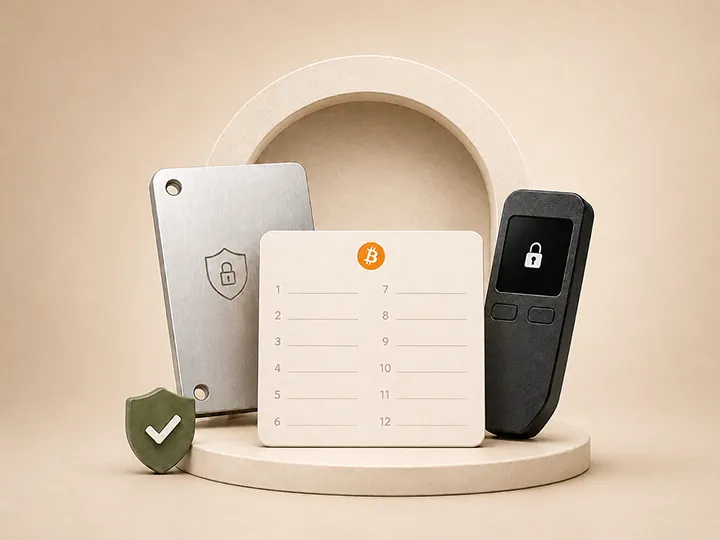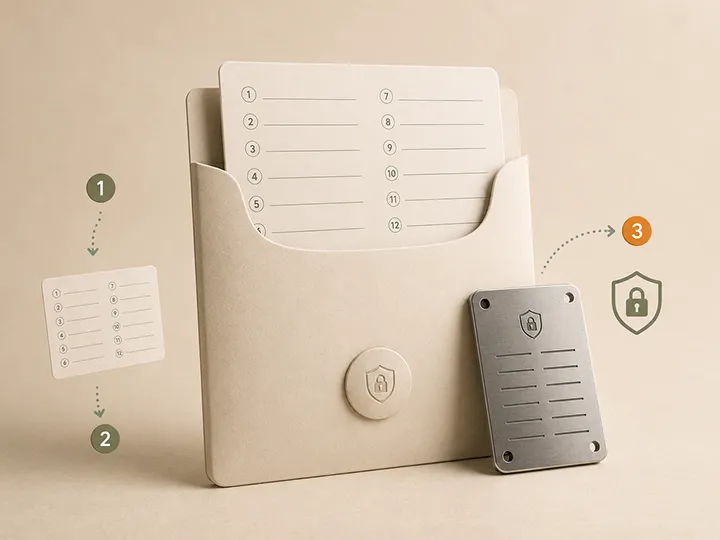
How seed phrases and private keys differ

A private key is a cryptographic secret a Bitcoin wallet uses to create signatures that authorize spending. A seed phrase is an ordered recovery backup that can recreate the wallet seed from which many private keys are derived.
They are connected, but they are not interchangeable.
The practical rule: Protect both secrets at the correct layer. Preserve the seed phrase accurately and privately. Let the hardware wallet generate, isolate, and use individual private keys. Do not export or manually handle raw private keys as a normal beginner workflow.
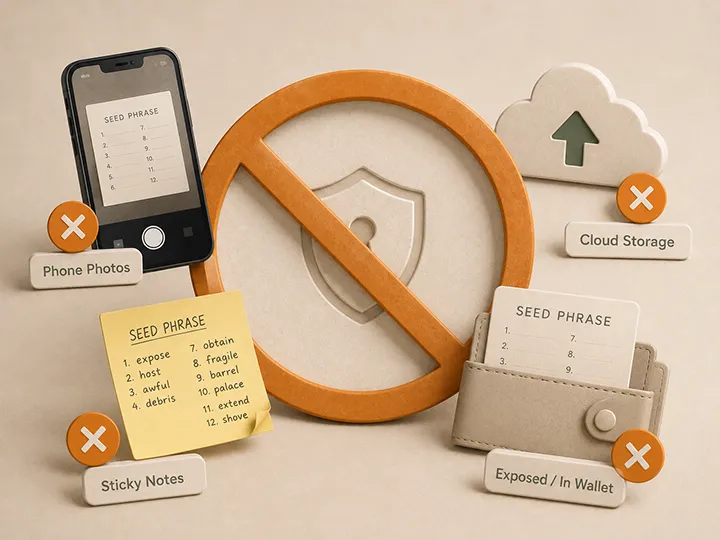
Neither secret belongs in a website, browser form, cloud document, email, support chat, screenshot, ordinary connected device, or AI tool.
Seed phrase vs private key at a glance
| Question | Seed phrase | Private key |
|---|---|---|
| Main job | Recreates the wallet seed and derived key hierarchy | Creates signatures that authorize spending |
| Typical form | Ordered words, often 12 or 24 in a BIP39 wallet | A secret number encoded for wallet software |
| Scope | Can recreate many private keys, public keys, addresses, and accounts | Usually controls one key relationship within the wallet |
| Normal use | Rarely, during backup verification or recovery | Used internally whenever the wallet signs |
| Who handles it directly? | The owner records and protects it | The wallet should manage it internally |
| Can it restore the whole wallet? | Usually, when the compatible standard, account structure, and optional passphrase match | Usually not; one private key is not a backup of the full deterministic wallet |
| Safe to share? | No | No |
For most hardware-wallet users, the decision is straightforward: protect the seed phrase as the recovery asset and let the device manage private keys.
Start with the fundamentals in What is a seed phrase?.
How a seed phrase becomes many private keys
A modern deterministic wallet does not usually create one unrelated private key and stop. It begins with recovery data and derives a structured hierarchy of keys.
A simplified model is:
wallet entropy
→ mnemonic seed phrase
→ binary wallet seed
→ hierarchical key structure
→ many private keys
→ public keys and wallet scripts
→ Bitcoin addresses
In a BIP39 wallet, the mnemonic words and any optional BIP39 passphrase produce the binary seed. The wallet then uses a deterministic derivation system, commonly based on BIP32 and related standards, to recreate the same hierarchy of keys.
The direction matters:
seed phrase → many private keys
It does not normally run backward:
one private key ✗→ original seed phrase
One exposed private key can compromise the spending authority associated with that key. It does not normally reveal the original seed phrase or recreate every other key in the wallet. An exposed seed phrase is broader because it can recreate the deterministic wallet when the other required recovery inputs are known.
That is why the seed phrase is normally the more powerful backup and the larger single point of failure.
What a private key actually does
A private key is a secret number used to create a cryptographic signature. The signature proves that a transaction was authorized by the required key without publishing that key to the network.
In normal hardware-wallet use:
- Wallet software prepares an unsigned transaction.
- The hardware wallet displays the important transaction details.
- You verify the destination and amount on the trusted device screen.
- The device uses the relevant private key internally to sign.
- The signed transaction is returned for broadcast to the Bitcoin network.
The private key should remain inside the protected signing environment. You should not need to copy it, paste it, print it, upload it, or move it between websites and apps.
A hardware wallet is valuable because it reduces the need to expose private keys to the internet-connected computer or phone coordinating the transaction.
One private key is not the whole wallet
A Bitcoin wallet manages more than one secret. A deterministic wallet can contain many current and future private keys, public keys, receiving addresses, change addresses, account structures, and transaction-signing rules.
Exporting one private key does not automatically back up that system. It normally preserves only the spending authority associated with that key relationship.
Do not replace seed-based recovery with an ad hoc collection of private-key exports.
What a seed phrase actually does
A seed phrase is human-readable recovery data. Its job is to recreate the wallet seed from which the deterministic wallet derives its keys.
That gives it a different operational role:
- It is created during wallet setup.
- It is recorded offline.
- It is stored for recovery, not everyday spending.
- It can recreate many keys and addresses.
- It should be used rarely.
- It must remain complete, exact, ordered, readable, private, and recoverable.
If the hardware wallet is lost, damaged, reset, or replaced, the correct seed phrase can usually recreate the wallet through a compatible recovery process.
The phrase does not contain bitcoin. A paper card or metal plate does not contain bitcoin either. Bitcoin remains represented by the network's transaction history and unspent outputs. The recovered keys restore the authority needed to spend the relevant outputs.
The device is replaceable. The recovery information may not be.
Recovery and spending are different workflows
| Recovery role | Spending role |
|---|---|
| The seed phrase recreates wallet seed material | Private keys create transaction signatures |
| Used rarely | Used internally whenever bitcoin is spent |
| Preserved as an offline backup | Isolated and used by wallet hardware or software |
| Exact words and order matter | The correct key must satisfy the relevant spending condition |
| Exposure can compromise the broader derived wallet | Exposure compromises the authority associated with that key |
| A replacement device can use the recovery data | The signing device handles everyday approvals |
The seed phrase is upstream recovery material. Private keys are downstream signing material.
Confusing those roles causes two common mistakes:
- Neglecting the seed phrase because the hardware wallet still works.
- Exporting or moving private keys manually because they sound like the "real" secret.
The correct model avoids both. Preserve the seed phrase. Keep private keys inside the wallet's protected signing environment.
Why the same phrase can recover many addresses
Deterministic wallets derive keys in a repeatable structure. Given the same recovery inputs, a compatible wallet can reproduce the same key hierarchy and locate the same addresses and bitcoin associated with it.
Those recovery inputs may include:
- the exact mnemonic words;
- the exact word order;
- the correct optional passphrase, when used;
- a compatible wallet standard;
- the expected derivation and account structure.
A recovery is not proven merely because a wallet accepts the words. The restored wallet should reproduce the expected identity, such as a known receiving address or account structure, without exposing the phrase to an unsafe environment.
The phrase may not restore every label, note, account name, transaction annotation, or interface setting from the original app. Recovery of the key hierarchy and restoration of application metadata are different things.
Learn the difference between recording and proving a backup in How to verify your seed phrase backup.
Seed phrase, private key, passphrase, PIN, public key, and address
| Item | Main role | Can it recreate the intended wallet? | Safe to share? |
|---|---|---|---|
| Seed phrase | Recreates the wallet seed and derived key hierarchy | Usually, with compatible recovery inputs | No |
| Private key | Signs for a specific key relationship | Usually not the entire deterministic wallet | No |
| Optional BIP39 passphrase | Changes the wallet derived from the mnemonic | Required for that passphrase-protected wallet | No |
| Device PIN | Restricts local access to one physical device | No | No |
| Public key | Supports verification and wallet-script construction | No | Not normally needed for casual sharing |
| Bitcoin address | Gives another person a destination for payment | No | Generally yes, with normal privacy considerations |
| Hardware wallet | Generates, protects, and uses keys for signing | It can host a recovery, but it is not the backup | No need to share the device |
The optional passphrase changes the derived wallet
A BIP39 passphrase is not the hardware-wallet PIN. The PIN protects local access to one device. The optional passphrase participates in wallet derivation.
Change one character in the passphrase and the wallet can derive a different valid set of keys and addresses. The device may not display an error because the different passphrase is not necessarily invalid. It simply produces a different wallet.
That makes the passphrase an additional recovery factor and an additional failure point. Read Passphrase vs seed phrase before adding one to an existing setup.
What happens when something is lost or exposed?
| Event | Practical consequence |
|---|---|
| Hardware wallet lost; seed phrase safe | The wallet can usually be recreated on compatible replacement hardware or software |
| Seed phrase lost; device still works | Spending may still work today, but the recovery path is weakened or gone |
| Seed phrase exposed | Another person may be able to recreate the derived wallet and spend from it |
| One private key exposed | The authority associated with that key is compromised; the full deterministic wallet is not automatically reconstructed |
| Device PIN exposed | Local device access may be weakened, but the PIN does not recreate the wallet elsewhere |
| Optional passphrase forgotten or mistyped | The same mnemonic words can derive a different wallet, often without an obvious error warning |
| Backup intact but recorded incorrectly | The expected wallet may not be recoverable |
If someone has seen the seed phrase, do not rely on a new hiding trick around the same recovery material. The durable remedy is to create a new wallet with new recovery data through a trusted process and move the bitcoin to addresses controlled by that wallet.
What our backup testing clarified
We have bought, handled, set up, or tested Billfodl, Coinplate Alpha, ELLIPAL Seed Phrase Steel, Keystone Tablet, Trezor Keep Metal, and SecuX XSEED backup systems. Their materials and recording methods differ, but they reinforced the same wallet model.
A seed backup is not a signing wallet
A metal backup stores recovery information. It does not generate addresses, sign transactions, or replace the hardware wallet. It protects the upstream recovery record while the wallet remains the signing environment.
Physical closure does not prove correctness
In our Billfodl setup, closing the unit confirmed that the letter tiles were retained. It did not confirm that the correct letters, words, or sequence had been recorded.
A backup medium preserves what the user enters. It cannot know whether that information belongs to the intended wallet.
Permanent marking should follow checking
The Coinplate workflow uses temporary marker positions before final punch marks. The general principle is more important than the product-specific method:
prepare
→ check
→ record permanently
→ verify the resulting wallet
A permanent mark in the wrong position is still wrong.
Durability matters because recovery data must remain usable
In our Trezor Keep Metal testing, the metal record remained readable after physical stress even when parts of the enclosure were damaged. The useful result was not that bitcoin or live private keys were stored inside the object. It was that the recovery record remained readable enough to preserve the input needed to derive the wallet again.
The conclusion is simple: a backup product is useful only when it preserves the exact recovery input and the owner has verified that the input recreates the expected wallet.
The protection standard for hardware-wallet users
- Protect the seed phrase directly. Record it exactly as generated. Keep the word order clear. Store it offline, private, readable, and separately from the everyday wallet device. Build the complete plan in How to store a seed phrase.
- Let the hardware wallet manage private keys. Do not export raw private keys as a routine task. Verify transaction details on the device and allow the protected signing environment to do its job.
- Verify the backup before relying on it. A written or metal record is not proven until a safe verification process confirms that it belongs to the expected wallet. Verify your seed phrase backup.
- Keep both secrets out of connected prompts. Do not enter a real seed phrase or private key into websites, browser utilities, cloud services, support forms, chats, or AI systems. See where a seed phrase should never be stored.
- Treat an optional passphrase as a separate recovery factor. The seed phrase alone does not recover the intended passphrase-protected wallet. The passphrase must be exact, recoverable, and included in the continuity plan without being casually stored beside the seed.
- Match the physical backup to the risk. Paper is simple, but fire, water, fading, tearing, and accidental disposal can destroy it. A tested metal backup can improve physical durability, but it cannot correct bad transcription or stop someone from reading an exposed phrase. Compare the trade-offs in Paper vs metal seed phrase backup.
Common misconceptions
- “A seed phrase is one private key written as words.” No. The mnemonic is recovery data used to create a wallet seed. The wallet derives a hierarchy containing many private keys from that seed.
- “The 12 or 24 words are separate private keys.” No. The words form one ordered mnemonic input. Dividing the list into arbitrary pieces does not turn it into a professional threshold-key system. Read Should you split a seed phrase? before using a home-made splitting scheme.
- “My bitcoin is inside the hardware wallet.” No. The device protects and uses signing keys. The Bitcoin network records transaction state. The wallet gives you the authority and tools to spend.
- “My PIN is the backup.” No. A PIN usually unlocks one physical device. It does not recreate the wallet on replacement hardware.
- “One exported private key backs up everything.” No. A deterministic wallet can contain many keys and future addresses. One key normally covers only its own key relationship, not the complete wallet hierarchy.
- “A metal backup proves recovery will work.” No. It proves only that recorded information survived in some form. The record can still contain the wrong letters, wrong order, wrong wallet, unreadable marks, or incomplete passphrase information.
- “Support needs my seed phrase or private key.” No legitimate support process needs either secret to verify, synchronize, unlock, or repair your wallet. A request for either secret is a stop signal.
Plain-English takeaway
A seed phrase and a private key are both critical secrets, but they solve different problems.
- Private keys authorize spending.
- The seed phrase recreates the wallet seed from which many private keys are derived.
- The hardware wallet should isolate and use private keys.
- You should preserve and verify the seed phrase as the recovery asset.
For most hardware-wallet users, the correct model is not to choose one secret and ignore the other. Protect each at the correct layer: keep the seed phrase exact, offline, private, verified, and physically resilient while keeping private keys inside the wallet's protected signing environment.
Protect the recovery record, not only the signing device
A hardware wallet protects private-key use during normal operation. The seed phrase still needs its own verified physical recovery path. Choose a metal backup only after the wallet relationship, phrase format, and storage location are understood.
For a substantial fixed-location backup, Coinplate Alpha is the contextual next-stage choice on this page. It is a permanent plate, so the layout must be checked before marking and the completed record must still be verified against the intended wallet.
Official Coinplate store affiliate link. We may earn a commission at no extra cost to you.
Use the metal backup selection criteria before buying, then compare the complete ranking in Best metal seed phrase backups.
Common questions about seed phrases and private keys
Is a seed phrase more important than a private key?
Both are critical secrets. For a normal deterministic hardware wallet, the seed phrase is usually the more important backup because it can recreate many private keys. The hardware wallet should protect and use individual private keys during normal operation.
Can a private key be derived from a seed phrase?
Yes. A compatible deterministic wallet derives private keys from the wallet seed created from the mnemonic recovery data and any required optional passphrase.
Can a seed phrase be derived from one private key?
No, not in the normal deterministic-wallet relationship. One derived private key does not reveal the original seed phrase or recreate the complete hierarchy.
Can the same seed phrase create different wallets?
Yes. A different optional BIP39 passphrase produces a different wallet. Different derivation or account structures can also cause wallet software to display different addresses until the correct structure is used.
Does a hardware wallet store the seed phrase or private keys?
The exact internal implementation varies by device. The practical role is consistent: a hardware wallet protects secret key material and signs without exposing raw private keys to the connected computer. The recovery phrase remains the owner's external backup.
Should I back up individual private keys?
Not as the normal recovery plan for a modern deterministic hardware wallet. Preserve and verify the wallet's supported seed-based recovery data instead of building an ad hoc collection of raw-key exports.
Can I type a private key into a website to check it?
No. Do not enter a real private key or seed phrase into a website, browser utility, support form, cloud service, chat, or AI tool.