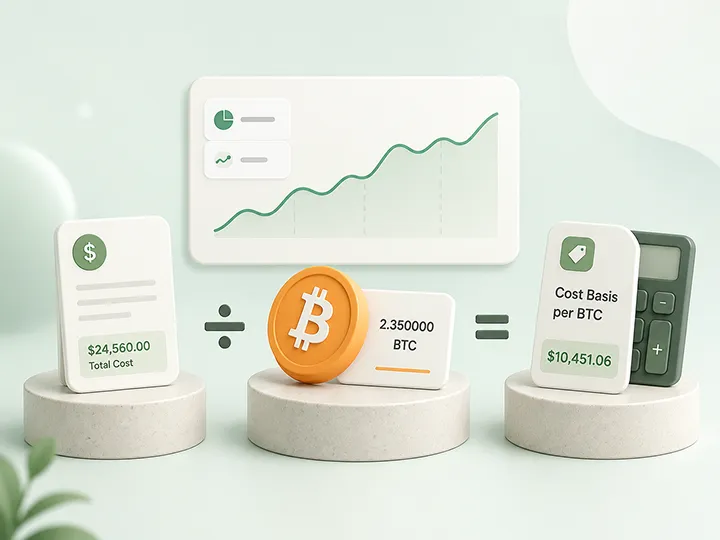
Bitcoin cost basis basics
Understand cost basis as a recordkeeping input, not a method choice or treatment verdict.

Enter your email to receive the free PDF checklist.
Read our Privacy Policy. For subscriber questions or corrections, use the Contact & Corrections page.
Bitcoin Tax Software
Most Bitcoin holders do not think about tax records until they need them. By then, the easy version of the job may already be gone.
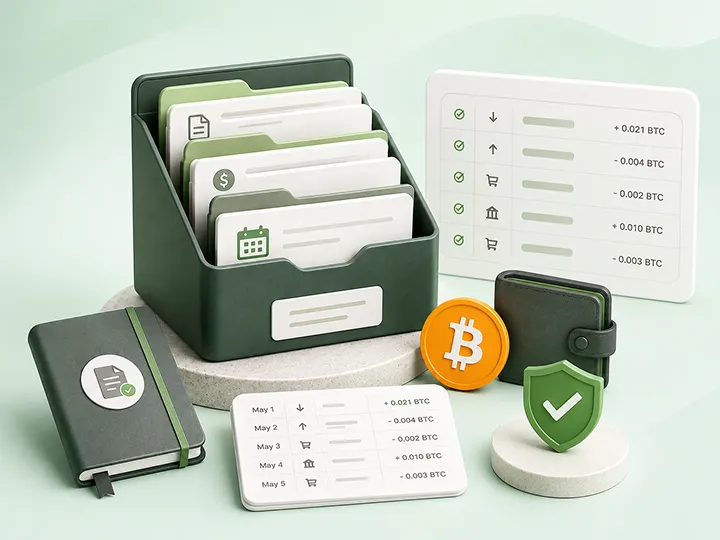

Most Bitcoin holders do not think about tax records until they need them. By then, the easy version of the job may already be gone.
A Bitcoin tax record is a preserved fact about something that happened: when you bought Bitcoin, moved it, sold it, spent it, received it, paid a fee, or transferred it between places you control. Those facts matter because, later, tax software or a qualified professional can only work from the information available to them. The key distinction is simple: records preserve facts; records do not determine tax treatment.
This is the foundation page for the lane - the field-by-field guide to what a Bitcoin tax record is and which facts to preserve before you use software. It is educational only, not tax, legal, or financial advice; rules differ by jurisdiction and change over time. For the scope of the lane, read the Bitcoin tax disclaimer; for the map, start at the hub.
A record is not a conclusion. It is not a filing decision. It is not a statement that something is or is not taxable. It is the evidence layer underneath any later review - the raw factual material that a spreadsheet, a tool, or a professional will later organize, calculate from, and interpret.
Think of it this way: months or years from now, someone (possibly you) will look at a transaction and need to answer a plain question - what was this, and does it connect to anything else? A good record answers that without anyone having to guess. A poor record, or a missing one, forces a reconstruction from memory and scraps, which is slower, weaker, and sometimes impossible.
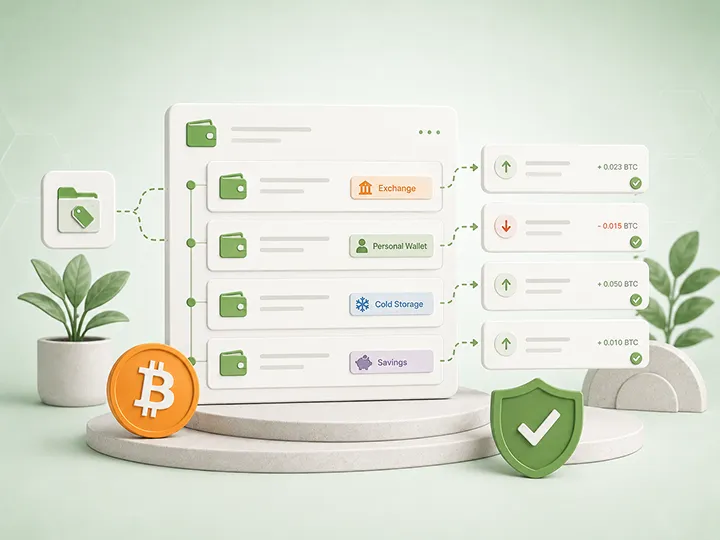
The most under-rated part of a record is the label. A transaction that looks obvious the day it happens rarely stays obvious. "Withdrawal to cold storage" is worth far more later than a blank line; "transfer to new wallet - both wallets mine" is worth far more than a bare address. Good records do not answer every tax question - they make the facts available so those questions can be reviewed at all.
This is the core habit of the entire lane. For each Bitcoin event, a complete record lets you show:
That last item is the single most valuable discipline on this page. An honest gap, clearly marked, is far more useful to future software or a professional than a confident invention that looks tidy and quietly misleads. You do not need a complex system to keep this checklist - you need the habit of capturing the facts close to the event, while the source is available and the reason is fresh.
Consider a common situation. In March you set up a recurring weekly buy on an exchange. In August you withdraw most of your Bitcoin to a hardware wallet. In November you move it again to a fresh wallet after a seed-phrase upgrade.
A clean record set here is not one line. It is: each weekly buy preserved as its own acquisition record (date, amount, source-shown value, fee, source); the August withdrawal connected to the hardware-wallet receipt (both sides, the transaction ID, the fee, and a label such as "withdrawal to cold storage - wallet mine"); and the November move recorded as "wallet migration - both wallets mine," with its own transaction ID and fee. Nothing in that record set decides how any of it is treated. It simply means that a year later - when you open tax software or hand the history to a professional - the trail can be followed without anyone asking you to reconstruct it from memory. That is the entire goal: not to answer the tax question yourself, but to make the facts reviewable.
When all activity happens inside one exchange account, that exchange may show a large part of your history in one place. Once you withdraw to your own wallet, that changes. The exchange may show an outflow; your wallet may show an inflow; the blockchain may show a transaction - but no single system automatically knows why the coins moved, whether the receiving wallet is yours, what those coins originally cost, or which earlier purchase they relate to.
The common failure is not that the blockchain loses the transaction - it keeps the movement permanently. The failure is that the holder loses the explanation around it. A wallet history can show that Bitcoin moved; it does not know what you paid on an exchange or why you moved it. That context has to come from your own records, which is exactly why self-custody raises the recordkeeping stakes rather than lowering them.
You do not need to start with a complex system - you need a consistent habit across a small number of record types. For each type below, the point is which facts to capture; where the underlying concept or boundary goes deeper, the linked page covers it.
Purchase and acquisition records. For every time Bitcoin comes into your control - a purchase, recurring buy, received payment, gift, or other incoming activity - capture the date and time, amount of Bitcoin, source-shown value at the time if available, fee, source account, and a source record (confirmation, export row, receipt, or statement), plus a label. Preserve the facts; do not decide treatment yourself. (For why acquisition records matter as an input, see Bitcoin cost basis basics.)
Sale, spend, and outgoing records. For every time Bitcoin leaves your control or is used in a transaction that may need review, capture the date and time, amount, destination, source-shown value if available, fee, and an explanation. A labeled outgoing transaction gives future software or a professional context that a blank one cannot. (For the disposal-versus-transfer boundary and the records a movement needs, see wallet transfer vs taxable event.)
Exchange exports and account statements. Keep your own copies of trade history, deposit history, withdrawal history, and fee or statement records where available. Interfaces change and old exports can become unavailable, so a periodic export gives you a copy that lives outside the platform. (For how to assemble a complete export set across every source, see export Bitcoin transaction history.)
Wallet transaction history. For self-custody, your wallet history and on-chain history become part of your record set. They show movement, amounts, timestamps, transaction IDs, and sometimes labels; they usually do not preserve the original purchase information, the source-shown value, or why a transaction happened - so pair them with notes, labels, and exchange history. (For how exchange and wallet records complement each other, see exchange CSV vs wallet history.)
Transfers between places you control. Record the sending source, receiving wallet, date and time, amount, transaction ID if on-chain, network fee, and a note explaining that it was a transfer between your own accounts. Whether any specific movement has tax consequences depends on your rules and is reviewed separately - the recordkeeping job is only to keep both sides connected and understandable.
Fees. Network, exchange, withdrawal, and trading fees are part of the record, even though they are small compared with the main transaction. Capture the amount, date, and the event each fee relates to. You are preserving the fact, not interpreting it.
Labels and notes. Labels turn raw history into a readable record. Keep them short and factual - for example "recurring buy," "withdrawal to cold storage," "transfer to new wallet," "exchange deposit," "wallet consolidation," "payment received," or "fee" - and avoid labels that only make sense the day you write them. (For the full labeling system, the "uncertain, needs review" label, and the wallet-secret safety rule, see wallet labeling for tax records.)
Cost and proceeds inputs. Preserve the source record for what you paid and what you received, plus fees, and keep the link between the Bitcoin you acquired and the Bitcoin later reviewed. This page does not explain calculation methods or which method applies. (For the concept and what facts support a basis review, see Bitcoin cost basis basics.)
Software can organize and calculate from records, but it cannot replace records you never kept. Good records help it import more complete data, match activity across sources, reduce duplicate or unexplained entries, preserve wallet context, and make gaps easier to spot. If you connect one exchange but used another, or your transfers are unlabeled, the risk is a report that looks organized but rests on incomplete inputs - which is why records come before tools. (For what a tool can and cannot do, see what tax software can and cannot do; for how it goes wrong, see Bitcoin tax software limitations.)
A professional interprets rules and applies them to your situation; records do not replace that judgment, but they are the starting material. Organized records let a professional spend time on substance rather than reconstructing basic facts, and let them see which sources are included, which may be missing, and which transactions need explanation. (For when a situation belongs with a professional, see when to use a tax professional.)
Records preserve what happened; they do not decide how rules apply, do not replace software or a qualified professional, and do not make incomplete history complete - they help you see what you have and what may still be missing. A recordkeeping habit helps preserve information; it does not tell you what to file, what you owe, or which rules apply. Bitcoin Plaster can help you understand the recordkeeping layer; it does not give tax, legal, or financial advice.
You do not have to build everything at once. Start with one question for every Bitcoin event: can I explain what happened later? Then capture what happened, when, how much moved, the value at the time if available, any fee, where it came from and went, why it happened, and which source record supports it. That can live in a spreadsheet, exported files, wallet labels, notes, or a dedicated workflow - the format matters far less than the habit of keeping the facts close to the event. The work is small when done early and much harder when delayed until you need the records under pressure.
A Bitcoin-only history is narrower than a broad multi-token portfolio, which makes a clean habit more realistic - but narrower is not effortless. For that framework, see Bitcoin-only tax recordkeeping.
What records should I keep for Bitcoin? Records that preserve what happened: dates, times, amounts, source-shown values where available, fees, sources, destinations, transaction IDs, exchange exports, wallet history, and notes explaining purpose. They preserve facts; they do not determine treatment.
Do I need to record transfers between my own wallets? Yes - as movements that may need to be explained later. Preserve the sending source, receiving wallet, date, time, amount, transaction ID if available, fee, and a note. This is a recordkeeping point, not a treatment conclusion.
Do tax records decide whether I owe tax? No. Records preserve the facts; they do not decide whether an event creates a tax consequence or how rules apply. That depends on your jurisdiction and circumstances.
What if I lost records from an old exchange? Gather whatever still exists - old exports, confirmation emails, bank records, wallet history, on-chain transaction IDs - and label any reconstructed notes clearly so they are distinguishable from original source records. Do not guess treatment from incomplete records; if important history is missing, consider a qualified professional.
Can tax software figure out my Bitcoin records for me? It can organize and calculate from data it receives; it cannot supply records you never kept or know context you never labeled. The cleaner your exports, wallet history, labels, and notes, the more useful it can be.
What is the difference between exchange records and wallet history? Exchange records show activity inside a platform: trades, deposits, withdrawals, fees, statements. Wallet history shows activity connected to a wallet or address, including on-chain movements and transaction IDs. A complete record often needs both, plus your own labels and notes.
How long should I keep Bitcoin records? This page does not set a jurisdiction-specific retention period, which depends on rules that vary and change. As a general recordkeeping habit, keep original source records for as long as the activity could plausibly still need review, and do not discard the only copy of an acquisition or movement record.
Understand cost basis as a recordkeeping input, not a method choice or treatment verdict.
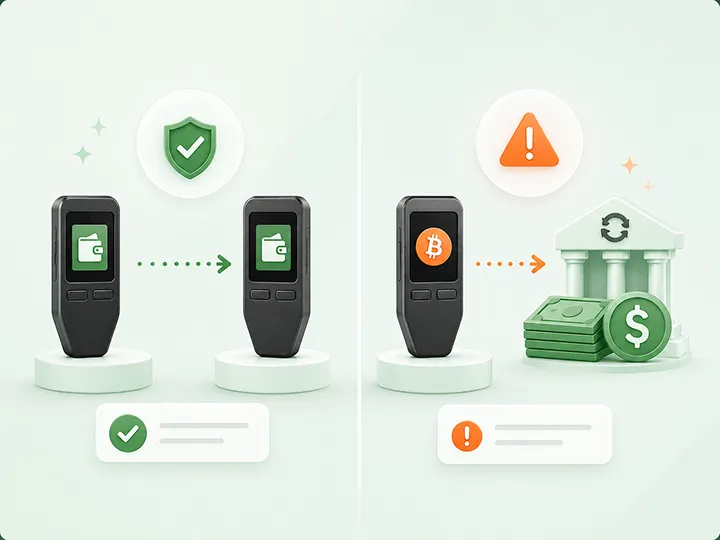
Preserve the facts a wallet movement needs without turning records into treatment conclusions.
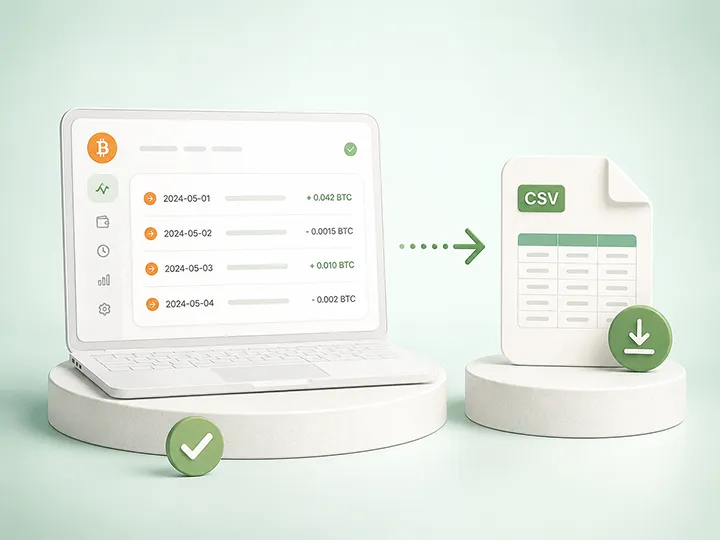
Assemble a complete export set before importing records into tax software.
Preserve ownership, purpose, source, destination, and uncertainty without recording wallet secrets.