
Bitcoin tax software and records
Start with the records-first map for tax software, self-custody records, and qualified review boundaries.

Enter your email to receive the free PDF checklist.
Read our Privacy Policy. For subscriber questions or corrections, use the Contact & Corrections page.
Bitcoin tax software boundary
This page sets the boundary for every Bitcoin tax page on Bitcoin Plaster. It explains what our tax content can and cannot do - before any software evaluation appears - and it stays in force over anything we publish later in this lane.
This page sets the boundary for every Bitcoin tax page on Bitcoin Plaster. It explains what our tax content can and cannot do - before any software evaluation appears - and it stays in force over anything we publish later in this lane.
Bitcoin Plaster tax content is educational recordkeeping orientation for Bitcoin holders. It is not legal, tax, estate, financial, filing, audit-defense, or personalized advice, and it is not tax strategy. When the right answer depends on your facts and your jurisdiction, "it depends" is the honest answer - and qualified professional judgment is the safer next step.
Three things follow, and they govern the whole lane:
For the broader hub, start with Bitcoin tax software and records.
A generic "this is not advice" line is easy to write and almost worthless. The real risk for Bitcoin holders is specific, and it is worth naming plainly: software, exports, wallet history, exchange records, and self-custody movements can combine to produce a report that looks complete even when the records underneath it are weak.
That is the failure this page exists to make visible. A tidy, professional-looking summary can rest on a missing exchange account, an omitted wallet, a mislabeled transfer, or an acquisition record no one ever kept - and nothing on the screen announces the gap. So instead of a one-line disclaimer, this page does the more useful thing: it explains what our content is built to do, what it is not allowed to do, how to treat software output, why self-custody changes the recordkeeping burden, and when a situation belongs with a qualified professional.
We write from a Bitcoin self-custody and recordkeeping perspective. We are not accountants, tax advisers, attorneys, or a CPA firm, and we do not give filing advice. That is not a limitation to apologise for - it is the reason this content can be useful and safe at the same time.
Recordkeeping and interpretation are genuinely different layers. Preserving and organizing the facts of what happened is one job. Deciding how tax rules apply to those facts, in your jurisdiction and your circumstances, is a different job that depends on information we cannot see and rules that change over time. We are confident about the first layer and deliberately silent on the second. Drawing the line there means our content can be specific and practical about records without ever pretending to decide a tax position it has no basis to decide. When a page reaches the interpretation layer, it routes you to someone qualified rather than guessing on your behalf.
A good educational page should make you more organized, more skeptical of bad data, and better prepared to ask specific questions. It should not pretend to decide your tax position.
It is educational recordkeeping orientation for Bitcoin holders: transaction history, cost basis, transfers, disposals, exports, missing records, software imports, software limits, and professional-support signals - and a trust boundary for anything we publish later in this lane.
It is not personal advice, filing guidance, product endorsement, or a professional replacement. There are no definitive taxable or non-taxable conclusions, filing or form instructions, tax strategies, or audit-defense guidance here; no product recommendation, ranking, product card, affiliate link, or vendor CTA; and no claim that Bitcoin Plaster, a tool, or a general article can replace qualified professional judgment.
"It depends" can sound like a non-answer. It is not - it is an accurate description of the problem, and it points to something you can act on.
Our content does not know your jurisdiction, your full transaction history, your income, your filing status, your business activity, your local rules, your reporting obligations, your previous filings, or your own records. Any confident, one-size answer that ignores those facts is not more helpful than "it depends" - it is riskier, because it hides the exact variables that change the outcome.
So the productive move is not to hunt for a universal answer online. It is to organize your facts and turn your uncertainty into specific questions: I cannot connect this wallet receipt to an exchange withdrawal; I do not know which acquisition record belongs to this movement; the software shows a number I cannot explain. Those are questions a qualified professional can actually answer under the rules that apply to you - and they are far more useful than a generic answer that was never built for your situation.
Software is useful, but it is not magic. It is a record-processing tool that works from the data you provide, the connections you authorize, the labels applied, and the settings you choose. At a boundary level: it may help import, organize, and calculate from records and prepare reports for review - and it cannot know whether a movement was a transfer between places you controlled, tell you what local law requires, or make a report correct simply because it looks complete.
This page keeps that at the boundary. For the model of what each part of a tool's job is, see what tax software can and cannot do; for how it goes wrong, see Bitcoin tax software limitations.
Self-custody is a major part of the Bitcoin Holder Standard, and it changes the recordkeeping burden. When you buy on an exchange, the exchange may hold the date, amount, price, fees, and currency value at acquisition. When you withdraw to a wallet you control, the wallet shows that Bitcoin arrived and the blockchain shows that it moved - but neither automatically carries the purchase-price context from the exchange.
This page does not say whether a transfer between wallets you control is taxable in your jurisdiction; that depends on facts and rules outside this page. The narrower, practical point: if you move Bitcoin into self-custody, keep the acquisition records and the transfer records connected. If that link breaks, later software output is weaker and later professional review is harder.
If you take one principle from this page, take this one. Software can make messy data look organized - which is useful when the data is right and dangerous when it is incomplete. Neat formatting and precise numbers can make output feel more certain than the inputs support, and a report rarely shows you which entries rest on complete source records and which rest on missing context. So a report is where review starts, not where it ends. Treat every calculated result as something to trace back to source records before you rely on it.
This is a general caution, not a personalized recommendation, and Bitcoin Plaster cannot choose a professional for you or replace their judgment. In broad terms, qualified professional help becomes more worth considering as records go missing, amounts grow significant, years go unreconciled, jurisdictions multiply, sources disagree, activity stops being simple holding, or an outcome would affect a filing decision you are not confident making.
For the detailed signals that separate a recordkeeping problem from a judgment problem, see when to use a tax professional.
We may later evaluate tax tools, but no tool evaluation overrides this boundary. A tool evaluation is not tax advice. A supported-exchange list, a clean interface, or a polished report does not prove your full history imported correctly. A report is a starting point for review, not proof that the records are complete. And the boundary on this page outranks any recommendation we might ever make.
This disclaimer is a prerequisite for the rest of the lane, and the commitment behind it is simple: no affiliate relationship, sponsorship, vendor access, or commercial incentive decides our conclusions. If we ever evaluate a tool, that evaluation is written to help you judge fit against your own records - not to sell you a product - and it remains subject to everything on this page. This page itself contains no product recommendation, ranking, product card, affiliate link, or /go route. For the broader standard, read the editorial policy.
Bitcoin Plaster tax content is educational. It helps Bitcoin holders keep better records, understand software limits, and ask better questions. It does not tell you what you owe or how to file, does not decide whether a specific transaction is taxable, and does not provide legal, tax, estate, financial, accounting, filing, audit-defense, or personalized advice. Tax rules depend on your jurisdiction and your facts. For your own situation, consult a qualified professional.
Is Bitcoin Plaster's tax content tax advice? No. It is educational recordkeeping orientation for Bitcoin holders - not legal, tax, financial, filing, audit-defense, or personalized advice, and not tax strategy.
Can Bitcoin tax software replace a qualified professional? No. It can organize records and calculate from the data it receives, but it cannot decide every fact, interpret every rule for your situation, repair missing history, or replace qualified judgment.
Can a report look complete but still be wrong? Yes. A report can look finished while the underlying records are incomplete, duplicated, mislabeled, or missing acquisition history. Review output before relying on it.
Does moving Bitcoin to self-custody create a taxable event? This page does not answer that; treatment depends on your jurisdiction and facts. The recordkeeping point is to preserve the link between the original acquisition records and the later wallet movement.
When should I talk to a tax professional? Consider qualified help as records go missing, amounts grow significant, years go unreconciled, jurisdictions multiply, your records conflict with an exchange's, or you are unsure how local rules apply. The professional-boundary page covers the specific signals.
Does this page recommend any tax software? No. It recommends, ranks, and links to nothing. It sets the scope boundary that anything we publish later in this lane must follow.
Start with the records-first map for tax software, self-custody records, and qualified review boundaries.
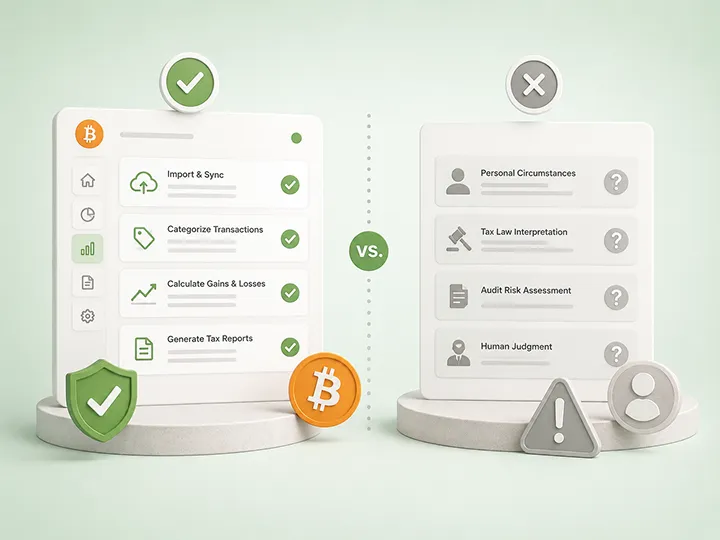
Use the five-stage model to separate import, classification, calculation, review, and interpretation.
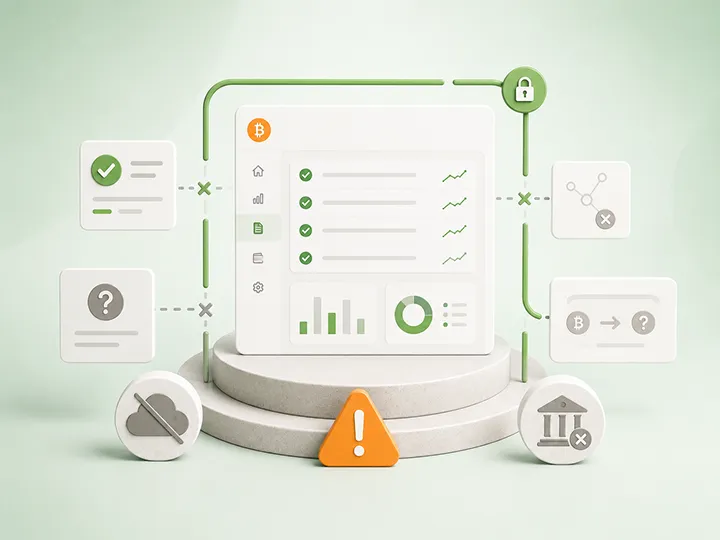
Separate recordkeeping work from judgment questions that may need qualified review.