How to build a recoverable storage plan

A safe seed phrase backup is not just a durable object. It is a complete recovery system: the correct words, a verified record, a controlled location, separation from the wallet, and a future path that an authorized person can actually use.
Our recommendation: Build the recovery architecture before buying the backup product. Verify the source record first, define the failures the system must survive, then choose the medium and location that fit those requirements.
The storage architecture in seven steps
- Create the seed phrase in the wallet's legitimate setup process and keep it offline.
- Record every word or entry accurately and in the correct order.
- Verify that the backup restores the intended wallet before long-term storage.
- Define the main risks: exposure, destruction, loss, data error, and continuity failure.
- Choose a storage location before choosing paper, metal, locks, or enclosures.
- Keep the wallet and its only recovery path outside the same realistic failure event.
- Maintain the plan when the wallet, location, household, passphrase, or authorized people change.
Each step has a dedicated guide. This page connects them into one operating sequence.
Layer 1: Preserve the correct recovery data
The first layer is accuracy. A fireproof backup that contains the wrong word, wrong order, wrong wallet, or missing passphrase dependency is still a failed backup.
Before placement, confirm:
- the expected number of words or entries;
- the exact order and readable spelling;
- the correct wallet identity;
- the correct recovery format;
- the role of any optional passphrase;
- the finished backup through a safe, understood verification process.
Use How to verify your seed phrase backup for the full procedure. Do not type a real phrase into a website, chat, ordinary computer application, or online checker.
Layer 2: Define what the system must survive
Storage decisions should follow a threat model, not a favorite product or hiding place.
| Failure class | Architecture question |
|---|---|
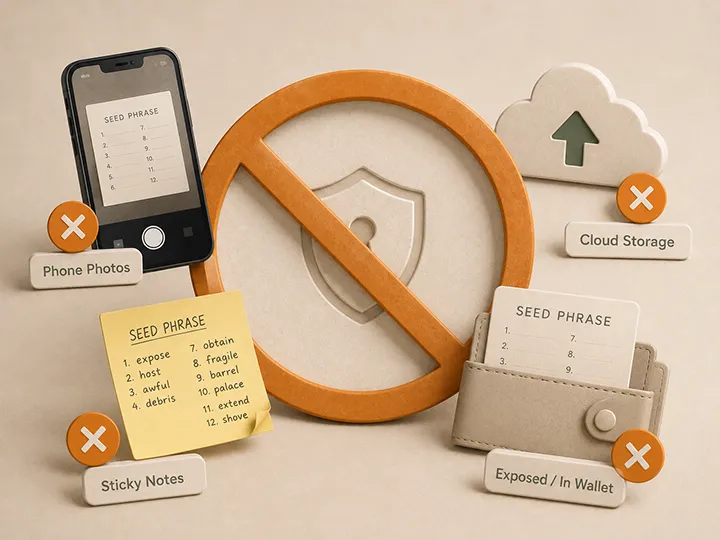
| Exposure | Who could read, photograph, copy, or remove the recovery data? |
| Destruction | What fire, water, corrosion, impact, or deterioration could make it unreadable? |
| Unavailability | Could the authorized person lose access to every usable copy? |
| Data failure | Could the record be wrong, incomplete, unordered, or tied to the wrong wallet? |
| Continuity failure | Could illness, death, memory loss, or unclear instructions defeat recovery? |
The seed phrase storage threat model turns those questions into a prioritized decision framework.
Layer 3: Choose the location before the medium
The location determines which physical risks matter and who can reach the backup. A compact metal enclosure, large plate, paper card, safe, sealed container, or off-site arrangement may be appropriate in one setting and impractical in another.
Evaluate:
- ordinary household or workplace access;
- fire, water, moisture, corrosion, and impact exposure;
- burglary, moving, renovation, cleaning, and accidental disposal;
- whether the object remains findable after years of disuse;
- whether the authorized person can reach it during an emergency;
- whether the wallet shares the same room, safe, building, or travel bag.
For residential implementation, use Seed phrase storage at home. For geographic separation, institutional access, and trusted-person dependencies, use Seed phrase storage outside the home.
Layer 4: Match paper or metal to the physical risk
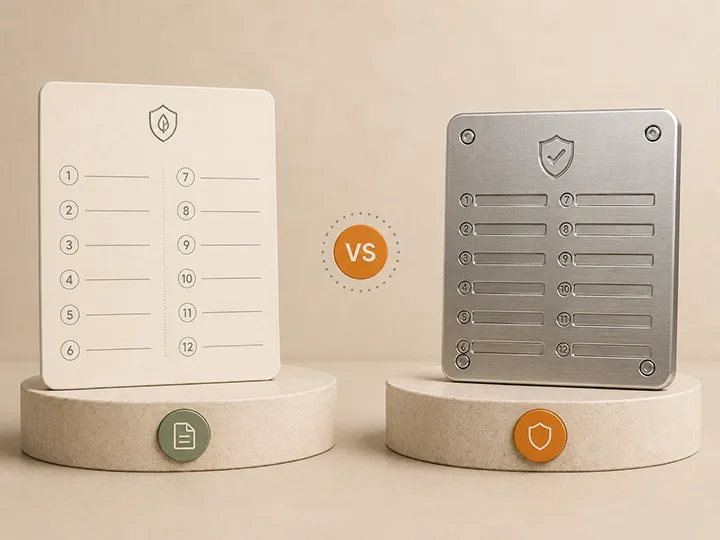
Paper is simple, readable, and easy to replace, but it is vulnerable to water, fire, fading, tearing, insects, and accidental disposal. Metal improves physical resilience, but it does not prevent theft, copying, wrong transcription, or failed continuity.
Use paper when the environment is controlled and its limitations are acceptable. Use a verified metal record when realistic physical hazards make a paper-only recovery path too fragile.
Read Paper vs metal seed phrase backup for the format decision, then apply the metal backup selection criteria before comparing products.
Layer 5: Separate independent failure events
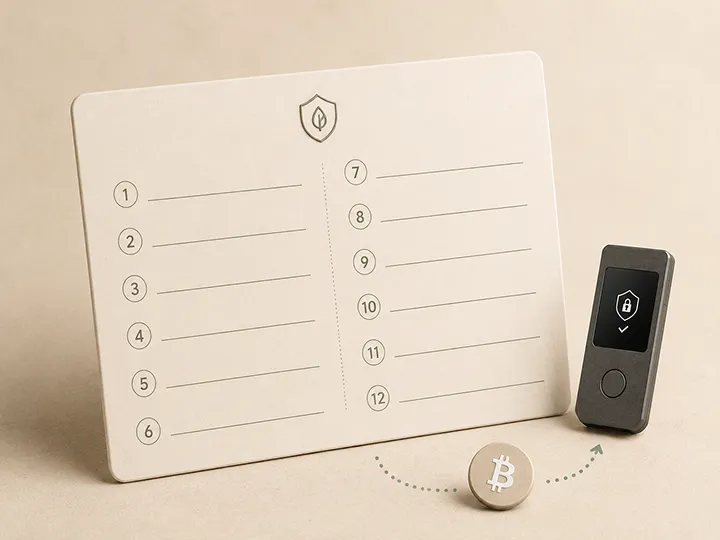
The hardware wallet and seed phrase do different jobs. The device supports normal signing. The seed phrase exists for recovery when that device is unavailable.
If one theft, fire, flood, confiscation, move, or access failure can remove both, the recovery architecture is concentrated even when two objects exist.
Separation does not always require a second complete seed copy. It requires a clear answer to this question:
Which single realistic event could remove the wallet and every usable recovery path?
Fix that common-mode failure without scattering uncontrolled copies.
Layer 6: Add redundancy only for a defined reason
Another copy can reduce location concentration, but it also expands the exposure surface, maintenance burden, and continuity problem.
Add a second copy only when:
- it protects against a named failure;
- its location is meaningfully independent;
- access is controlled;
- the copy is verified separately;
- the active and retired copies can be tracked over time.
Do not improvise custom splitting or coded fragments as a substitute for a designed recovery scheme. Read Should you split a seed phrase? before using any split arrangement.
Layer 7: Design for future recovery
A plan that works only because one person remembers the location, passphrase, labels, and sequence is not complete.
Keep non-secret instructions separate from the secret material. Document enough for an authorized person to identify the correct wallet, locate the recovery path, understand whether a passphrase exists, and know whom to contact for legal or technical help.
Use Family recovery instructions, Bitcoin inheritance basics, and the emergency recovery plan for continuity work.
Maintain the storage architecture
Review the system after:
- a wallet migration or replacement;
- adding or removing a passphrase;
- moving, renovation, or a change in property control;
- adding or retiring a backup copy;
- a change in household access or trusted people;
- suspected exposure, physical damage, or a broken seal;
- a material change in the value protected.
A routine review can confirm existence, location control, copy status, and continuity instructions without repeatedly reading or digitizing the seed phrase.
Final architecture checklist
- The recovery data is correct and entirely offline.
- The backup restores the intended wallet through a safe verification process.
- The location matches the real threat model.
- The medium matches the physical environment.
- The wallet and only recovery path do not share one realistic failure event.
- Every additional copy has a defined purpose and owner.
- Passphrase and continuity dependencies are understood.
- Temporary and retired recovery material is controlled.
- The authorized future recovery path is findable and understandable.
When one item is unclear, follow the linked child guide instead of adding more products or complexity.
Choose the physical backup after the storage plan
A product should follow the location, recovery format, access plan, verification method, and number of independent copies. It should not define those decisions for you.
Trezor Keep Metal is our overall winner for a compact permanent backup when its exact version matches the wallet. Coinplate Alpha is the alternative for a larger fixed-location plate with more storage space and easier visual inspection.
Official Trezor and Coinplate store affiliate links. We may earn a commission at no extra cost to you.
Use the full metal backup comparison to compare setup accuracy, dimensions, permanence, and post-damage recovery before choosing.
Common questions about seed phrase storage architecture
What is the safest way to store a seed phrase?
Keep it offline, verify it, place it in a controlled location, match the medium to the physical risks, separate it from the wallet's failure event, and preserve an understandable future recovery path.
Should I choose the storage location or the backup product first?
Choose the location and threat model first. The product should fit the environment, access plan, recovery format, and available space.
Should the hardware wallet and seed phrase be in the same safe?
Not when that safe becomes the only shared failure point. One event should not remove both the signing device and every recovery path.
Do I need more than one seed phrase copy?
Only when an additional copy removes a defined risk and can be controlled, verified, tracked, and maintained independently.
Is metal always better than paper?
No. Metal is stronger against many physical hazards, while paper is simpler and easier to inspect. The correct choice depends on the environment and the consequences of physical damage.
How often should I review the storage plan?
Review it after material changes to the wallet, passphrase, location, household, authorized people, copy count, or physical condition. Periodic existence and access checks are also useful.