Paper vs metal seed phrase backup: which is better?

Paper is the best immediate setup medium. Metal is the stronger long-term primary medium when physical durability is the weak point.
This page answers the format decision only. It does not rank products, design storage locations, or replace backup verification.
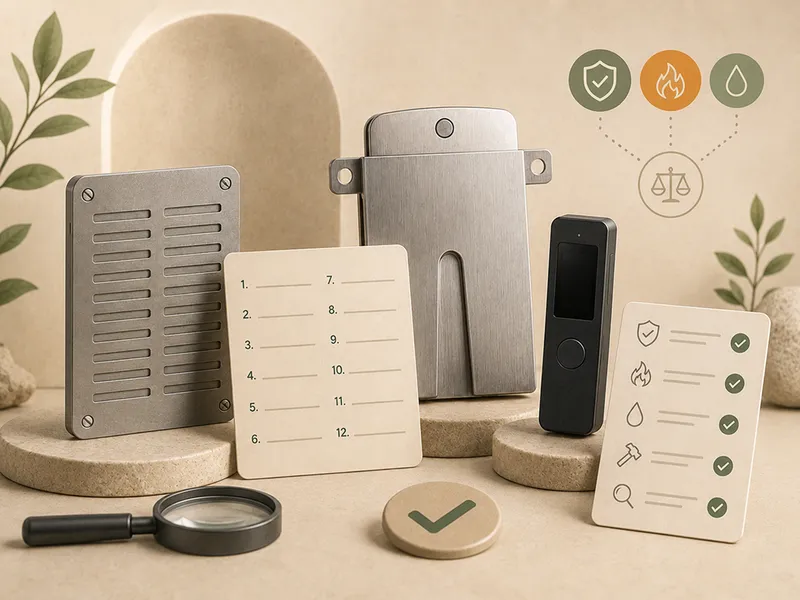
Paper vs metal at a glance
| Question | Paper | Metal |
|---|---|---|
| Best role | Immediate offline setup, temporary staging, and easy full-word inspection | Long-term primary record where fire, water, corrosion, or wear are credible |
| Setup | Fast, familiar, and easy to correct | Slower and method-dependent; some errors become permanent |
| Readability | Full words are easy to inspect | Depends on marks, grid labels, tile order, and representation |
| Physical durability | Weak against heat, water, humidity, insects, tearing, and disposal | Potentially much stronger, but only when the material and recording method are appropriate |
| Component risk | Usually one sheet or card | Ranges from one-piece plates to multi-part tile enclosures |
| Cost | Minimal | Higher and justified only after the recovery plan is understood |
| Security against reading or theft | None by itself | None by itself |
What paper is for
Paper is appropriate when you need an immediate offline backup during wallet setup, are still checking the words and order, or want a clear full-word record before committing to a permanent format.
Its strengths are simplicity, low cost, easy correction, and direct readability. Those strengths make paper a useful starting medium, not necessarily a sufficient long-term primary medium.
What metal is for
Metal improves resistance to physical destruction and long-term degradation. It is justified when the recovery record may face fire, water, humidity, corrosion, abrasion, insects, repeated handling, or accidental disposal over many years.
The category is broad. A punched plate, stamped plate, engraved record, capsule, cassette, and reusable tile enclosure do not share the same setup risk or post-damage behavior. Use the selection criteria before choosing a product.
What neither medium solves
Paper and metal protect the same recovery information. Neither medium automatically:
- proves that the correct seed was recorded;
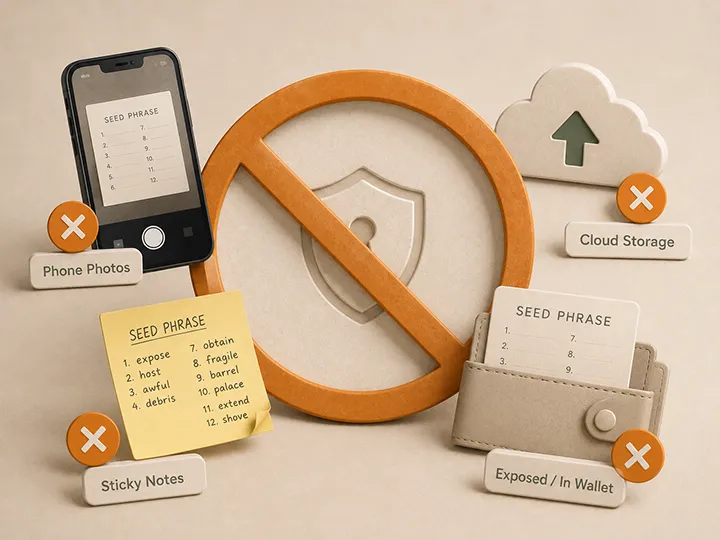
- prevents someone from copying readable recovery data;
- recovers a forgotten passphrase;
- creates independence when every copy is stored together;
- makes a hidden backup findable to the authorized person;
- keeps an outdated backup synchronized with the active wallet.
Fix those problems through verification, access control, location design, version control, and continuity planning.
The correct sequence
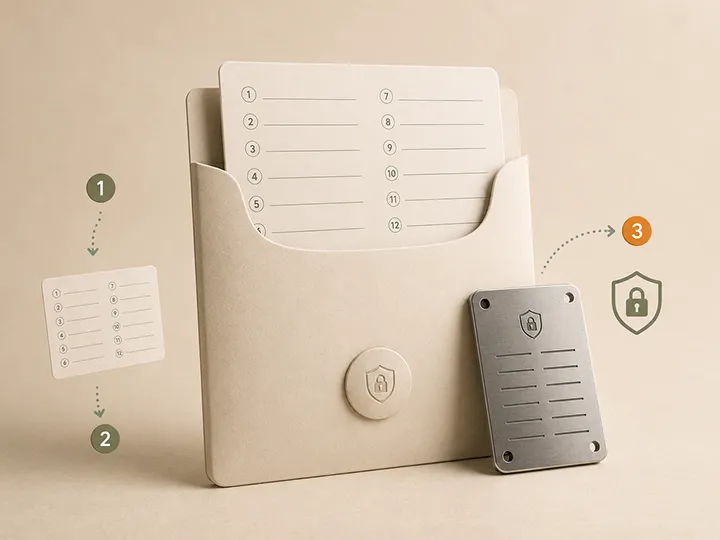
- Create an offline paper backup immediately. Do not delay having a recovery record while shopping for metal.
- Verify the backup. Confirm the exact words, order, wallet relationship, format, and any passphrase dependency.
- Assess the physical environment. Use the fire and water risk guide and the storage threat model.
- Move to metal when durability justifies it. Select the recording method and product only after the first three steps are settled.
When paper is enough
Paper may remain acceptable when the record is verified, the environment is dry and controlled, the storage period is limited, the value at risk is modest, and an independent recovery path already reduces the consequence of losing that copy.
That is a bounded decision. It should not be confused with a claim that paper is equally durable.
When metal is justified
Choose metal when the backup is intended to last for years, the current paper copy is the weakest part of the recovery plan, or credible fire, water, humidity, corrosion, wear, and disposal risks exceed what paper can reasonably tolerate.
Do not buy metal yet when the seed is unverified, the recovery format is unclear, the passphrase plan is unresolved, or the storage locations have not been chosen.
Using paper and metal together
A verified metal record can serve as the primary long-term copy while paper remains a temporary setup record or a controlled secondary copy. Every additional copy increases exposure and maintenance obligations, so keep it only when it creates an independent recovery path.
Labeling and instructions should identify which backup is current without placing the secret itself in an ordinary document.
Final verdict
Use paper first. Rely on metal for the long-term primary record when physical durability matters.
The format decision comes before the product decision. After deciding that metal is appropriate, use the current product comparison to choose by fit.
If metal is the correct medium
These routes are for readers who have verified the seed, resolved the storage plan, and decided that physical durability is the remaining problem.
Official Coinplate and Billfodl store affiliate links. We may earn a commission at no extra cost to you.
Trezor Keep Metal remains our overall winner when its exact version matches the wallet. Use the complete metal backup comparison to check that route and all six reviewed products.
Paper vs metal seed phrase backup FAQ
Is a metal seed phrase backup safer than paper?
It is generally safer against physical destruction. Appropriate metal and durable marks provide stronger resistance to fire, water, moisture, tearing, insects, and long-term wear. Metal does not protect the phrase from someone who finds it and does not correct inaccurate recording.
Do I need to replace my paper seed phrase backup immediately?
Replace it when physical fragility is the weak point and you can create a metal record accurately. Do not delay having any offline backup while waiting for metal. A clear, verified, protected paper copy is the correct interim medium.
Can I keep both paper and metal seed phrase backups?
Yes, when each copy has a defined purpose and location. Keeping both creates redundancy and another exposure point. Do not keep them together and treat that as independent recovery.
Is stainless steel always better than aluminum for a seed phrase backup?
Stainless steel generally offers stronger heat and physical resistance, but it can be harder to mark deeply. Aluminum is easier to engrave and has a different protection profile. Judge the finished record, not only the alloy name.
Are tile-based metal seed phrase backups reliable?
They can be reliable when assembled accurately and kept inside an enclosure that preserves character order. Their advantage is correction before closure. Their main risk is that severe enclosure failure can release or reorder components.
Are punched or stamped metal plates better than removable tiles?
Permanent plates remove the risk of loose characters shifting after closure. They introduce irreversible marking risk. They are usually the stronger fit when impact and component retention matter more than reusability.
Is a fire-rated safe enough for a paper seed phrase backup?
A safe can improve paper's protection, but its actual result depends on rating, installation, exposure duration, internal temperature, water intrusion, and the event itself. It does not make paper and metal share the same failure profile. Read the seed phrase fire and water risk guide for the deeper analysis.