Bitcoin inheritance basics

Bitcoin inheritance requires both lawful authority and a usable technical recovery path. One without the other creates either inaccessible property or unauthorized access.
This page explains principles, roles, and boundaries. It is educational, not legal, tax, or estate-planning advice. Use qualified local professionals for documents and obligations in your jurisdiction.
The inheritance problem
Self-custodied Bitcoin does not automatically move through an institution when the owner dies or becomes incapacitated. The plan must connect five separate requirements:
- The right people know that Bitcoin exists.
- The right people have lawful authority to act.
- They can locate the non-secret instructions and recovery components.
- They can recover the intended wallet safely.
- They can distinguish legitimate help from scams and coercion.
Legal authority and technical access are different
| Layer | Question | Failure when missing |
|---|---|---|
| Legal authority | Who is entitled or authorized to act? | A technically capable person may lack the right to move or distribute the asset. |
| Technical access | Can the authorized person recover the intended wallet? | Valid documents may exist while the Bitcoin remains inaccessible. |
| Continuity instructions | Can the authorized person connect the legal and technical layers? | People know something exists but cannot safely begin. |
Do not place a complete seed phrase or passphrase directly into an ordinary will or broadly distributed instruction document. Such documents may be copied, reviewed, stored, or disclosed through processes that are not designed for wallet secrets.
Define the roles
One person may hold several roles, but the plan should name them separately.
- Owner: defines the wallet, recovery model, and intended succession.
- Heir or beneficiary: receives the economic interest under the applicable plan.
- Executor, trustee, or authorized representative: acts under the legal documents and local law.
- Technical helper: assists with wallet recovery without automatically receiving ownership authority.
- Custodian of a component: controls a location, key, share, instruction packet, or other recovery dependency.
- Professional adviser: handles jurisdiction-specific legal, tax, or fiduciary questions.
Each role needs a clear trigger, scope, and fallback. Avoid a plan in which one unreviewed person has both unrestricted secret access and sole interpretive authority.
Build the plan in five layers
1. Authority
Use valid local documents and clearly defined decision rights. Include incapacity as well as death.
2. Awareness
Ensure that at least one appropriate person knows the asset and plan exist without publishing the secret or exact storage map.
3. Non-secret instructions
Explain the wallet type, component roles, passphrase status, legitimate starting point, expected-wallet confirmation, and stop conditions. The practical document belongs in Family recovery instructions.
4. Controlled access
Define how authorized people obtain the required locations, keys, shares, devices, or professional support when the activation event occurs.
5. Verified recovery material
Every active seed backup, passphrase dependency, and multi-part structure must be verified before it becomes an inheritance dependency.
Choose the simplest recoverable model
Complexity should solve a named problem.
- Complete seed backup: simplest to understand, but possession may provide complete technical control.
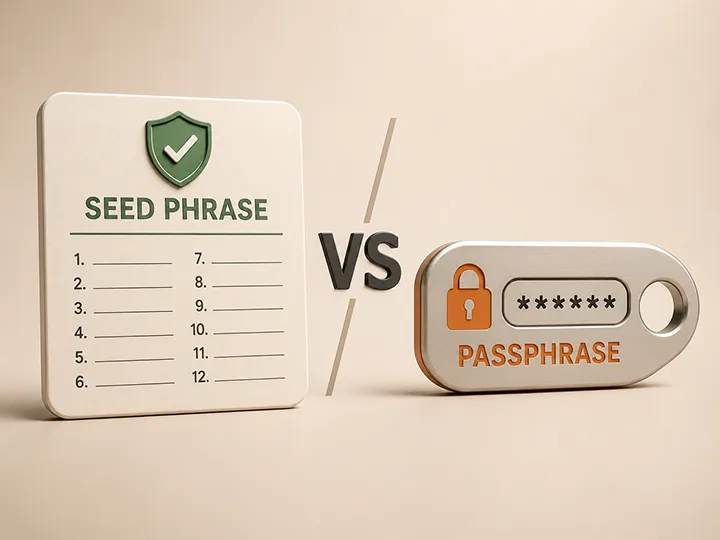
- Seed plus optional passphrase: separates one secret from another, but creates a second loss and continuity risk.
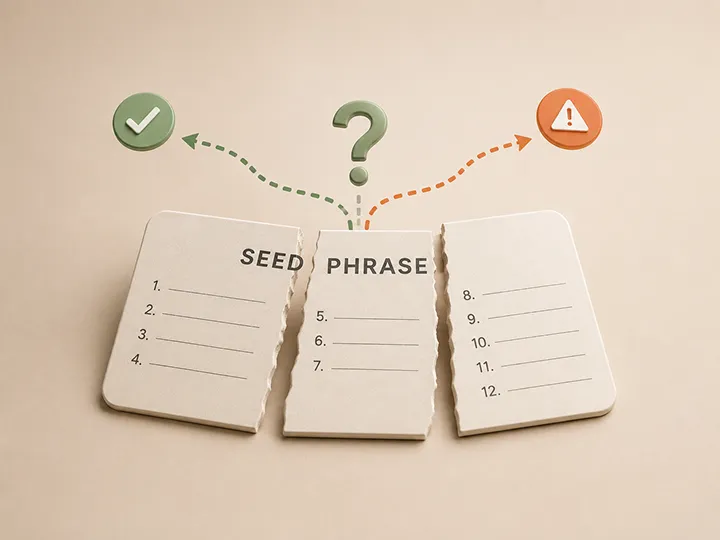
- Standardized threshold shares: can distribute control, but requires correct threshold, labels, locations, tools, and future understanding.
- DIY splits or private codes: often create ambiguity and should not be treated as a default inheritance method.
The best structure is the least complex one that satisfies the legal, security, and continuity requirements.
Minimum inheritance plan
- The legal documents identify the relevant authority and intended outcome.
- An appropriate person knows the plan exists.
- A non-secret instruction document provides the safe starting path.
- The active wallet and recovery components are identifiable.
- Passphrase status is documented without revealing the passphrase.
- The expected wallet can be confirmed through a non-secret identifier.
- Every required copy or share has been verified.
- The plan covers incapacity, death, damaged devices, and unavailable locations.
- A review trigger exists for wallet, family, residence, legal, and storage changes.
What belongs in the emergency plan
Inheritance defines who may act and why. The emergency recovery plan defines what operational steps occur during device loss, backup damage, suspected exposure, or owner unavailability.
Keep the authority document, non-secret handoff, operational template, and secret material as separate layers unless a qualified design deliberately combines them.
Final principle
A complete inheritance plan gives the right people lawful authority, enough awareness to begin, controlled access to the required components, and a verified method for recognizing the intended wallet without exposing the secret prematurely.
Choose the physical backup after the inheritance path works
The heirs first need lawful authority, awareness, non-secret instructions, controlled access, and a verified recovery process. A metal plate cannot supply those missing roles. Choose the physical record only after the continuity plan explains who may recover, when, and how the expected wallet will be confirmed.
Coinplate Alpha is the contextual choice when a substantial fixed-location plate fits the inheritance plan better than a compact enclosure. Its size can support direct inspection, but the words must remain secret and the access path must still be controlled.
Official Coinplate store affiliate link. We may earn a commission at no extra cost to you.
Finish the family recovery instructions and emergency recovery plan before treating any physical medium as inheritance readiness.
Frequently asked questions
Is a hardware wallet enough for Bitcoin inheritance?
No. A device does not establish legal authority, explain the recovery model, reveal whether a passphrase exists, or guarantee access to the correct backup.
Should heirs receive the seed phrase now?
Not by default. Give them the awareness, authority, and non-secret instructions required by their role. Current secret access should be a deliberate security decision.
Can I put the seed phrase in a will?
An ordinary will may be copied or disclosed through processes that are not appropriate for wallet secrets. Obtain jurisdiction-specific professional advice and separate legal instructions from secret material.
Is possession of the seed the same as legal ownership?
No. Technical control and legal entitlement are different questions.
What changes when a passphrase is used?
The plan must preserve the exact passphrase recovery path without exposing it alongside the seed or depending on one person's memory.
How often should the inheritance plan be reviewed?
Review it after material changes to the wallet, passphrase, family, legal documents, residence, trusted people, storage locations, or value protected.