Standard Keystone Tablet review

Our verdict: Buy the standard Keystone Tablet only when its lower-cost, smaller reusable-tile format is the specific fit.
The standard Keystone Tablet is a quiet, correction-friendly metal backup with organized character sheets and direct tile placement. It is easier to revise than a permanently punched plate, but the finished recovery record still depends on small parts, screws, retaining plates, and preserved tile order.
If you are choosing between the two removable-tile Keystone models, Keystone Tablet Plus is our family-level pick. Its individual tile slots and more redundant enclosure improve retention. The standard Tablet remains the value choice when compactness and the lower current price matter more.
Neither model is our best overall metal backup. Trezor Keep Metal remains the stronger default because its recovery data is permanently punched into metal rather than held as removable letters.
Official Keystone store affiliate link. We may earn a commission at no extra cost to you.
Keystone Tablet review summary
| Category | Our assessment |
|---|---|
| Overall verdict | Buy only for the standard model's value, compactness, correction, and reuse |
| Best for | Careful users who want organized removable tiles and a lower-cost Keystone option |
| Not best for | Maximum tile retention, permanent data, minimum component count, weak eyesight, or limited dexterity |
| Main strength | Open direct placement makes entries easy to inspect and correct before closure |
| Main limitation | Recovery order depends on the enclosure, retaining layers, screws, and removable characters |
| Recording method | First four letters of BIP39 words using removable metal tiles |
| Phrase support | Manufacturer states support for 12-, 18-, and 24-word BIP39 phrases |
| Reusability | Yes, after complete re-verification and secure cleanup of the previous phrase |
| Keystone family winner | Keystone Tablet Plus |
| Best overall alternative | Trezor Keep Metal |
Evidence map for this review
- Observed on our standard Tablet: tile selection, first-four-letter recording, direct placement, screws, orientation, blank handling, closure, visual inspection, leftover-sheet privacy, and recovery verification.
- Manufacturer-stated: current standard-model identity, 304 stainless-steel construction, BIP39 compatibility, supported phrase lengths, package contents, and environmental claims.
- Related-model evidence: our separate Tablet Plus review and stress test. Those destructive results are not relabeled as tests of the standard unit.
- Editorial conclusion: the standard Tablet is the value-oriented reusable Keystone model; Plus is the stronger Keystone tile design; permanent-mark products remain structurally simpler.
The direct buying decision
Choose the standard Keystone Tablet when:
- you specifically want the lower-cost Keystone tile model;
- compact horizontal storage is preferable to the larger Plus format;
- quiet setup matters more than hammering or punching;
- you want to correct entries before final closure;
- you value reuse after a wallet change;
- organized character sheets are easier than loose mixed pieces;
- you can handle small screws and tiles carefully;
- you will run a trusted recovery check after assembly;
- you have a secure plan for unused tiles, character sheets, and temporary notes.
Choose Keystone Tablet Plus instead when you want the stronger current Keystone tile enclosure, individual tile slots, and more retention redundancy.
Skip both Keystone tile models when you want recovery data permanently attached to one record, the fewest finished-state components, or the lowest dependence on enclosure integrity.
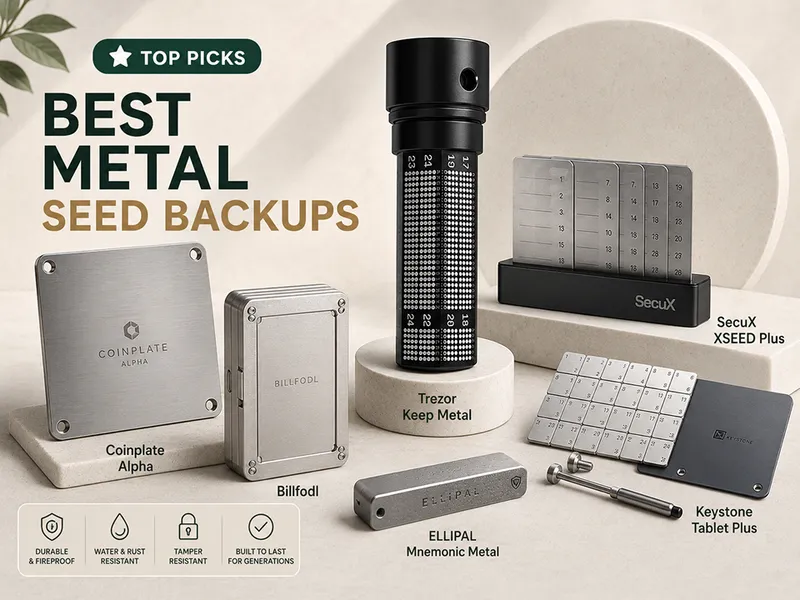
Choose Trezor Keep Metal for our best overall permanent-mark option, Billfodl for a compact reusable cassette, or Coinplate Alpha for a large heavy-duty plate.
Official Keystone store affiliate link. We may earn a commission at no extra cost to you.
The standard Keystone Tablet reviewed here
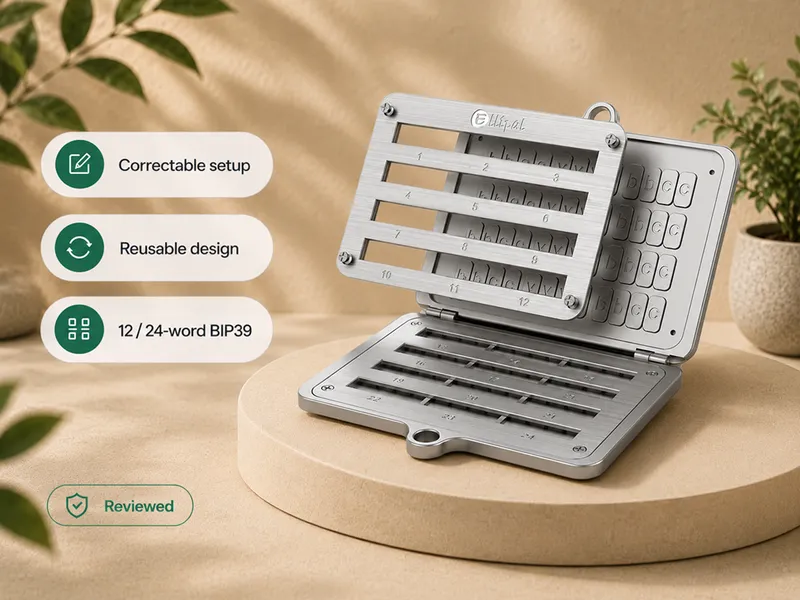
This page covers the standard removable-tile Keystone Tablet. It stores the first four letters of BIP39 recovery words with pre-engraved metal characters arranged in numbered positions and secured inside a stainless-steel enclosure.
The workflow is quiet, correctable, and reusable. The trade-off is mechanical dependency: the characters remain useful only while their orientation and numbered order remain recoverable.
Keystone Tablet Plus is a distinct redesigned product with individual positions for each tile. Keystone Tablet Punch is a permanent punch-grid product and belongs to a different recording category.
How the first-four-letter system works
For the standard English BIP39 word list, the first four letters uniquely identify each word. Keystone therefore stores four character positions for each numbered recovery-word slot.
This saves space, but it does not reduce the need for accuracy. The correct letters must remain attached to the correct numbered position. A three-letter word, ambiguous blank, reversed tile, or shifted row can create recovery uncertainty.
The four-letter rule applies to standardized BIP39 words. It does not make the Tablet suitable for arbitrary optional passphrases, numbers, symbols, or private shorthand.
Our setup workflow
- Identify the exact model. Confirm that the package is the standard Keystone Tablet, not Plus or Punch.
- Prepare the phrase privately. Keep the real recovery words offline and outside camera view.
- Open the enclosure. Remove the required screws carefully and keep the supplied spares controlled.
- Select the required tiles. Use the first four letters of each BIP39 word and preserve numbered word order.
- Place and inspect each row. Confirm orientation, seating, blanks, and that earlier rows did not move.
- Close without overtightening. Start each screw cleanly and avoid damaging the threads.
- Run a trusted recovery check. The product cannot validate spelling, word order, wallet identity, or passphrase state.
- Secure setup residue. Treat unused sheets, detached tiles, notes, and packaging as sensitive.
Where the standard Tablet works well
- Direct placement: characters are placed into open positions instead of being forced through a narrow cassette channel.
- Correction: an entry can be changed before final closure without destroying the plate.
- Organized inventory: supplied character sheets are easier to manage than a loose tray of mixed tiles.
- Quiet setup: no hammering, punching, or electric engraving is required.
- Complete kit: the enclosure, character sheets, screwdriver, and spare screws reduce extra-tool procurement.
- Reuse: the enclosure can be reset after a wallet change, provided the previous phrase is handled and retired correctly.
Where setup friction appears
Small screws and threads
The screws are easy to misplace, and careless alignment can damage the threads. We found that gently turning a screw backwards until it settles into the thread before tightening reduces the risk of cross-threading. Overtightening is unnecessary.
Tile movement and orientation
Removable characters can shift before the retaining layer is secured. Every row needs a final visual inspection after the enclosure is moved or folded.
Three-letter words and blanks
The reviewed character sheets did not provide a dedicated blank tile for every situation. Any workaround must remain unambiguous years later and during recovery by another authorized person.
Leftover-sheet privacy
Removed characters leave gaps in the inventory sheets. Those gaps may reveal information about which letters were used. Do not leave the sheets beside the finished backup or discard them casually.
Verification is mandatory
A clean-looking metal backup can still contain the wrong phrase. The Tablet does not verify spelling, word order, wallet identity, or a BIP39 passphrase.
Before relying on it, confirm every position visually and complete a trusted wallet-level recovery check. Keep the original working wallet available where possible. Do not enter a real seed into an online checker, browser form, ordinary computer application, support chat, or AI tool.
Keystone Tablet vs Keystone Tablet Plus
| Decision factor | Standard Keystone Tablet | Keystone Tablet Plus |
|---|---|---|
| Positioning | Value-oriented reusable tile model | Stronger current reusable tile model |
| Form | Smaller landscape-style enclosure | Larger portrait-style enclosure |
| Tile retention | Open placement with fewer retention boundaries | Individual slot for each tile and greater fastening redundancy |
| Setup | Fewer fasteners and faster closure | More fasteners and a slower closure workflow |
| Price position | Lower current official price | Higher current official price |
| Our recommendation | Choose for value and compactness | Choose when buying a Keystone removable-tile backup today |
The Plus redesign improves the weakest part of the standard model: keeping each character in a defined position when the enclosure bends. It does not turn removable tiles into permanent data. Read the full Keystone Tablet Plus review and stress test before paying for the upgrade.
Shared limits of the removable-tile design
Metal survival and recovery survival are different outcomes. A tile can remain readable while the backup fails because numbered order is lost.
The standard Tablet therefore remains dependent on:
- accurate transcription;
- correct tile orientation;
- retaining layers staying aligned;
- screws and threads remaining functional;
- the enclosure preserving numbered order;
- the authorized person understanding the four-letter recovery format.
This is an editorial design-class risk supported by our separate Plus stress evidence. It is not a claim that the standard sample underwent the same destructive sequence.
Keystone Tablet pros and cons
Pros
- Lower-cost entry into Keystone's reusable metal backup family.
- Quiet setup without hammering or engraving.
- Direct tile placement and easy correction before closure.
- Organized character sheets and included screwdriver.
- Supports common BIP39 phrase lengths according to the manufacturer.
- Reusable after complete cleanup and verification.
- Compact format.
Cons
- Less tile-retention redundancy than Tablet Plus.
- Many small components and screws.
- Manual entry with no spelling or order validation.
- Leftover character inventory creates a privacy-handling problem.
- Locks and seals do not stop theft or copying.
- Recovery order still depends on enclosure integrity.
- Not suitable for arbitrary passphrase text, numbers, or symbols.
Is the standard Keystone Tablet worth buying?
Yes, for a narrow use case: you want a reusable metal tile backup, prefer the smaller standard enclosure, and the lower price matters.
No, when you want the best Keystone tile design. In that case, buy Tablet Plus. No, when you want the structurally simpler permanent-mark option; choose Trezor Keep Metal or another verified plate-based system.
Setup checklist
- Confirm the listing says Keystone Tablet, not Plus or Punch.
- Confirm the phrase uses a supported BIP39 length.
- Keep the seed offline and outside camera view.
- Check the first four letters and numbered position for every word.
- Use an unambiguous method for three-letter words.
- Inspect every tile after moving or closing the internal layers.
- Start screws cleanly and avoid overtightening.
- Run a trusted recovery check.
- Handle unused sheets and setup residue as sensitive information.
- Store the finished backup under real access control.
Sources and test notes
- Bitcoin Plaster first-party setup notes for the purchased standard Keystone Tablet, including character placement, screws, blanks, closure, leftover sheets, and recovery verification.
- The official Keystone Tablet product page is used for current model identity, 304 stainless-steel construction, BIP39 compatibility, phrase support, package contents, and current product positioning.
- Our Keystone Tablet Plus review owns the destructive vehicle, debris, crushing, separation, and post-destruction flame evidence. Those results are not presented as standard-Tablet tests.
Final verdict
Buy the standard Keystone Tablet for value, compactness, correction, and reuse, not because it is the strongest Keystone model.
Tablet Plus is the better Keystone family choice because it improves tile retention. Trezor Keep Metal remains our stronger overall metal-backup recommendation because permanent marks reduce finished-state component dependency.
Official Keystone store affiliate link. We may earn a commission at no extra cost to you.
Frequently asked questions
Is the standard Keystone Tablet the same as Tablet Plus?
No. Both use removable characters, but Plus is a distinct redesigned product with individual tile slots and more retention redundancy.
Which Keystone Tablet should I buy?
Choose Tablet Plus when you want the stronger Keystone tile enclosure. Choose the standard Tablet when lower price, smaller size, and a shorter closure workflow matter more.
Why does Keystone Tablet store only four letters per word?
Standard English BIP39 words are uniquely identified by their first four letters within the correct word list. Correct numbered order and unambiguous blanks are still required.
What is the biggest setup risk?
Incorrect or reversed characters, disturbed rows, ambiguous blanks, damaged threads, and incomplete recovery verification. The enclosure cannot validate the phrase.
What should I do with leftover character sheets?
Treat them as sensitive setup residue. Missing characters and frequency patterns may reveal information about the phrase.
Is Keystone Tablet reusable?
Yes. Reuse requires exposing and removing the previous phrase, securely handling every old component, assembling the new phrase, and completing a fresh recovery check.