SecuX XSEED family review

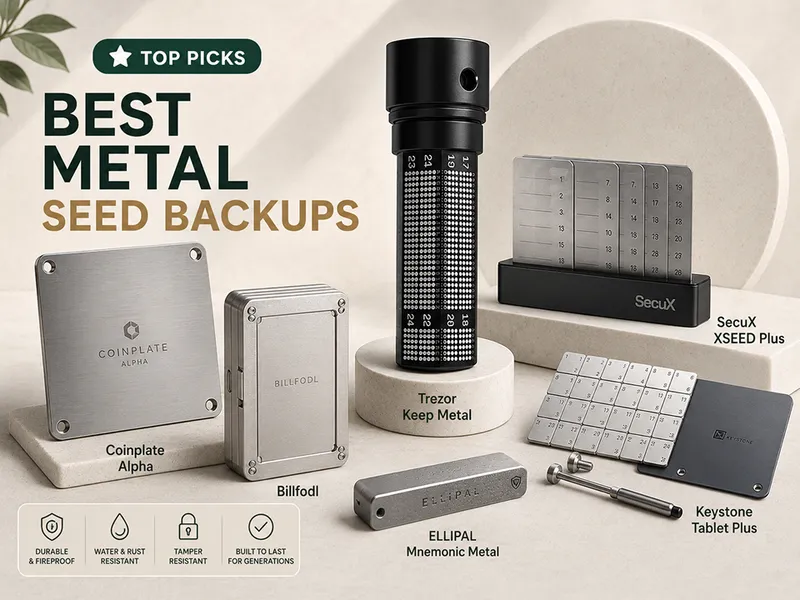
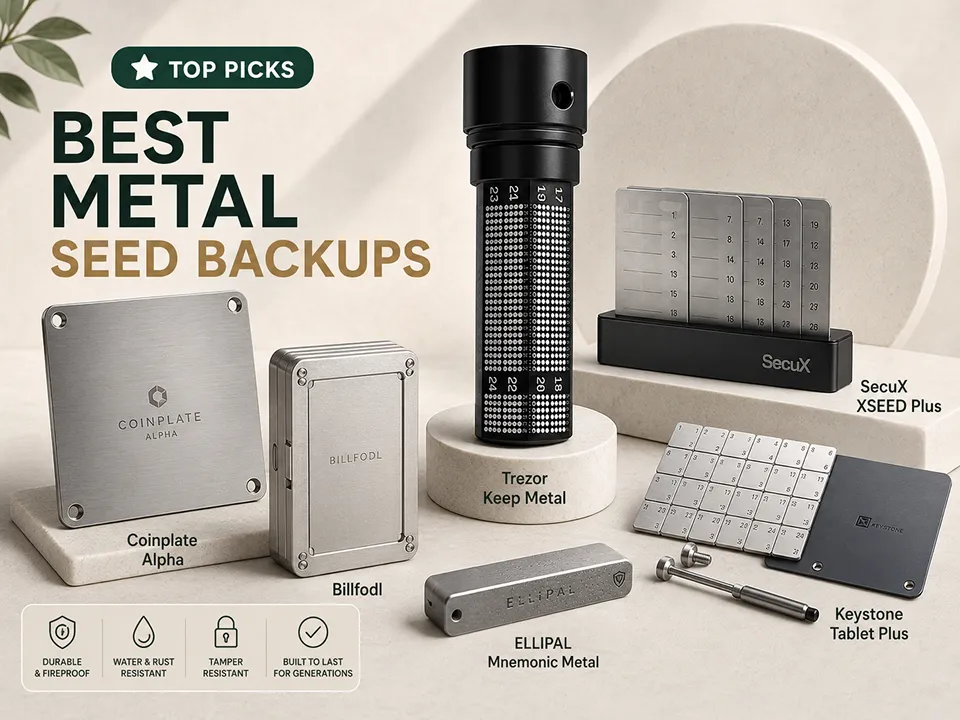
Our verdict: XSEED Plus is the best model in the SecuX XSEED family, but Trezor Keep Metal remains our better overall metal seed backup.
The XSEED name covers three materially different recovery-backup systems:
- XSEED: hand engraving on stainless-steel plates after a practice stage on aluminum;
- XSEED Plus: permanent letter stamping across several metal plates;
- XSEED Pro: reusable character tiles in a steel cassette, plus a secondary aluminum plate.
They do not differ only in size or price. They use different tools, create different setup risks, and fail in different ways.
Our family winner is XSEED Plus because permanent stamped data avoids the basic model's shallow-mark concern and the Pro model's removable-tile dependency.
It is still a use-case recommendation. XSEED Plus requires hammering, noise, alignment, repeated manual checks, and acceptance that a wrong strike is permanent. We also do not have the same product-specific destructive-test record for it that we have for Trezor Keep Metal.
Best SecuX model: XSEED Plus. Best reusable SecuX model: XSEED Pro. Best overall metal backup: Trezor Keep Metal.
Official SecuX store affiliate link. We may earn a commission at no extra cost to you.
SecuX XSEED comparison at a glance
| Model | Recording method | Best for | Main advantage | Main limitation | Our verdict |
|---|---|---|---|---|---|
| XSEED | Hand engraving on two steel plates, with aluminum practice sheets | Budget-conscious users comfortable engraving | Useful practice-first workflow | Supplied tool initially produced shallow-looking steel scratches | Buy only for a careful budget engraving setup |
| XSEED Plus | Hammer stamping across several plates | Permanent multi-plate backup | Fixed steel data with no internal tile-order dependency | Noise, alignment, irreversible errors, and limited destructive evidence | Best XSEED model |
| XSEED Pro | Reusable pre-engraved tiles in a steel cassette, plus an aluminum plate | Correction, reuse, and quiet setup | Two recording methods and reusable enclosure | Small parts, screws, abbreviation rules, and tile retention | Buy only for the reusable hybrid use case |
Evidence map for this family review
- Observed on basic XSEED: engraving trials on aluminum and stainless steel, tool behavior, mark depth, and the gap between easy practice marks and reliable steel marks.
- Observed on XSEED Plus: plate handling, character-stamp alignment, hammer workflow, permanent-error risk, and the different roles of steel and aluminum plates.
- Observed on XSEED Pro: tile insertion, screws, closure, open-frame fragility, reusable cassette behavior, and the mismatch between sample capacity and current wording about character count.
- Manufacturer-stated: current materials, compatibility, package contents, and environmental specifications. These are not presented as Bitcoin Plaster destructive-test results.
- Editorial inference: XSEED Plus is the family winner because permanent stamped steel avoids the basic model's shallow-mark concern and the Pro model's internal tile-order dependency.
The direct buying decision
Choose XSEED Plus when:
- you want permanent marks on steel;
- a multi-plate kit fits your storage architecture;
- you do not want recovery order to depend on loose internal characters;
- you can use a hammer privately on a stable surface;
- setup noise is acceptable;
- you can align stamps accurately and check every character;
- you accept that mistakes become permanent;
- you will verify the finished record against the expected wallet.
Choose XSEED Pro when:
- correction before closure is essential;
- reuse after a wallet change provides real value;
- quiet assembly matters more than minimum component count;
- you want an enclosed steel cassette plus a secondary plate;
- you can manage small tiles, screws, and abbreviated entries;
- you will document the recovery format clearly for a future authorized user.
Choose the basic XSEED when:
- budget is the primary constraint;
- a practice stage before final steel is useful;
- you are comfortable engraving by hand;
- you can prove the final steel marks are deep and unambiguous;
- you accept a paired two-plate system and limited product-specific durability evidence.
Skip the family when:
- you want our strongest overall recommendation;
- you want a compact permanent product with broader first-hand stress evidence;
- you do not want to choose among engraving, stamping, and tile assembly;
- you are likely to rush a repetitive manual setup;
- you expect locks or seals to protect a readable seed from a determined person;
- you will not complete a legitimate recovery check.
Official SecuX store affiliate link. We may earn a commission at no extra cost to you.
Three XSEED workflows, not one product
The XSEED family covers three materially different recovery systems: hand engraving on the basic model, permanent character stamping on XSEED Plus, and removable characters plus a secondary plate on XSEED Pro.
These workflows have opposite operational properties. Permanent marks reduce loose-part risk but make mistakes irreversible. Removable characters support correction and reuse but depend on retention and order.
The model name must therefore be confirmed before reading specifications, following instructions, or choosing an affiliate route.
Why model identity matters
The product name alone is not enough to make a safe purchase.
A permanent stamped plate and a reusable tile cassette can both be sold under the XSEED family while creating opposite operational trade-offs.
One earlier comparison note also described a two-layer sliding-tile product as “XSEED Plus.” That description conflicts with the product-specific Plus evidence showing flat plates, alphabet stamps, an engraving tool, and a hammer workflow. The sliding-tile description is closer to XSEED Pro or another revision.
For that reason, every public claim should remain tied to:
- the exact model name;
- the photographed or tested sample;
- the exact setup method;
- the current official product listing.
Buying the wrong model changes the entire recovery workflow, not merely the package contents.
How we tested the family
Bitcoin Plaster purchased, handled, and documented the relevant XSEED kits used for this review.
Our evidence includes:
- engraving trials on the basic XSEED's aluminum and stainless-steel components;
- comparison of mark depth and tool behavior across the two materials;
- stamping trials on XSEED Plus using a small household hammer;
- inspection of the Plus plate and stamp workflow;
- assembly and handling of the XSEED Pro cassette and character pieces;
- comparison of the Pro steel cassette with its thinner aluminum plate;
- review of locks, seals, closure components, and multi-copy storage implications.
We have not completed a product-specific destructive protocol on a finished XSEED kit equivalent to our Trezor Keep Metal tests.
The family verdict is therefore based primarily on setup, materials, construction, component count, mark creation, and recovery-system design. Manufacturer fire, water, rust, shock, or temperature statements are not presented as Bitcoin Plaster test results.
Basic XSEED: the engraving model
The basic kit we reviewed used aluminum working sheets, two stainless-steel recovery plates, a pointed engraving tool, numbered positions, and supporting packaging or instructions.
One steel plate covers positions 1 through 12. The other covers positions 13 through 24 in the reviewed format.
The useful idea is a two-stage workflow:
- plan or practice the record on aluminum;
- verify spelling and order;
- transfer the confirmed information to steel;
- inspect every final mark;
- verify that the record recovers the intended wallet.
What the practice stage solves
The aluminum stage helps with:
- spacing;
- handwriting and tool control;
- plate-side planning;
- word order;
- familiarity before touching the final steel.
What it does not solve
It does not guarantee:
- deep final steel marks;
- consistent character shape;
- long-term readability;
- correct wallet selection;
- secure pairing of both plates;
- successful recovery verification.
Our engraving finding
The pointed tool marked aluminum relatively easily.
Our first attempt on stainless steel created visible scraping but did not immediately produce the same clear, localized indentation.
That is the basic model's decisive limitation:
A visible scratch on steel is not automatically a durable recovery mark.
A reliable result may require greater pressure, repeated passes, improved technique, or a more suitable marking tool. Every final character must be judged for depth, clarity, consistency, and readability under more than ideal lighting.
Basic XSEED verdict
Buy it only when budget matters, you are comfortable engraving, and you can prove the final steel marks are deep enough before relying on the backup.
Skip it when you want standardized punch marks, stronger setup repeatability, or broader product-specific durability evidence.
XSEED Plus: the family winner
The Plus kit we reviewed included several steel plates, an aluminum plate, metal character stamps, an engraving tool, plate-handling accessories, and a storage holder. Exact stamp inventory and current package contents should be confirmed before purchase.
A hammer was not included in our reviewed package.
Why XSEED Plus wins within the family
XSEED Plus converts the phrase into permanent marks on steel.
After setup, recovery order does not depend on:
- removable tiles;
- internal channels;
- small characters staying in sequence;
- screws preserving a cassette layout.
The plates can still bend, corrode, be lost, be stolen, or contain a recording mistake. The information itself does not fall out as separate pieces.
Stamping steel
A small household hammer produced visible marks during our stamping trials.
Mark quality depends on:
- strike force;
- stamp alignment;
- a stable support surface;
- character orientation;
- the number and consistency of strikes;
- the user's technique.
A heavier hammer may produce deeper marks, but greater force does not correct poor alignment or the wrong character.
The aluminum plate's role
The aluminum component is easier to mark than the steel plates.
It can be useful as:
- a practice surface;
- a lower-risk working copy;
- a secondary record with explicitly understood limits.
It should not automatically be treated as equivalent to the primary stainless-steel record. The two materials differ in rigidity, thickness, deformation behavior, and likely long-term resistance.
Multiple plates are not automatic redundancy
Several plates create flexibility for multiple wallets or separated copies.
They do not create independent recovery paths when they are stored together in one holder, safe, or building.
Meaningful redundancy requires copies that are:
- independently verified;
- physically separated;
- protected from different failure events;
- discoverable by the authorized continuity plan.
Setup friction
XSEED Plus requires:
- a hammer;
- a private and impact-safe workspace;
- tolerance for repetitive noise;
- strong lighting;
- consistent alignment;
- manual checking before and after every strike.
A complete phrase can require many character actions. Our evidence demonstrates the setup method but does not justify a universal completion-time claim.
Permanent-error risk
A strong stamp can preserve the wrong character as effectively as the right one.
Before every strike, confirm:
- correct plate;
- correct side;
- correct word position;
- correct stamp;
- correct orientation;
- correct character sequence.
Replace an ambiguous plate rather than relying on a private explanation that may be forgotten years later.
XSEED Plus verdict
Buy XSEED Plus when permanent multi-plate stamping is the exact use case and the workspace demands are acceptable.
It is the strongest XSEED design, but Trezor Keep Metal remains the better overall recommendation because its compact permanent format is supported by broader product-specific first-hand testing.
XSEED Pro: the reusable hybrid
The Pro kit we reviewed combined a stainless-steel tile cassette, pre-engraved characters, screws and closure parts, an aluminum backup plate, an etching pen, seals, and lock-related hardware in the reviewed revision.
The full kit felt substantial when closed. The secondary aluminum plate was lighter, thinner, and easier to mark.
Two recording methods
The steel cassette offers:
- correction before closure;
- reuse;
- quiet setup;
- no hammering;
- enclosed recovery data.
It also introduces:
- many small parts;
- screws and retention mechanisms;
- abbreviated word interpretation;
- dependency on enclosure integrity;
- order-loss risk if components scatter.
The aluminum plate offers:
- more writing space;
- direct marking;
- fewer moving data components;
- a possible secondary copy.
It also introduces permanent errors and a weaker primary-backup case than the steel cassette.
Our setup observations
The character tiles entered the slots without major resistance, and the two-sided layout was understandable.
The product felt strongest after closure. During setup, the frame was open and the data components were loose. Some small pieces shifted during transport and had to be sorted again.
This makes assembly one of the highest-risk phases of the product lifecycle.
Four letters, five letters, or full words
The documentation and our physical sample did not align perfectly.
SecuX materials describe first-four-letter BIP39 storage, while the slots on our unit appeared to fit roughly five characters.
The safe rule is:
- follow the current official workflow for the exact revision;
- do not invent private abbreviations;
- document the format so an authorized future user can interpret it without memory;
- do not assume physical slot capacity means every full word will fit.
Reusability is both benefit and risk
Reusability allows correction and later seed replacement.
It also means:
- reopening exposes the phrase again;
- characters can be moved or rearranged;
- the enclosure remains part of data integrity;
- old tiles and setup residue require secure handling;
- every change requires complete recovery verification.
Our Billfodl and Keystone Tablet Plus tests showed the category-level danger: readable metal characters can lose recovery value when their positions and order disappear. Those are not XSEED Pro test results, but they are relevant structural evidence for any removable-tile design.
Lock and seal limits
Locks and seals can provide closure, casual deterrence, and a visible indication of possible access.
They cannot prevent determined opening, photography, copying, theft of the whole unit, or wallet recovery by someone who obtains the phrase.
XSEED Pro verdict
Buy XSEED Pro only when correction, reuse, and the hybrid cassette-plus-plate format provide concrete value.
It is the most flexible XSEED model. It is not the strongest long-term primary-record design in the family.
Stainless steel and aluminum are not equivalent
SecuX uses both materials across the family.
In our handling evidence, the steel components were heavier, more rigid, more substantial, and better suited to a primary long-term record.
The aluminum components were easier to engrave, lighter, thinner, and useful for practice or secondary recording.
That creates a clear rule:
Use aluminum convenience to reduce setup errors, but do not automatically assign it the same disaster-survival role as the primary steel record.
Exact material grades and current specifications should be checked for the model being purchased.
Mark depth and data retention
A recovery mark must remain interpretable after the surface stops looking new.
Potential events include abrasion, corrosion, soot, heat discoloration, bending, and impact.
The relevant question is not whether a fresh mark is visible today. It is whether it remains deep, ordered, and unambiguous after physical damage.
The family shifts this risk across three models:
- Basic XSEED: final success depends heavily on engraving depth and handwriting consistency.
- XSEED Plus: stamping creates more localized permanent marks but introduces alignment and irreversible-error risk.
- XSEED Pro: the characters are already engraved, so the main risk moves to component retention and interpretation.
This is why XSEED Plus has the strongest structural argument within the family.
What the durability evidence supports
Direct XSEED evidence supports conclusions about:
- steel and aluminum handling differences;
- basic-model engraving difficulty;
- visible Plus stamp results;
- Pro tile insertion and closure;
- the Pro cassette's substantial closed state;
- the Pro frame's more vulnerable open setup state;
- the limits of locks and seals.
It does not yet support calling every XSEED model:
- indestructible;
- universally fireproof;
- waterproof under every condition;
- immune to corrosion;
- crush-proof;
- equivalent across every revision.
Relevant first-hand comparison evidence remains product-specific:
- Billfodl's cassette opened and released tiles after severe impact;
- Keystone Tablet Plus retained order through major pressure until catastrophic separation scattered its tiles;
- Coinplate Alpha's permanent marks remained readable after our heat, corrosion, and deformation tests;
- Trezor Keep Metal's marks remained readable across our documented water, fire, chemical, abrasion, drop, vehicle, hammer, and vice scenarios.
These comparisons explain why permanent-mark designs lead our ranking without pretending that an untested XSEED model passed another product's protocol.
XSEED Plus versus Trezor Keep Metal
| Factor | XSEED Plus | Trezor Keep Metal |
|---|---|---|
| Recording method | Letter stamping on flat plates | Permanent punch marks in a compact enclosure |
| Finished data movement | None | None |
| Setup | Hammer, stamps, alignment | Marker and spring-loaded punch |
| Correction | Limited after stamping | Limited after punching |
| Copy flexibility | Several plates in the reviewed kit | Model-specific unit |
| Storage footprint | Flat multi-plate system | Compact capsule |
| Product-specific destructive evidence | Limited | Broad |
| Main advantage | Multi-plate permanent toolkit | Best overall evidence-backed balance |
| Main limitation | Noise, repetitive setup, limited stress evidence | Model matching and difficult access after severe deformation |
| Our decision | Use-case alternative | Overall winner |
Choose XSEED Plus when a multi-plate stamping kit is the priority.
Choose Trezor Keep Metal for the stronger overall decision.
XSEED Plus versus Coinplate Alpha
Both products create permanent steel data.
XSEED Plus offers multiple plates and directly stamped characters. It may be easier to allocate across several wallets or storage locations.
Coinplate Alpha provides a large predefined grid, marker-first review, substantial steel plates, and first-hand heat, corrosion, and deformation evidence.
Choose XSEED Plus for multi-plate flexibility.
Choose Coinplate Alpha for a heavy, spacious, standardized punch grid.
XSEED Pro versus reusable alternatives
XSEED Pro, Billfodl, ELLIPAL Seed Phrase Steel, and Keystone Tablet all preserve recovery information through movable components.
XSEED Pro's advantage is hybrid flexibility: a substantial steel cassette plus a secondary plate.
Its friction includes small parts, screws, abbreviated entries, and open-frame handling.
Billfodl has stronger product-specific water, fire, and impact evidence, including a severe-drop enclosure failure that demonstrates the category's tile-retention risk.
ELLIPAL is more compact but more cramped and exposed a finite-letter limitation in our setup.
Keystone provides a more open direct-placement workflow but creates leftover-sheet privacy and enclosure-separation risks.
Choose XSEED Pro only when the hybrid package creates a real recovery benefit, not simply because it includes more components.
Shared family limits
Every XSEED model stores recovery information offline, but metal does not make readable seed data harmless. Anyone who obtains the complete record may be able to restore the wallet.
Locks and seals can discourage casual opening or reveal possible access. They do not stop theft, forced opening, photography, or copying.
Several included plates become meaningful redundancy only when each copy is verified and stored in a different failure domain. Multiple plates kept together remain one local failure point.
Recovery verification is mandatory
The last engraved character, hammer strike, or tightened screw does not finish the setup.
The setup is finished when the metal record reproduces the expected wallet.
Verification should confirm:
- the correct wallet;
- the correct phrase and word order;
- the correct model and recording format;
- the correct plate and side;
- clear and durable marks;
- correct tile placement and retention;
- the correct optional passphrase;
- the expected recovered wallet.
Use a legitimate wallet-native recovery check or another trusted offline workflow.
Do not enter a real seed into a website, browser form, cloud document, AI tool, ordinary connected computer, or random recovery application.
Read how to verify your seed phrase backup and complete a recovery drill.
SecuX XSEED pros and cons
Advantages
- Three distinct recording approaches within one family.
- Offline and non-electronic.
- No app, battery, account, or firmware dependency.
- Choice between permanent and reusable storage.
- Several plates in the Plus kit we reviewed.
- Practice layer in the basic model.
- Hybrid cassette and plate in Pro.
- Numbered word positions.
- Included tools reduce some setup procurement.
- Compact and flat storage options.
Limitations
- Model names and workflows are easy to confuse.
- Every model requires complete manual verification.
- Basic-model reliability depends heavily on engraving skill.
- Plus requires hammering, noise, alignment, and irreversible marking.
- Pro introduces small parts, screws, abbreviation rules, and tile-order dependency.
- Aluminum and stainless steel should not be treated as equivalent.
- Multiple included plates can create false redundancy when stored together.
- Locks and seals do not protect an exposed phrase.
- Product-specific destructive evidence is weaker than for Trezor Keep Metal.
- Current specifications and package contents require model-specific verification.
Is SecuX XSEED worth buying?
Yes, but only after selecting the model deliberately.
XSEED Plus is worth buying when permanent multi-plate stamping is the exact need and the workspace demands are acceptable.
XSEED Pro is worth buying when correction, reuse, and the secondary plate will be used intelligently.
The basic XSEED is worth buying when budget is decisive and the user has already proven a durable steel-marking technique.
For most readers, the simpler recommendation remains:
Buy Trezor Keep Metal for the best overall evidence-backed metal backup. Buy XSEED Plus only when you specifically want its multi-plate stamping format.
Setup checklist
Before buying
- Identify the exact XSEED model and revision.
- Confirm its recording method matches your abilities and workspace.
- Confirm the supported phrase format.
- Confirm current materials and package contents.
- Confirm whether required external tools are included.
- Decide whether aluminum is practice, secondary, or primary material.
- Decide whether duplicate plates will be stored independently.
Before recording
- Confirm the intended wallet and phrase.
- Confirm word order and any approved abbreviation method.
- Prepare a private offline workspace.
- Remove phones, cameras, connected computers, and observers.
- Stabilize plates or cassette components.
- Practice the chosen marking method.
- Reject private shorthand and ambiguous substitutions.
- Organize tiles, screws, stamps, and plates.
Before storage
- Inspect every mark for depth and readability.
- Inspect every tile for order and retention.
- Confirm the correct plate and side.
- Complete a legitimate recovery check.
- Handle unused tiles and setup residue securely.
- Separate verified copies when redundancy is intended.
- Store the primary backup under access control.
- Document the model and recovery format for continuity.
- Retire temporary paper only after successful verification.
Sources and test notes
- Bitcoin Plaster hands-on notes for the purchased basic XSEED, XSEED Plus, and XSEED Pro kits, with observations kept separate by model.
- Basic-model engraving, Plus stamping, and Pro assembly results describe the tested samples and tools, not every current revision.
- The official SecuX XSEED family page, XSEED Plus page, and XSEED Pro page are used for model identity, compatibility, materials, package contents, and environmental specifications.
- Destructive results from Trezor Keep Metal, Coinplate Alpha, Billfodl, and Keystone Tablet Plus remain named comparison evidence and are not relabeled as XSEED tests.
Final verdict
Our verdict: XSEED Plus is the best SecuX XSEED model, but it is a use-case recommendation rather than our overall winner.
Choose XSEED Plus for permanent stamped marks, several steel plates, and no internal tile-order dependency.
Accept the costs: hammering, noise, repetitive setup, alignment, irreversible errors, and limited product-specific destructive evidence.
Choose XSEED Pro when correction and reuse are more important.
Choose the basic XSEED only when budget matters most and deep steel engraving can be proven before the backup is trusted.
Best XSEED: XSEED Plus. Best reusable XSEED: XSEED Pro. Best overall metal backup: Trezor Keep Metal.
Official SecuX store affiliate link. We may earn a commission at no extra cost to you.
Frequently asked questions
Is SecuX XSEED one product?
No. Basic XSEED uses engraving, XSEED Plus uses permanent stamping, and XSEED Pro uses a reusable tile cassette plus an aluminum plate. The workflows should not be treated as interchangeable.
Which XSEED model is best?
XSEED Plus is our family-level pick because permanent stamped steel avoids the basic model's uncertain steel engraving and the Pro cassette's removable-tile dependency.
Did the basic XSEED tool produce reliable steel marks?
It produced visible scraping in our initial steel attempt but not the same clear indentation achieved on aluminum. The final technique must be proven on spare material before a real backup is trusted.
Does XSEED Plus include a hammer?
A hammer was not included in the kit we reviewed. Confirm current package contents before purchase.
Does XSEED Pro store four letters, five letters, or full words?
The documentation and our sample did not align perfectly. Follow the exact instructions for the current revision and verify that every selected word is represented unambiguously.
Are aluminum and stainless steel equivalent?
No. In our handling, aluminum was thinner, lighter, more flexible, and easier to mark. Steel was more substantial and better suited to the primary long-term record.
Is XSEED fireproof or waterproof?
We have not completed a finished-product destructive protocol equivalent to our Trezor Keep Metal tests. Manufacturer environmental claims are not presented as Bitcoin Plaster results.